




Volume 195 - Issue 11
Bibliophiles beware — a light-hearted look at book collecting
Author: Darren J Kester
Med J Aust 2011; 195 (11): 730. || doi: 10.5694/mja11.11340
Published online: 12 December 2011
Published online: 12 December 2011
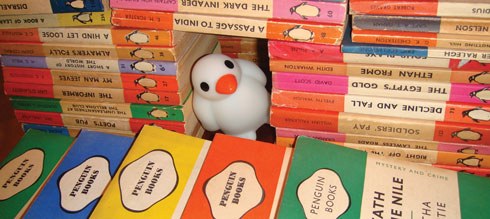
First published in 1935, the original Penguin books are instantly recognisable, with three horizontal bands on the cover, and a colour scheme according to genre. They originally sold for sixpence. First editions remain highly collectible. Here, I describe Penguinius collectionavidus infection, following a firsthand encounter with this fiction affliction.
Clinical features: The host has a penchant for collecting first edition Penguin books, especially from the period 1935–1950. A proclivity for dust jackets and a bias towards creaseless and unchipped volumes are the norm.
Patients may often be seen browsing in second-hand bookstores and scouring eBay and AbeBooks for obscure titles. Joyful exclamations and/or dancing a jig characteristically follow serendipitous discoveries. Patients will often experience palpitations on locating an antiquarian bookstore — this is an important differential diagnosis for consideration by emergency physicians. Insomnia and disturbed sleep are not unusual, with many online auctions based on Greenwich Mean Time. The staking out of letterboxes and trailing of postmen may sometimes be confused with more illicit activities.
A hallmark of P. collectionavidus infection is chromophilia — with a predilection for green (crime), orange (fiction), cerise (travel and adventure) and dark blue (biography). Patients with severe infection may also have an affinity for yellow (miscellaneous), purple (essays and belles-lettres), red (plays) and even grey (world affairs).
Disposition toward animals is varied. A partiality for species of avian origin is pathognomonic, especially pelicans, puffins, peregrines and peacocks. This is in stark contrast to a general aversion to dog (ears) and a total abhorrence for foxing.
Transmission: The author’s case was acquired in Singapore in July 2011 at an exhibition entitled “An Ode to Penguin”, apparently organised by a fellow sufferer, without a warning to visitors that the disease is highly contagious.
Complications: Multiple trauma (faulty stepladders, collapse of shelving), concussion (falling folios), rhinitis (dusty volumes) and, rarely, mycetoma (musty monographs). The discovery in tomes of writing in margins, coffee stains or graffiti may result in trichotillomania.
Prognosis: With thousands of titles in print, the course of illness may be protracted. Rapid serial acquisition may result in tachyphylaxis. With some editions fetching three figures, walleticus bankruptosis may feature. The author is yet to remortgage his house. Size of bookcases may not contain propagation of the illness, with books known to reside in drawers, wardrobes and under the bed.
Treatment: Suggestions welcome.
Competing interests: Other collectors, particularly book scouts, whose deportment at book fairs has been observed to be questionable. Actions such as book snatching and crawling under tables may indicate conversion to bibliomania. Patients are warned that the final minute of eBay auctions can be a veritable bloodbath.
Prisoner of war pathology in Changi, 1942–1945
Kate Ariotti, Elizabeth Roberts‐Pedersen
Should medical eponyms continue to be used in everyday practice?
Leya Nedumannil, Diana Lewis
100 years on: the first use of insulin in Australia
Sophie Templer
Reflections on the life and career of Professor Dame Valerie Beral AC DBE FRS FRCOG FMedSci (1943–2022)
Karen Canfell, Bette Liu, Emily Banks
The Honourable Dr Donald James Grimes AO
Michael Kirby, Patti Warn
From wipeout to drill out: a history of exostosis management and Australian surfing
Alon Taylor, Hannah North, Narinder P Singh, Paul A Fagan