




Volume 195 - Issue 11
Birthmarks: phacomatosis pigmentovascularis
Authors: Jianjun Qiao and Hong Fang
Med J Aust 2011; 195 (11): 709. || doi: 10.5694/mja11.10720
Published online: 12 December 2011
Published online: 12 December 2011
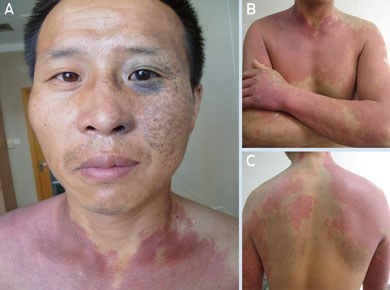
A 36-year-old Chinese man had been born with multiple coloured lesions on his face, sclera, neck, trunk and limbs. Physical examination revealed extensive capillary malformations (naevus flammeus or port wine stain) on his neck, chest, back and upper limbs (Figure, A). Bluish-grey macules involved the left V2 dermatomal distributions of his face and conjunctiva, consistent with naevus of Ota and melanosis oculi (Figure, A). Aberrant Mongolian spots were present on his trunk (Figure, B and C). No other positive findings were noted. A diagnosis of phacomatosis pigmentovascularis (phacomatosis cesioflammea form) was made.
Phacomatosis pigmentovascularis is defined as the coexistence of an extensive vascular naevus and various melanocytic lesions.1 It is estimated that 50% of patients with phacomatosis pigmentovascularis have systemic involvement, particularly of the eyes and central nervous system.1,2 No systemic involvement was evident in this patient.
References
- Fernandez-Guarino M, Boixeda P, de Las Heras E, et al. Phakomatosis pigmentovascularis: clinical findings in 15 patients and review of the literature. J Am Acad Dermatol 2008; 58: 88-93. 0_CHDBFHBI
- Happle R. Phacomatosis pigmentovascularis revisited and reclassified. Arch Dermatol 2005; 141: 385-388. 0_i1139828
Diagnosing Acute Kava Dermopathy: A Case Report of a Characteristic Cutaneous Eruption
Ali Abid, Nicholas Allen, Abeer Hagelamin, Christopher Henderson, Artiene Tatian
Localised Herpes Simplex Following Midline Laparotomy
Jessica S. Bulluss, Paul Chee, Matthew J. Verheyden
No silver lining with health misinformation: argyria caused by intentional silver consumption
Luke Collins, Logesh Palanikumar, Stephen Bacchi
Lingual Raynaud phenomenon
Michael Taggart, Mina John
Melasma in the male: a less well recognised entity
Tim Aung, Rowland Noakes
Age group‐specific changes in keratinocyte cancer treatment rates in Australia, 2012–2021: a retrospective cohort study based on MBS claims data
Catherine M Olsen, Nirmala Pandeya, Rachel E Neale, David C Whiteman