




Volume 195 - Issue 11
Stab in the dark
Author: Martin R Brown
Med J Aust 2011; 195 (11): 708. || doi: 10.5694/mja11.10857
Published online: 12 December 2011
Published online: 12 December 2011
A 55-year-old man suffered a thoracic knife wound during an assault. The wound was sutured by a general practitioner. Five days later, the patient re-presented to another medical centre with chest pains after travelling on two Australian domestic flights, including one for which airport security required him to undergo screening with a metal detector.
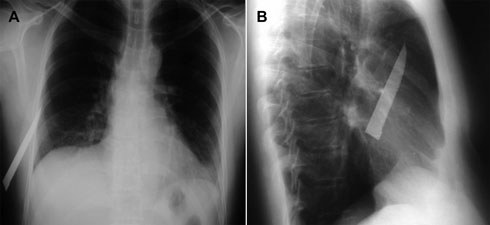
Chest x-rays showed a 13-cm steak-knife blade, with no handle, lodged deep within the chest wall muscle, but not perforating the pleura (Figure, A, posteroanterior view, and B, lateral view). The blade was removed surgically.
This case highlights the need for thorough investigation of thoracic stab wounds.
‘Once Bitten’: A Case of Tetanus Following Snakebite in Australia
Adrian A. S. Doherty, Naomi N. E. Clarke, Sarah Fletcher, Sarah Huffam, Camille V. Awburn, Eugene Athan
Epidemiology and Quality of Care for Aboriginal and Torres Strait Islander Peoples Treated by Emergency Medical Services for Stroke in Victoria, Australia: Retrospective Analysis of Linked Data
Candice Menezes, Ziad Nehme, Luke J. Burchill, Tegwyn McManamny, Angela Dos Santos, Michelle Crilly, Luke P. Dawson, Benjamin Clissold, David Anderson, Emily Nehme
Intranasal Adrenaline Use for the Management of Insect Venom-Induced Anaphylaxis
Thomas J. Young, Wilhelmina R. F. Johnson, Braydon L. Pennington, Troy Wanandy, Wun Y. Lau, Thanh-Thao A. Le
Gabapentinoid Poisoning Presentations to Victorian Emergency Departments: A 15-Year Trend Analysis
Bishaal Tej Gurung, Amy McNeilage, Angus Skeen, Tina Lam, Joanna F. Dipnall, Jane Hayman, Suzanne Nielsen, Ting Xia
They Brought the Hospital to Me
Hugh N. Burrill
Predictors of Ambulance Transport to Hospital for Older People Living in Tasmanian Aged Care Facilities: A Retrospective Cohort Study
Sharon Andrews, Pieter F. Fouche, Belinda Flanagan, Michael McDermott, Melanie Greenwood