




Volume 195 - Issue 11
Weather to evacuate?
Authors: Cindy E Woods, Donna Goodman, Jane Mills, Kim Usher and William J H McBride
Med J Aust 2011; 195 (11): 712-713. || doi: 10.5694/mja11.11052
Published online: 12 December 2011
Published online: 12 December 2011
In February 2011, Cyclone Yasi was bearing down on the Queensland coast near Cairns. People living in coastal suburbs and towns from Cairns to Townsville were given orders to evacuate their homes, airlines put on extra flights to help people evacuate, and Queensland Health made the decision to evacuate Cairns hospitals for the first time in history.
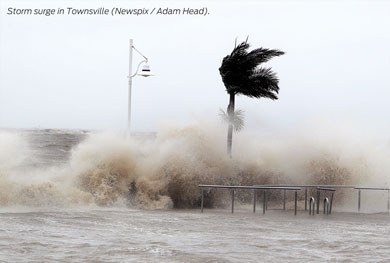
Cairns Base Hospital was established in 1884 on the waterfront overlooking the Coral Sea. The hospital’s location leaves it vulnerable to cyclones, tsunamis and storm surges. Based on the Bureau of Meteorology’s cyclone tracking model,1 Yasi’s landfall was predicted to coincide with high tide, which put hospital staff and patients at risk of inundation by a 5-metre storm surge.
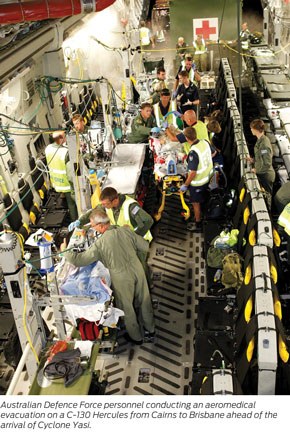
On Tuesday 1 February, more than 250 patients from Cairns Base Hospital and the nearby Cairns Private Hospital were airlifted to Brisbane hospitals in what is believed to be Queensland’s largest mass medical evacuation and the largest hospital evacuation ever undertaken in Australia. A timeline of events is summarised in the Box.
Seven pregnant women, 16 babies, eight intensive care patients, 18 mental health patients and more than 60 dialysis patients were among those evacuated. General medical patients, the parents of evacuated children, medical escorts and carers were also airlifted to Brisbane. Many patients were transferred to regional hospitals or discharged home if considered safe to do so.
Australian Defence Force personnel with 11 medivac-equipped C-130 Hercules aircraft, the Royal Flying Doctor Service, CareFlight, the Queensland Government Air Wing, and several commercial airlines (Qantas, Alliance Airlines and JetStar) were involved with the evacuation. A convoy of ambulances transported patients to Cairns Airport, from where they were flown to Brisbane. Another convoy of ambulances in Brisbane took arriving patients to a number of hospitals.
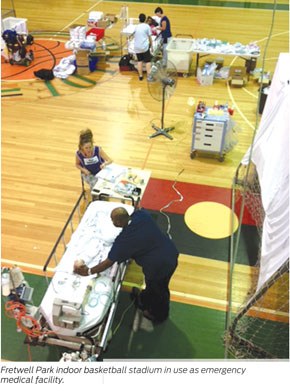
By 3 am on Wednesday 2 February, the Cairns Base Hospital emergency department was eerily empty. The hospital was closed at 9 am that day. A temporary emergency medical facility, staffed by doctors and nurses, was set up at an indoor basketball stadium at the Fretwell Park Sporting Complex, about 10 km inland.
By 4 am on Wednesday, Yasi intensified into a Category 5 cyclone, with a storm front 650 km wide, sustained wind speed of 205 km/h, and wind gusts of 285 km/h.1 Its forecast track had veered slightly southward away from Cairns. Yasi crossed the coast in the early hours of Thursday morning, and the northern Queensland towns of Innisfail, Tully, Mission Beach and Cardwell bore the brunt of one of the most powerful cyclones in Australia’s history.
Four women gave birth during Cyclone Yasi. One baby was born at Fretwell Park under a soccer net covered with a bed sheet for privacy, and another at an emergency shelter. The other two babies were born at Innisfail Hospital. Cairns Base Hospital reopened at 12 pm on Thursday 3 February with limited services until staffing levels returned to normal. Some staff were unaware the hospital had reopened and others were unable to reach the hospital because of flooded and blocked roads. The Fretwell Park emergency medical facility closed at 4 pm the same day.
Parts of Cairns were without power for several days after the cyclone, and roads leading south were impassable due to floodwaters. Trucks carrying essential food and supplies were unable to reach Cairns to restock supermarket shelves that had been stripped bare before the cyclone.
Doctors and nurses who organised the evacuation of patients did an amazing job under extreme pressure, as did those who staffed the emergency medical facility while the cyclone raged around them. No patients died as a result of the evacuation. Eventually all evacuated patients were returned to Cairns, although this took several weeks and was stressful for patients and their families. The evacuation posed enormous logistical challenges in terms of medical records, medications and equipment required. Continuity of care for acutely unwell patients, including those receiving dialysis or in coronary care, intensive care and mental health units, was extremely complex, and it is a tribute to the dedication of the staff at the respective hospitals that there were no major adverse outcomes.
Pre-emptive evacuations of hospitals are rare events, occurring just three times in the United States since 2005.2-4 Detailed analyses of the evacuation process are underway and will improve our ability to respond to future disasters.
Timeline of events in evacuation of Cairns hospitals due to Cyclone Yasi, 2011
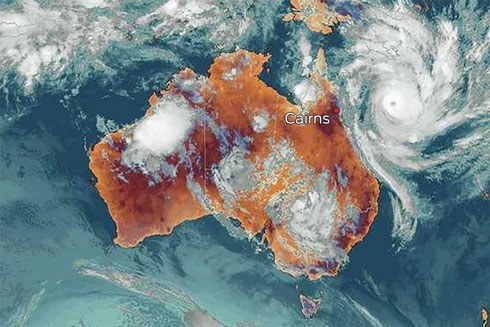
Cyclone Yasi approaching the Queensland coast, 1 February 2011, 5.30 pm (satellite image originally processed by the Bureau of Meteorology from the Geostationary Meteorological Satellite MTSAT-2 operated by the Japan Meteorological Agency).
Competing interests
No relevant disclosures.
References
- Australian Government Bureau of Meteorology. Severe Tropical Cyclone Yasi: 30 January – 3 February 2011. http://www.bom.gov.au/cyclone/history/yasi.shtml (accessed Nov 2011).
- Sexton KH, Alperin LM, Stobo JD. Lessons from Hurricane Rita: the University of Texas Medical Branch Hospital’s evacuation. Acad Med 2007; 82: 792-796. doi: 10.1097/ACM.0b013e3180d096b9. 0_i1115388
- Eosco GM, Shafer MA, Keim B. Lessons learned: evacuations management of Hurricane Gustav. 4th Symposium on Policy and Socio-Economic Research, American Meteorological Society; 2009 Jan 11-15; Phoenix, Ariz. http://ams.confex.com/ams/pdfpapers/151280.pdf (accessed Nov 2011).
- Maybauer MO, Megna M, Asmussen S, Maybauer DM. Hurricane evacuations of the University of Texas Medical Branch at Galveston. In: Lupo A, editor. Recent hurricane research: climate, dynamics, and societal impacts. InTech, 2011: 473-482. http://www.intechopen.com/articles/show/title/hurricane-evacuations-of-the-university-of-texas-medical-branch-at-galveston (accessed Nov 2011).
‘Once Bitten’: A Case of Tetanus Following Snakebite in Australia
Adrian A. S. Doherty, Naomi N. E. Clarke, Sarah Fletcher, Sarah Huffam, Camille V. Awburn, Eugene Athan
Epidemiology and Quality of Care for Aboriginal and Torres Strait Islander Peoples Treated by Emergency Medical Services for Stroke in Victoria, Australia: Retrospective Analysis of Linked Data
Candice Menezes, Ziad Nehme, Luke J. Burchill, Tegwyn McManamny, Angela Dos Santos, Michelle Crilly, Luke P. Dawson, Benjamin Clissold, David Anderson, Emily Nehme
Intranasal Adrenaline Use for the Management of Insect Venom-Induced Anaphylaxis
Thomas J. Young, Wilhelmina R. F. Johnson, Braydon L. Pennington, Troy Wanandy, Wun Y. Lau, Thanh-Thao A. Le
Gabapentinoid Poisoning Presentations to Victorian Emergency Departments: A 15-Year Trend Analysis
Bishaal Tej Gurung, Amy McNeilage, Angus Skeen, Tina Lam, Joanna F. Dipnall, Jane Hayman, Suzanne Nielsen, Ting Xia
They Brought the Hospital to Me
Hugh N. Burrill
Predictors of Ambulance Transport to Hospital for Older People Living in Tasmanian Aged Care Facilities: A Retrospective Cohort Study
Sharon Andrews, Pieter F. Fouche, Belinda Flanagan, Michael McDermott, Melanie Greenwood