




Volume 219 - Issue 10
100 years on: the first use of insulin in Australia
Author: Sophie Templer
Med J Aust 2023; 219 (10): 457-460. || doi: 10.5694/mja2.52137
Published online: 20 November 2023
Published online: 20 November 2023
The nationwide use of insulin began 100 years ago with experiments in an Adelaide laboratory
A century ago, the only accepted treatment for diabetes in Australia and worldwide was the so‐called “starvation diet” of severely restricted carbohydrate intake. However, near‐starvation only prolonged the natural course of disease, and profound hunger and progressive emaciation would almost inevitably give way to coma and eventually death. The successful isolation of a therapeutic pancreatic extract in the Canadian summer of 1921 by Frederick Banting, Charles Best, James Collip and John Macleod followed numerous less successful attempts by other researchers over preceding decades. The extract, which they named “insulin” (from the Latin insula, meaning island), would become, in the words of medical historian Michael Bliss, “the elixir of life for millions of human beings around the world”.1
Australian insulin production begins in Adelaide
Six‐year‐old Phyllis Lush, by most accounts the first person in Australia to be treated with insulin, received a sample of the Canadian product in late 1922 after her father's direct appeal to Banting.2 Meanwhile, Thorburn Brailsford Robertson (Box 1), professor of physiology and biochemistry at the University of Adelaide, wrote to Macleod after reading about the Toronto group's success, enquiring about the process of manufacturing insulin and requesting permission to use the Toronto method in Adelaide. With permission from Macleod, Robertson began experimenting with the manufacture of insulin at his Adelaide laboratory in late 1922. Robertson's plan was to refine production methods and costs in Adelaide, before transferring production to the Commonwealth Serum Laboratories (CSL) in Melbourne once CSL was able to produce sufficient quantities of insulin to meet demand for the whole of Australia.3
Initial work in Adelaide was beset by limited supplies of volunteer labour and absolute alcohol, which was a key ingredient in the purification process.4,5 While restrictions on the amount of alcohol that could be purchased free of duty charges were waived for CSL, the University of Adelaide balked at the cost of the high volumes of alcohol needed.5 Despite these issues, Robertson was able to start supplying samples of locally produced insulin to Adelaide physicians for the treatment of a small number of patients with diabetes just months after starting his experiments.3
The 25 August 1923 issue of the Medical Journal of Australia included an original article by Robertson outlining a modification of the Toronto technique for insulin extraction, which would save both time and reagents, and enhance the yield of insulin from a given weight of animal pancreas. He emphasised the importance of creating an inexpensive product, as the administration of insulin “must, so far as we can see at present, be continued throughout life”.6 Robertson's article was accompanied by the first case series, by the Adelaide physician CTC de Crespigny, of seven patients with diabetes treated with what came to be known as “Adelaide insulin”.7
Although the public press ran excited headlines such as “Magic insulin tested in Australia”,4 reactions to the introduction of insulin were more tepid within the medical community. An unsigned editorial published in the MJA on 1 September 1923 warned that “hundreds of diabetics will be hastened to their graves” by the use of insulin. The author predicted that insulin use would require close and continuous glucose monitoring, and therefore it should not be prescribed by the “ordinary medical practitioner” who is not a trained biochemist. The editorial ended with the warning: “the sooner the public can be persuaded to forget the word ‘Insulin’, the better it will be for the unfortunate victims of this uncanny disease.”8 Robertson and de Crespigny defended their work in a letter to the MJA published on 22 September 1923, outlining the favourable outcomes of insulin observed over a year of use in England, Canada and the United States, and describing the claims in the original editorial as “alarming and unfounded” and “manifestly absurd”. “While the ‘ordinary medical practitioner’ is not ‘trained as a bio‐chemist’”, they wrote, “he is most thoroughly trained in common sense”.9
Production and supply increases
By July 1923, limited supplies of insulin produced by CSL (Box 2) using the techniques refined by Robertson were available. At the same time, preliminary steps were being made to commence the preparation of insulin in Sydney at the Royal Prince Alfred pathology department in conjunction with Royal North Shore Hospital.10 Increasing supplies of imported insulin, mostly from England, were also starting to reach the Australian market. Although English insulin was reported to be more potent than the Australian product, imported insulin was subject to duty charges of up to 40% until the waiver of duties by the Customs Department in January 1924.11
An essential condition of the agreement between the University of Toronto and Robertson was that insulin should not be sold at any price above the actual cost of production. Robertson, in turn, strived to cut the costs of production to ensure that insulin did not become a privilege that could only be afforded by the wealthy. CSL insulin entered the market at a price of 4⅔ pence per unit12 — equivalent to around $1.50 in modern decimal currency. In a public plea to Acting Prime Minister Earle Page to take action to reduce the cost of insulin, doctors at Sydney Hospital in late 1923 estimated that the hospital was paying £1000 (now roughly equivalent to $90000) per year for insulin for six patients, averaging about £3 (about $270) per week per patient.13 Gradually, as experimental processes gave way to large scale production, the cost of insulin steadily declined until it became financially accessible to increasing numbers of Australians with diabetes.
As the cost and scarcity of insulin fell, so too did the restrictions on its prescription. The first notice issued by the Director‐General of Health in July 1923 announcing that supplies of insulin were ready for distribution in Australia also stipulated that insulin could only be sold by manufacturers to “competent specialists”, those being honorary physicians at a specified list of hospitals with laboratories capable of glucose monitoring.14 These conditions, specified by the Commonwealth's terms of agreement with the University of Toronto,15 led JM Baxter to complain in a letter to the MJA that the restrictions on insulin supply would create “a monopoly amongst a few medical men”, while noting that English‐made insulin could be procured in Melbourne without such restrictions.16 By September 1923, any physicians willing to comply with criteria for the use of insulin were invited to apply to CSL to obtain supplies for prescription (Box 3).12
Robertson and his team at the University of Adelaide continued to refine their processes for insulin extraction and purification. By November 1923, the efficiency of production had increased such that the same volume of pancreas that had yielded 30 doses of insulin in Robertson's first experiments now yielded 3000 doses.17 As the process became more efficient and inexpensive, supplies of CSL‐manufactured insulin were gradually able to match demand. Insulin production in Adelaide ceased altogether in May 1924 and CSL became the sole Australian manufacturer of insulin.18 In total, insulin production continued at Adelaide for 15 months,19 during which time 40000 doses of insulin were made.20
A century of insulin in Australia
By the end of 1924, less than two years after its first use in the country, insulin was within reach of most Australians with diabetes — in terms of both cost and supply. In addition to CSL‐branded insulin, different formulations and strengths of insulin were being imported readily from the United States and the United Kingdom (Eli Lilly and Co, and Burroughs, Wellcome and Co, respectively).21,22 Within a few years, insulin was broadly accepted in the medical community, and by 1928 major public hospitals had begun to establish dedicated diabetes clinics.2
The following 50 years saw further evolution in the insulin landscape in Australia with the introduction of protamine insulin in the 1930s, isophane insulin in the 1950s, and single‐peak insulins in the 1970s. A national standard was created in 1980 mandating the universal switch to U100 insulins, requiring all insulin products to be produced at a strength of 100 units per millilitre.23 Following the introduction of recombinant human insulin to Australia in 1986, porcine and beef insulins were gradually phased out, and in the early 2000s, insulin analogues took over the market. After a brief joint venture with the Danish pharmaceutical giant Novo in the 1980s, CSL was eventually pushed out of the rapidly evolving and competitive global insulin market. The last doses of Australian‐made insulin were produced in December 1993, when CSL dropped its insulin line.24
At a time of frequent and remarkable medical innovations, highlighted in recent years by the scientific response to the COVID‐19 pandemic, it may be difficult to fully appreciate the speed and vigour with which insulin was produced and distributed following its discovery. Few discoveries in medical history have resulted in such a rapid and dramatic transformation in the course of an otherwise fatal disease. Although it is no longer homegrown, insulin continues to transform the lives of Australians with diabetes 100 years after the first patients were treated with “Adelaide insulin”.
Box 1 – Thorburn Brailsford Robertson, circa 1912
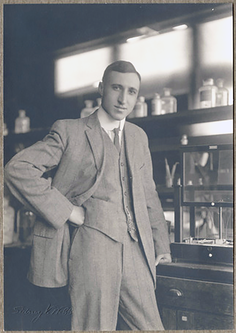
Source: State Library of South Australia, PRG 136/7/9 (https://collections.slsa.sa.gov.au/resource/PRG+136/7/9).
Box 2 – A vial of 10 units of insulin manufactured by Commonwealth Serum Laboratories, circa 1920s
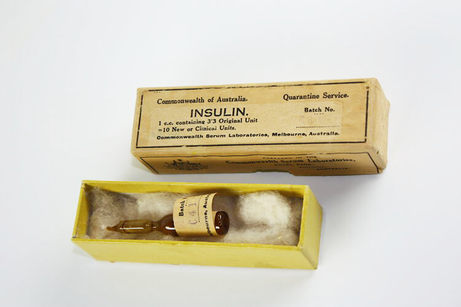
Source: Museums Victoria Collections (https://collections.museumsvictoria.com.au/items/2100638). Copyright Museums Victoria / CC BY (licensed as ).
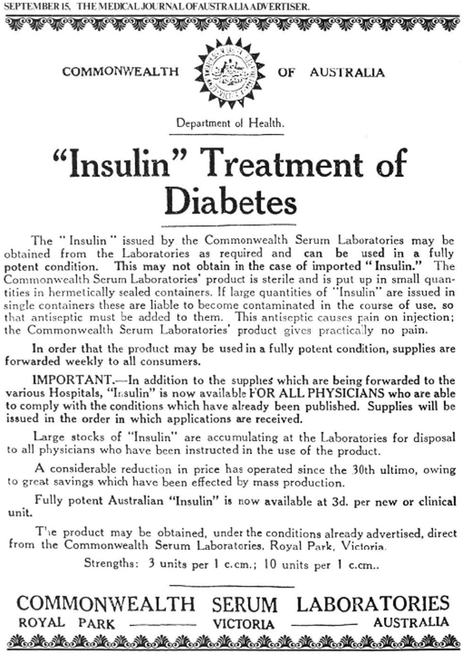
Competing interests
No relevant disclosures.
References
- Bliss M. The discovery of insulin: special centenary edition. Toronto: University of Toronto Press, 2021; p 11.
- Martin FI. The introduction of insulin to Australia. Occasional Papers Med Hist Aust 1993; 6: 141‐150.
- Insulin. The Register (Adelaide); 26 July 1923; p 10. https://trove.nla.gov.au/newspaper/article/64310255 (viewed Oct 2023).
- Magic insulin tested in Australia. News (Adelaide); 25 July 1923; p 6. https://trove.nla.gov.au/newspaper/article/129820909/11087850 (viewed Oct 2023).
- Alcohol for insulin. News (Adelaide); 29 Nov 1923; p 1. https://trove.nla.gov.au/newspaper/article/129309778/11080800 (viewed Oct 2023).
- Robertson TB, Anderson AB. A modified method for the manufacture of “insulin”. Med J Aust 1923; 2: 189‐191. https://doi.org/10.5694/j.1326‐5377.1923.tb118842.x
- De Crespigny CTC. The treatment of diabetes by “insulin”. Med J Aust 1923; 2: 193‐199. https://doi.org/10.5694/j.1326‐5377.1923.tb118844.x
- “Insulin”. Med J Aust 1923; 2: 231‐232. https://doi.org/10.5694/j.1326‐5377.1923.tb118875.x
- “Insulin”. Med J Aust 1923; 2: 316‐317. https://doi.org/10.5694/j.1326‐5377.1923.tb118952.x
- Insulin. The Sun (Sydney); 26 July 1923; p 10. https://trove.nla.gov.au/newspaper/article/224092670 (viewed Oct 2023).
- Insulin. Sydney Morning Herald; 10 Jan 1924; p 5. https://trove.nla.gov.au/newspaper/article/16110509/1231016 (viewed Oct 2023).
- The price of “Insulin”. Med J Aust 1923; 2: 289. https://doi.org/10.5694/j.1326‐5377.1923.tb118933.x
- Cheaper insulin. Daily Telegraph (Sydney); 4 Dec 1923; p 7. https://trove.nla.gov.au/newspaper/article/246003828/26879251 (viewed Oct 2023).
- “Insulin”. Med J Aust 1923; 2: 53‐54. https://doi.org/10.5694/j.1326‐5377.1923.tb118696.x
- Insulin. Advocate (Burnie); 14 Sept 1923; p 3. https://trove.nla.gov.au/newspaper/article/66787696/6695426 (viewed Oct 2023).
- “Insulin”. Med J Aust 1923; 2: 160. https://doi.org/10.5694/j.1326‐5377.1923.tb118802.x
- Insulin. News (Adelaide); 12 Nov 1923; p 9. https://trove.nla.gov.au/newspaper/article/129315568/11080650 (viewed Oct 2023).
- Insulin. Advocate (Burnie); 5 Apr 1924; p 5. https://trove.nla.gov.au/newspaper/article/67133381/5822913 (viewed Oct 2023).
- Sufferers of diabetes. The Mail (Adelaide); 21 Mar 1925; p 2. https://trove.nla.gov.au/newspaper/article/59711346/5286976 (viewed Oct 2023).
- Manufacture of insulin. The Register (Adelaide); 28 June 1924; p 8. https://trove.nla.gov.au/newspaper/article/57383160/4543647 (viewed Oct 2023).
- Cost of insulin. Sydney Morning Herald; 20 Nov 1924; p 10. https://trove.nla.gov.au/newspaper/article/16177657/1224576 (viewed Oct 2023).
- Cost of insulin. Sydney Morning Herald; 27 Nov 1924; p 5. https://trove.nla.gov.au/newspaper/article/16169558/1224683 (viewed Oct 2023).
- Hartman LJ. U100 insulin and the general practitioner. Aust Fam Physician 1980; 9: 464‐468.
- Beauchamp K. Red Alert!: is regulation working for imported and CSL blood products? Canberra: Rupert Public Interest Movement, 1994; p 277.
Provenance: Not commissioned; externally peer reviewed.
When ‘Liver Enzymes’ Are Not Hepatic: Late-Onset Pompe Disease
Shauna Madigan, Georgina England, Wayne Rankin
Primary Hyperparathyroidism in Adults: Recent Developments in Diagnosis and Management
Elizabeth Wootton, Sunita M. C. De Sousa, Richard L. Prince, Donald S. A. McLeod, David A. Pattison, Mathis Grossmann
Severe Hypoglycaemia Secondary to Chronic Opioid-Induced Hypothalamic–Pituitary–Adrenal Axis Suppression: An Under-Recognised Phenomenon
Michael Do, Annabelle Hayes, Malgorzata Brzozowska
Rethinking diabetes care for Indigenous Australians: the need for Indigenous‐codesigned and led diabetes models of care
Natalie Nanayakkara, Sharon Atkinson‐Briggs, Alicia J Jenkins, Neale D Cohen
The first Australian evidence‐based guidelines on male infertility
Darren J Katz, Liza O’Donnell, Robert I McLachlan, Tim J Moss, Clare V Boothroyd, Veena Jayadev, Sarah R Catford