




Volume 194 - Issue 8
Medicine in the crosshairs
Author: Bruce H Short
Med J Aust 2011; 194 (8): 417. || doi: 10.5694/j.1326-5377.2011.tb03034.x
Published online: 18 April 2011
Published online: 18 April 2011
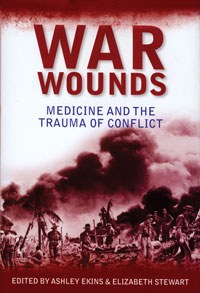
War wounds: medicine and the trauma of conflict.
Ashley Ekins and Elizabeth Stewart, editors. Wollombi: Exisle Publishing, 2011 (240 pp, $49.99). ISBN 9781921497872.
ORIGINALLY presented at an international conference by the Australian War Memorial (AWM) and the Department of Veterans’ Affairs in September 2009, this book is edited by two military historians at the AWM.
It is well illustrated and contains 14 chapters covering both World Wars and the Korea and Vietnam conflicts, written predominantly by Australian historians and military medical and nursing personnel.
There are four chapters on World War I. American historian Jay Winter expounds on shell shock syndrome. Ashley Ekins, head of the Military History Section at the AWM, discusses self-inflicted wounds. Kerry Neale, from the Australian Defence Force Academy (ADFA), provides an excellent narrative on the facially disfigured soldier. Melbourne historian Marina Larsson takes a sensitive look at the psychiatrically impaired veteran.
There are similar contributions on World War II. Paul Weindling, a professor in the history of medicine at Oxford Brookes University in the United Kingdom, describes the “medical” experiments at Ravensbrück concentration camp. Debbie Lackerstein, a lecturer in history at ADFA, writes of the overwhelmed Allied forces’ medical response to survivors of concentration camps. Professor Simon Gandevia, deputy director of the Prince of Wales Medical Research Institute in Sydney, gives an account of his father’s service in Korea and his contribution to medical history.
The essays on the Vietnam War cover a regimental medical officer’s experience in managing sexually transmitted infections, the work of the Australian civilian surgical teams, and Agent Orange.
The book concludes with three personal accounts: Tony White on the nightmare of treating injured soldiers in a minefield; nurse Sharon Cooper on medical recovery after a helicopter crash in Timor-Leste; and Graham Edwards on how, after sustaining double lower limb amputations, he overcame severe disability to enter federal Parliament.
I recommend this book to those working in military medicine, to military medical historians, to present and past serving members and their families, and to the enquiring general reader.
Prisoner of war pathology in Changi, 1942–1945
Kate Ariotti, Elizabeth Roberts‐Pedersen
Should medical eponyms continue to be used in everyday practice?
Leya Nedumannil, Diana Lewis
100 years on: the first use of insulin in Australia
Sophie Templer
Reflections on the life and career of Professor Dame Valerie Beral AC DBE FRS FRCOG FMedSci (1943–2022)
Karen Canfell, Bette Liu, Emily Banks
The Honourable Dr Donald James Grimes AO
Michael Kirby, Patti Warn
From wipeout to drill out: a history of exostosis management and Australian surfing
Alon Taylor, Hannah North, Narinder P Singh, Paul A Fagan