




Volume 194 - Issue 8
Laparoscopic adjustable gastric banding in patients with insulin-treated type 2 diabetes
Authors: Timothy M E Davis and Catherine Coleman
Med J Aust 2011; 194 (8): 427-428. || doi: 10.5694/j.1326-5377.2011.tb03044.x
Published online: 18 April 2011
Published online: 18 April 2011
To the Editor: Laparoscopic adjustable gastric banding (LAGB) is the most common bariatric surgery performed in Australia, and diabetic patients represent an important target population.1 In one of few trials in type 2 diabetes, 73% of 30 LAGB-treated obese patients reverted to normal glucose tolerance by 2 years, compared with 13% of 30 obese patients randomly assigned to treatment with changes to their lifestyle.2 These Australian data precipitated publicity implying that many people with type 2 diabetes were cured by LAGB.3,4 However, only recently diagnosed patients were recruited. The benefits of LAGB in those with diabetes of long duration (and usually with a substantial loss of pancreatic beta-cell function5) may not be as dramatic.
We reviewed the records of eight patients with insulin-treated type 2 diabetes (aged 40–65 years, with a diabetes duration of 4–39 years) referred for LAGB by one of us (T D) to two established bariatric surgical units over 4 years. All eight patients had a diabetes-specific review within 2 months of surgery and at 3 and 6 months postoperatively, and six patients had a further review at 12 months. Perioperative diabetes management was coordinated by the anaesthetist and ward staff, but patients were encouraged to contact their doctor or regional diabetes education unit for advice at any time if necessary. Patients attended the bariatric unit for saline insertion into the band once or twice before their diabetes-specific review at 3 months.
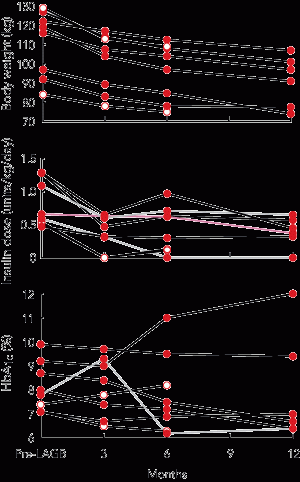
No patients developed postoperative complications. The median weight loss was 14% at 6 months and 20% at 12 months (Box). By 3 months, insulin doses had been reduced in all patients and two had stopped using insulin. However, most had increased their insulin doses at 6 months (and the two who had discontinued insulin started using it again) because of unsatisfactory glycaemic control. During the 12 months’ follow-up, only one patient stopped using insulin and remained without its use without an unacceptable glycated haemoglobin (HbA1c) increase.
Although our eight patients achieved the same median percentage weight loss at 1 year as trial patients with diabetes of relatively short duration achieved over 2 years,2 insulin use was still required in most cases. When asked, the patients suggested that inappropriate initial insulin reductions were not because they experienced hypoglycaemia, but rather because they expected substantial LAGB-associated metabolic improvement. Perhaps this was encouraged by media coverage3,4 and/or concerns of bariatric unit staff that continuing their insulin therapy might retard their LAGB-associated weight loss. In some cases, problems with insulin adjustment and glycaemia overshadowed the psychological benefits of progressive weight loss.
These preliminary observations suggest a need for more data on diabetes management after LAGB, to inform acute treatment modification and to provide a realistic idea of the effects of LAGB on longer term disease outcomes.
References
- Colagiuri S. Diabesity: therapeutic options. Diabetes Obes Metab 2010; 12: 463-473. 0_CBBGIHFG
- Dixon JB, O’Brien PE, Playfair J, et al. Adjustable gastric banding and conventional therapy for type 2 diabetes: a randomized controlled trial. JAMA 2008; 299: 316-323. 0_i1095860
- Lap band can “cure” obese of diabetes. Sydney Morning Herald 2007; 8 May. http://news.smh.com.au/national/lap-band-can-cure-obese-of-diabetes-20070508-blk.html (accessed Mar 2011).
- McArthur G. Gastric band: cheap way to fight type 2 diabetes, obesity. Daily Telegraph 2009; 25 Feb. http://www.dailytelegraph.com.au/news/fight-fat-diabetes-on-cheap/story-0-1111118962467 (accessed Mar 2011).
- Butler AE, Janson J, Bonner-Weir S, et al. Beta-cell deficit and increased beta-cell apoptosis in humans with type 2 diabetes. Diabetes 2003; 52: 102-110. 0_i1095866
Non-Technical Errors Associated With Deaths in Surgical Care, Australia, 2012–2019, by Surgical Specialty (Australian and New Zealand Audit of Surgical Mortality)
Jesse Ey, Guy J. Maddern
Localised Herpes Simplex Following Midline Laparotomy
Jessica S. Bulluss, Paul Chee, Matthew J. Verheyden
Non‐technical errors associated with deaths in surgical care, Australia, 2012–2019, by surgical specialty (Australian and New Zealand Audit of Surgical Mortality): a retrospective cohort study
Jesse Ey, Victoria Kollias, Octavia Lee, Kelly Hou, Matheesha Herath, John B North, Ellie Treloar, Suzanne Edwards, Martin Bruening, Adam J Wells, Guy J Maddern
Changes in patient management after preoperative MRI for newly diagnosed breast cancer: a multicentre prospective observational study
Michael L Marinovich, Nehmat Houssami, Andrew Spillane, Gregory B Mann, Donna Taylor, Michelle Reintals, Nadine Phillips, Max K Bulsara, Patsy Siok Hwa Soon, Tracey Dickens, Christobel M Saunders
The first Australian evidence‐based guidelines on male infertility
Darren J Katz, Liza O’Donnell, Robert I McLachlan, Tim J Moss, Clare V Boothroyd, Veena Jayadev, Sarah R Catford
The first live term birth following uterus transplantation in Australia
Rebecca Deans, Brigitte Gerstl, Antonia W Shand, Sarah Lyons, Aaron Budden, Helen L Barrett, Grant Luxton, Mangalee Fernando, Kenneth Yong, Karen Keung, Kaushalya Arulpragasam, Henry Pleass, King Man Wan, Eva Kehag, Jana‐Emily Pittman, Mianna Lotz, Maria Fenn, Erin Nesbitt‐Hawes, Lily Byun, Katrina Tang, Mats Brannstrom, Jason Abbott