




Volume 194 - Issue 8
Cough mixture dependence and stroke: implications for pseudoephedrine regulation
Authors: Ajay Bharatula and Peter W New
Med J Aust 2011; 194 (8): 427. || doi: 10.5694/j.1326-5377.2011.tb03043.x
Published online: 18 April 2011
Published online: 18 April 2011
To the Editor: A middle-aged male night-shift driver experienced dizziness, vomiting, sudden onset of limb weakness, and then collapsed and became delirious. He had no past history of renal impairment or hypertension.
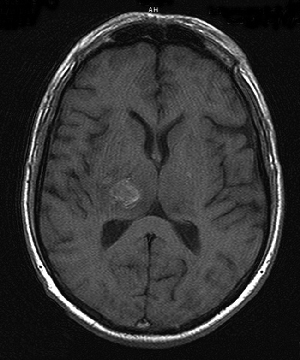
At presentation in an emergency department, he was hypertensive (blood pressure, 220/140 mmHg) and hyperglycaemic. An upper motor neurone pattern of persistent dysarthria and left hemiparesis was evident. An electrocardiograph and transthoracic echocardiogram confirmed sinus rhythm and left ventricular hypertrophy. Magnetic resonance angiography of the brain showed subacute basal ganglia haemorrhage (Box) and an anterior communicating artery aneurysm. Renin levels were elevated at 124.7 mU/L (reference range, 4.5–46.0 mU/L) but renal artery stenosis was absent on ultrasound. Evaluation of an elevated initial normetadrenaline level of 1610 pmol/L (reference range, < 900 pmol/L) with a diagnostic algorithm1 suggested that phaeochromocytoma was unlikely. Hypertension, proteinuria, suboptimal renal function, inactive urine sediment and normal fasting blood glucose suggested hypertensive nephropathy. Antihypertensives were initiated to mitigate the risk of further stroke, nephropathy and cardiomyopathy. Results of an electroencephalogram were normal.
Further history revealed that the patient had nicotine dependence with occasional amphetamine and cannabis exposure. Before admission, he had an estimated intake of 1–2.5 bottles of cough mixture episodically (600–1500 mg of pseudoephedrine). A pattern of ingesting excessive amounts of various brands of over-the-counter combination pseudoephedrine and codeine cough mixture developed over 20 years, and he suffered cravings when abstaining. He visited various pharmacies, provided identification, was repeatedly cautioned, but rarely consulted doctors. A Naranjo score2 of 7 indicated a probable adverse drug reaction to pseudoephedrine, resulting in a disabling hypertensive haemorrhagic stroke.
During 2.5 months of inpatient rehabilitation, he regained full independence in self-care and mobility. His unstable employment was interdependent with pseudoephedrine misuse. He accepted counselling regarding constructive, non-pharmacological coping strategies for social stressors. Financial, legal and housing difficulties complicated his discharge plan. He planned to return to work as a driver.
Pseudoephedrine is associated with a modest elevation in blood pressure3 and hypertensive crises.4 Intracerebral haemorrhage associated with pseudoephedrine usage is anecdotally reported.5 Dependence and chronic psychoses have been reported6,7 but their prevalence is unknown. Night-shift workers, students, recreational or self-medicating users, and athletes are potentially vulnerable to misuse.
Project STOP is an initiative of the Pharmacy Guild of Australia (http://www.projectstop.com.au/index.html) to curb diversion of pseudoephedrine-containing medications from retail pharmacies into illegal amphetamines. However, it is not mandatory and the National Drugs and Poisons Schedule Committee has rejected the Pharmacy Guild’s proposal to enhance Project STOP’s capabilities using an electronic messaging tool for pharmacists (NotifyRx, RelayHealth, Atlanta, Ga, USA) to regulate codeine sales (excluding cough mixtures). In contrast, New Zealand authorities now restrict the supply of pseudoephedrine to prescription only. A concerted effort from all relevant parties, including tighter regulation or legislation, is essential for harm minimisation. We urge regulatory bodies to review the effectiveness of current practice.
References
- Eisenhofer G, Goldstein DS, Walther MM, et al. Biochemical diagnosis of phaeochromocytoma: how to distinguish true- from false-positive test results. J Clin Endocrinol Metab 2003; 88: 2656-2666. 0_CBBIEGII
- Naranjo CA, Busto U, Sellers EM, et al. A method for estimating the probability of adverse drug reactions. Clin Pharmacol Ther 1981; 30: 239-245. 0_CBBHEGHB
- Salerno SM, Jackson JL, Berbano EP. Effect of oral pseudoephedrine on blood pressure and heart rate: a meta-analysis. Arch Intern Med 2005; 165: 1686-1694. 0_CBBBFAIJ
- Wang NE, Gillis E, Mudie D. Hypertensive crisis and NSTEMI after accidental overdose of sustained release pseudoephedrine: a case report. Clin Toxicol (Phila) 2008; 46: 922-923. 0_CBBHFGBC
- Cantu C, Arauz A, Murillo-Bunillo LM, et al. Stroke associated with sympathomimetics contained in over-the-counter cough and cold drugs. Stroke 2003; 34: 1667-1672. 0_CBBEEBDH
- Pugh CR, Howie SM. Dependence of pseudoephedrine [letter]. Br J Psychiatry 1986; 149: 798. 0_CBBGICIC
- Lambert MT. Paranoid psychoses after abuse of proprietary cold remedies. Br J Psychiatry 1987; 151: 548-550. 0_CBBCFHDA
Motor Neuron Disease Mortality Trends in Australia From 1986 to 2023: A Population-Based Study
Carol M. Y. Lee, Rupendra N. Shrestha, Julian Gold, Mark Stevenson, Kelly L. Williams, Lyndal Henden, Sandrine K. K. Chan Moi Fat, Zoe Zussa, Amanda Wright, Martin Jude, Mark A. S. Laidlaw, Willem J. R. Fokkink, Dominic B. Rowe
Mild traumatic brain injury and concussion and persisting post‐concussion symptoms: new guidelines to support evidence‐based assessment and management in Australia and Aotearoa New Zealand
Karen M Barlow, Jennie L Ponsford, Alice Theodom, Gill Cowen, Gavin A Davis, Vicki Anderson, Franz E Babl, David Cole, Jennifer Cullen, Stuart R Dalziel, Melinda Fitzgerald, Howard Flavell, Caroline Yates, Rebecca Kimble, John H Olver, Rhonda Orr, Mark Ralfe, Michael Rose, Nick Rushworth, Julia Treleaven, Gary Browne, Nathan Delang, Sarah Harris, Gary Mitchell, Sean Tweedy
The prevalence of and variation in indicators of the quality and safety of long term aged care in Australia, 2019: a cross‐sectional population‐based study
Tesfahun C Eshetie, Gillian E Caughey, Catherine Lang, Olivia Ryan, Renuka Visvanathan, Craig Whitehead, Keith Evans, Janet K Sluggett, Jyoti Khadka, Carolyn Dawkins, Helena Williams, Miranda Starke, Sara Blunt, Anne Liddell, Megan Corlis, Anna Sheppeard, Penelope Lello, Marilyn Thien, Steven L Wesselingh, Maria C Inacio
Health and economic benefits of improving pre‐hospital identification of stroke in Australian women: a modelling study
Thomas Gadsden, Lei Si, Emily R Atkins, Cheryl Carcel, Xia Wang, Stephen Jan, Mark Woodward, Laura E Downey
Symptom burden, quality of life, and diagnostic journey of people with postural orthostatic tachycardia syndrome, Australia, 2021–24: a descriptive patient registry data study
Marie‐Claire Seeley, Gemma Wilson, Eric Ong, Amy Langdon, Jonathan Chieng, Danielle Bailey, Kristina Comacchio, Amanda Page, Dennis H Lau, Celine Gallagher
The intersection of rurality and dementia prevalence in Australia for Aboriginal and Torres Strait Islander and non‐Indigenous peoples
Antonia J Clarke, Marwan Ahmed, Judith M Katzenellenbogen, John Towney (Wiradjuri), Anna H Balabanski, Adrienne Withall (Dharawal Yuin), Kylie Radford, Amy Brodtmann