




Volume 208 - Issue 7
Striving for more socially just global health
Author: Mieke L van Driel
Med J Aust 2018; 208 (7): 294. || doi: 10.5694/mja17.00925
Published online: 16 April 2018
Published online: 16 April 2018
Textbook of global health, 4th edition
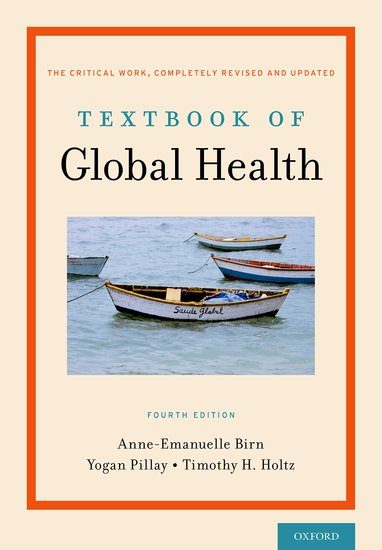
Textbook of global health, 4th edition. Birn AE, Pillay Y, Holtz TH. Oxford University Press, 2017 (£64.00; 712 pp). ISBN 9780199392285
The 21st century term “global health” replaces the 20th century banner of “international health”. Whereas international health acknowledges collaborations between sovereign nations to deal with health issues of mutual interest, global health goes a step further. It adds a focus on social justice and reduction of disparities in a global context. Although there is no clear consensus about the definition of global health, by emphasising the political and economic roots of ill health, the authors of this textbook advocate for “more socially just” agenda setting by the leading global health actors.
Global health moves away from the traditional approach that regards low income countries as “receivers” and high income nations as “givers”. For instance, some lower and middle income countries have been more successful in equitably reducing the burden of ill health across their populations than high income countries where embarrassing health inequities persist. The 1978 Declaration of Alma-Ata clearly articulated the need to manage the underlying economic, political and social causes of ill health. However, decades of disease-based programs have distracted from the focus. In our current reality, when conflict in another continent affects the whole world, there is no other choice.
The Textbook of global health is a reconceptualisation of its predecessor, the Textbook of international health, building on the original work by Paul Basch. In this fourth edition, the authors paint a comprehensive picture of contemporary global health using an analytical framework grounded in political economy. Historical perspectives throughout the book provide a background for a better understanding of where we are today and how we got there, making the narrative interesting and accessible. But this textbook is not for the faint-hearted. Its use as a learning resource is facilitated by key questions and learning points for each of the chapters.
The authors have an impressive track record in global and public health, with field experience across the Americas, Asia and Africa. Their combined academic, policy and operational perspectives add authority to the real world applicability of the book. The Textbook of global health is relevant to all interested or working in global health worldwide.
Competing interests
No relevant disclosures.
Designing Housing to Reduce Overcrowding-Related Harms: Rheumatic Heart Disease as the Canary in the Coal Mine
Simon Quilty, Veronica Matthews, Angus Baumann, James Marangou, Bo Remenyi, Gavin Wheaton, Serena Morton Nabanunga, Norman Frank Jupurrurla, Simon Robinson, Steve Mintern, Cary Duffield, Joshua R. Francis, Paul C. Memmott
Australian Climate Leadership in 2026: COP-Out or Step-Up for Health?
Catherine G. A. Pendrey, Angie Bone, Aletha Ward, Francis Nona, Michelle Isles, Paul M. Kelly, Nicholas J. Talley
The impact of the Breast Screen NSW transition from film to digital mammography, 2002–2016: a linked population health data analysis
Rachel Farber, Nehmat Houssami, Katy J L Bell
Shifting focus to adolescent wellbeing and inclusive participation in the digital age
Allyson R Todd, Elena Wang, Stephanie R Partridge
The CURE Asthma roadmap
Gary P Anderson, Anthony Flynn, Phil G Bardin, John D Blakey, Shyamali C Dharmage, Paul Foster, Peter G Gibson, Adam Jaffe, Alan James, Christine R Jenkins, Sundram Sivamalai, Peter D Sly, Guy B Marks, Vanessa M McDonald, Judy Wetttenhall
Protecting public interest journalism as a public health good
Bronwyn Fredericks, Neha Lalchandani, Melissa A Sweet, Alex Cramb, Carmel Williams