




Volume 208 - Issue 7
Tick-induced allergies: mammalian meat allergy and tick anaphylaxis
Author: Sheryl A van Nunen
Med J Aust 2018; 208 (7): 316-321. || doi: 10.5694/mja17.00591
Published online: 16 April 2018
Published online: 16 April 2018
Tick bite-induced allergies are often severe, should be largely avoidable and give fascinating insights into allergies
Summary
- Mammalian meat allergy after tick bites and tick anaphylaxis are the most serious tick-induced allergies. They are often severe, should be largely avoidable and offer fascinating insights into the development and prevention of allergies.
- Australian clinicians reported the first cases of tick anaphylaxis and discovered the association between tick bites and the development of mammalian meat allergy. The subsequent finding of the allergen epitope within the meat responsible for the allergic reaction, α-gal (galactose-α-1,3-galactose), stimulated further interest in this emergent allergy.
- Reports of mammalian meat allergy associated with bites from several tick species have now come from every continent where humans are bitten by ticks. The number of diagnosed patients has continued to rise.
- Clinically, mammalian meat allergy and tick anaphylaxis present quite differently. The prominent role of cofactors in triggering episodes of mammalian meat allergy can make its diagnosis difficult.
- Management of mammalian meat allergy is complicated by the manifold potential therapeutic implications due to the widespread distribution of the mammalian meat allergen, α-gal. Exposures to α-gal-containing medications have proved lethal in a minority of people, and fatal tick anaphylaxis has been reported in Australia. Prevention of tick bites is prudent and practicable; killing the tick in situ is crucial to both primary and secondary prevention of allergic reactions.
- Mechanisms in the development of mammalian meat allergy constitute a paradigm for how allergies might arise.
This Narrative Review includes individual journals not accessible via PubMed — due to their earlier date of publication — and a PubMed search for original and review articles published between 1940 and October 2017. In addition, specialist societies’ publications and guidelines were examined to formulate an evidence-based review of the spectrum of tick-induced allergies, their discovery, distribution, clinical features, management and prevention, and mechanisms of development.
Spectrum of tick-induced allergies
Tick-induced allergies comprise large local reactions to tick bites, mammalian meat allergy after tick bites, and tick anaphylaxis.1,2 Ixodes holocyclus (the Australian paralysis tick) (Box 1) is responsible for the majority of bites in humans in Australia and is therefore the tick that causes most tick-induced allergies.3 The colloquial term “paralysis tick” is commonly used, but it mostly refers to effects on non-human mammals, such as dogs.
Large local allergic reactions to tick bites, while incapacitating at the time, are the least severe form of tick-induced allergies. The commonest presentation of a serious tick-induced allergy is mammalian meat allergy after a tick bite, which may manifest as anaphylaxis, recurrent angioedema or gut symptoms after ingestion of mammalian meat — all typically delayed by 3–6 hours.1,2,4-6 Mammalian meat allergy is an emergent allergy that has become increasingly prevalent in tick-endemic areas of Australia and the United States, and has been reported worldwide where Ixodes spp, Amblyomma spp and Haemaphysalis longicornis are endemic and known to bite humans (Box 2). The most severe manifestation of a tick-induced allergy is anaphylaxis to ticks, and it has resulted in four deaths in Australia.22,23 Tick anaphylaxis, which occurs most commonly in Australia,24-32 is becoming increasingly prevalent.1-3 Each of these reaction types relies on IgE mediation, but presents differently.
Large local reactions are restricted to the tick bite site, commence within 4–12 hours of the tick bite, reach their height by 72 hours, take 7–10 days to resolve, and are due to a late-phase allergic reaction primed by insect-specific IgE,32 as seen with many other insect bites and stings.33
Mammalian meat allergy is due to an IgE-mediated reaction to a carbohydrate moiety, α-gal (galactose-α-1,3-galactose),6 which is present in all mammals (except humans, great apes and Old World monkeys)34-36 and is therefore in all mammalian meat (and mammalian products) eaten by humans. The delay of 3–6 hours in these allergic reactions is due not to arcane immunological influences, but rather to factors modulating the uptake of the allergen (α-gal) from the gut and its subsequent presentation to the host circulation.1,37
Tick anaphylaxis is a classic immediate IgE-mediated reaction directed against a protein (in this instance a tick salivary protein) that is injected into the host by the tick when it is disturbed during feeding.32,38-42
Discovery of the association between tick bite and mammalian meat allergy
In 2007, van Nunen and colleagues4 described the cases of 25 adults who developed red meat allergy after tick bites. This was a serendipitous finding, insofar as van Nunen was practising in a region of Australia where the condition occurs (along the Eastern seaboard) at a time when it was becoming more prevalent.
Making a direct link between having tick bites and the subsequent development of an allergy to a previously tolerated food (mammalian meat), however, also required a long familiarity with investigating anaphylaxis (leading to van Nunen skin-testing patients with all foods eaten at the meal before their anaphylaxis, even though their anaphylaxis had occurred an unprecedented 3–6 hours beforehand) and van Nunen’s experience in using fresh food skin prick testing in anaphylaxis diagnosis (“prick-prick”; ie, prick the food and then prick the patient using fresh, raw, organic meats) before it became routine (the commercially available skin testing agents for beef, pork and lamb gave reactions small enough to be dismissed as being clinically insignificant).5,6,37 Moreover, it necessitated an understanding of the nexus between IgE, parasites and allergy, and the consequent recognition of the potential for an immunological response to a parasite to skew the host’s immune system to a T helper type 2 cells “pro-allergy” predominance.43,44
Distribution of mammalian meat allergy after tick bite: a worldwide phenomenon
Since 2007, Commins and colleagues6 and Platts-Mills and colleagues37 have determined the epitope (α-gal) within the meat against which the specific IgE antibody is directed. These researchers and many others around the world7-21,45-57 have also produced considerable data providing convincing evidence confirming the observation by van Nunen and colleagues4,5 of the development of mammalian meat allergy after tick bites.
Cases have now been reported from Australia,4,5,48,55 the United States,6,47 Europe (France,7,49-51 Spain,8 Germany,9,52,54 Switzerland,13 Sweden,12,53 the United Kingdom,15 Italy16 and Norway21), Asia (Korea10 and Japan11,18), Central America (Panama14), South America (Brazil19) and Africa (South Africa17 and Ivory Coast20) (Box 2); that is, on all continents where humans are bitten by ticks.
Estimates of mammalian meat allergy prevalence are currently 113/100 000 in the Sydney Basin, Australia, 13/100 000 in Virginia, US, and 4/100 000 in Baden-Württemberg, Germany.28 The locations of reports of mammalian meat allergy after tick bite in Australia correlate with the distribution of Ixodes holocyclus (Box 3) — around 50% of Australians are potentially exposed to bites from this species.58 In late 2016, a case of mammalian meat allergy was diagnosed in a man bitten by Ixodes australiensis in Western Australia, suggesting another tick species may be capable of inducing the condition in Australia. In other countries reporting cases of mammalian meat allergy, the association with exposure to ticks endemic to their regions has also been confirmed.7,9,10,12,14,28,45-48,50,56,57
Clinical features of mammalian meat allergy and tick anaphylaxis
Both adults and children with mammalian meat allergy after tick bites have similar findings, ranging from angioedema or gut symptoms alone through to life-threatening anaphylaxis, with severe allergic reactions being more common (65.5%).28,47 The clinical features of mammalian meat allergy after tick bite are summarised below (Box 4).
Reactions to mammalian gelatine
Fewer than 10% of patients who are allergic to mammalian meat react to mammalian gelatine as well. Mullins and colleagues48 established that parenteral administration of gelatine increased the likelihood of anaphylaxis, and observed that gelatine allergy may be the initial presentation of mammalian meat allergy. The authors documented clinical reactivity to both intravenous and oral gelatine, and reported a small number of patients with positive gelatine tests and negative mammalian meat tests who reacted to gelatine challenge.48 Mullins and colleagues48 confirmed that bites from Ixodes holocyclus (Australian Capital Territory and New South Wales’ south coast), α-gal sensitisation and allergy to red meat are associated.48
The role of amplifying factors (cofactors) in mammalian meat allergy
An understanding of the crucial role of cofactors in triggering a reaction in patients with mammalian meat allergy is important in ensuring their safety. As with all food allergens, to a greater or lesser degree, modulating factors all separately and collectively confer an increased risk of an α-gal-sensitised individual having an allergic reaction to mammalian meat at any particular time.28,50,59,60 These comprise ingesting a greater amount of allergen, co-ingestion of alcohol, exercise (particularly within 2 hours), the inclusion of spices (usually chilli and capsicum), the prior administration of non-steroidal anti-inflammatory agents, being otherwise unwell, being in the perimenstrual phase, and the effect of cooking (slow cooking or reheating of the meat dish).28,50,59,60 In addition, the concentration of α-gal varies between different mammalian meat products.50 Offal (eg, pork kidney) has the highest α-gal concentration,50 increasing the likelihood of a reaction. On the other hand, while cow’s milk contains α-gal, boiling cow’s milk abolishes α-gal reactivity,61 so pasteurised cow’s milk is often tolerated. The effect of cofactors is so striking in mammalian meat allergy that European authors have drawn parallels with food-dependent exercise-induced anaphylaxis.28,50 Accounting for the role of cofactors is pivotal in mammalian meat challenge design28 if reliable advice is to be forthcoming.
Pitfalls in the diagnosis of tick bite-induced mammalian meat allergy
The diagnosis of tick bite-induced mammalian meat allergy is beset by a number of pitfalls summarised below (Box 5). Notably, the prevalence of α-gal-specific IgE sensitisation does not necessarily equate to clinical reactivity, as is the case with almost all allergens. The prevalence of α-gal sensitisation throughout Europe (α-gal-specific IgE > 0.10 kUA/L) is 5.5–8.1%.62 In the southeastern regions of the US, α-gal sensitisation prevalence is as high as 34–37% (Viracor-IBT Laboratory, 7300 serum samples63). In Germany, of the 35.0% of forest workers and hunters who are sensitised to α-gal (α-gal-specific IgE > 0.10 kUA/L), only 8.6% have had mammalian meat anaphylaxis.64
Clinical features of tick anaphylaxis
In Australia, tick anaphylaxis has been reported since the 1940s,3,65-69 and since 1991, there have been documented cases in the US,24,25 France26 and Spain.27,29-31,70 Worldwide, Ixodes spp. (Ixodes holocyclus,3 Ixodes pacificus,24 Ixodes ricinus26,27), Rhipicephalus bursa,29,31 Rhipicephalus sangineus30 and Hyalomma marginatum31 are causative of tick anaphylaxis, the clinical features of which are listed in Box 6.
Management of tick-induced allergies
Tick anaphylaxis
At present, the management of tick anaphylaxis relies on tick bite prevention and killing the tick in situ and removing it, if necessary, under medical supervision to prevent allergic reactions if a subsequent tick bite occurs.3,71 The identification of tick proteins likely responsible for anaphylaxis in patients,31,40-42,72,73 however, offers the prospect of diagnostics and immunotherapy for tick-induced allergies.
Mammalian meat allergy
Dietary education
Avoidance of mammalian meat and meat products is necessitated when mammalian meat allergy is severe. An expert dietitian is required to help with avoidance of meat products and maintenance of iron stores and to ensure vitamin B12 adequacy (www.tiara.org.au). In the minority of patients with mammalian meat allergy who are also clinically allergic to cow’s milk or mammalian gelatine, the identification of hidden sources of cow’s milk and gelatine is essential for their safety (www.allergy.org.au, www.allergyfacts.org.au).
Therapeutic precautions
α-Gal is widely distributed in therapeutic agents, and several novel therapeutic opportunities may prove risky in people who are α-gal sensitised (eg, wound healing and tumour therapy advances):74
-
cetuximab — due to its α-gal content, fatal reactions have occurred with its use;75
-
vaccination — α-gal is measurable in some vaccines (eg, measles–mumps–rubella and zoster), and other vaccines may contain mammalian products.76 Use of these vaccines may expose patients with α-gal-specific IgE to the risk of an allergic reaction;76
-
gelatine — sources of gelatine may need flagging (eg, vaccines, capsules, tablets, suppositories and collagen-containing agents, including implants);48
-
porcine heart valve prostheses — α-gal sensitisation has likely played a role in serious allergic events after porcine cardiac valve xenograft transplantation;77-79 and
-
antivenoms — snake,80 redback and funnel web spider, box jellyfish and stonefish antivenoms plus scorpion and other antivenoms produced internationally (all made in mammals) may confer a risk of reaction.
Pharmaceutical and complementary medicine manufacturers, pharmacists and regulatory authorities need to be aware of therapeutic implications of mammalian meat allergy.
Prevention strategies in tick-induced allergies
Neither mammalian meat allergy nor tick anaphylaxis develops without a tick bite having occurred. Further tick bites recharge α-gal sensitisation levels and, in the absence of tick bites, the α-gal-specific IgE level reduces over time and some individuals lose their sensitivity to mammalian meat.81
Prevention of tick bites involves “dressing for the occasion” and ensuring your property is unfriendly to ticks (www.tiara.org.au). The available data, albeit limited, indicate that lifestyle changes targeting tick bite prevention may largely avert subsequent tick bites, and tick anaphylaxis may be prevented by using appropriate removal techniques.71 Killing the tick in situ is crucial to preventing allergic reactions,71,82 and is aimed at ensuring the tick does not regurgitate allergen into the host. The most practicable method of killing a tick on a human host is to use an ether-containing freezing agent.71,82 The dead tick ideally should be left to detach.83 If tick removal is undertaken, then the greatest care should be taken to avoid compressing its salivary glands. Fine-tipped forceps should be used by health care experts with resuscitation facilities at hand.83,84 Using fine-tipped forceps requires excellent vision, but many patients with tick anaphylaxis report difficulty in visualising the tick. Moreover, household tweezers are tick squeezers and their use should be discouraged.71 Patients who have had a tick anaphylaxis previously should not disturb the tick, should summon paramedics and be taken to the nearest emergency department for tick killing and removal (www.allergy.org.au).
Overall, there are limited data regarding the relative efficacy of tick removal methods in preventing tick-induced allergies, chiefly because these are emergent allergies, but such studies are in progress.71
Mechanisms in the development of mammalian meat allergy
Mammalian meat allergy after tick bites is a paradigm for the development of an allergy: a process driven by genetic predisposition (eg, three out of four people in a single family will have the condition), environmental change (more ticks, more people, microclimate changes) and parasite-induced host immune changes, and possibly even an effect of the co-existence of an infectious agent in the tick (eg, rickettsiosis).
The emergence of mammalian meat allergy after a tick bite commenced 20–28 million years ago, when the fossil record shows the extinction of almost all hominoids after a catastrophic epidemiological event. Our surviving progenitors (and Old World monkeys and apes) had inactivated the enzyme that produces α-gal (α-galactosyltransferase), so humans and the higher primates then recognised α-gal as a foreign substance and could therefore elaborate anti-gal IgG antibodies, thus conferring protection against pathogenic α-gal-containing Old World organisms (enveloped viruses, protozoa and bacteria).74
However, the fact that α-gal is a foreign substance to humans allows those so prone — after a tick bite, which likely promotes a “pro-allergy” T helper type 2 cell cytokine profile in the host85 — to make a switch in production in B cells, making anti-gal antibodies from IgG manufacture to IgE production.40-42 This is facilitated by the galactosylation of the tick proteins, which enhances their immunogenicity. When the class switch to IgE production to the tick proteins is generated in the host, α-gal-specific IgE is also made.40-42 α-Gal is then a cross-reactive carbohydrate determinant, in that allergic reactions occur after mammalian meat is consumed because the host has become allergic to the α-gal injected by a tick and α-gal is present in non-primate mammal meats.
Previously documented instances of a cross-reactive carbohydrate determinant provoking anaphylaxis comprise those reported by Jyo and colleagues86 in 1993 (galacto-oligosaccharides allergy in Japanese oyster farmers exposed to sea squirt body fluids) and Goh and colleagues87 in 2001 (bird’s nest soup anaphylaxis in Singaporean children).
Araujo and colleagues88 generated an α-galactosyltransferase knockout mouse model for the development of mammalian meat allergy, and Commins and Karim89 have now shown anaphylaxis occurs when α-galactosyltransferase knockout mice sensitised to α-gal by intradermal injection of tick saliva are fed mammalian meat.
The final unique element is the delay seen with the majority of mammalian meat allergic reactions. The delay is likely due to the time taken to transport the α-gal from the gut to the circulation. α-Gal is present on both glycoproteins and glycolipids (including chylomicrons). Fat digestion takes several hours; α-gal-containing chylomicrons are absorbed by the enterocytes, transported in the lymphatics and then enter the circulation via the thoracic duct, triggering basophil mediator release61 when they reach the circulation.
Conclusion
Tick bite-induced allergies, mammalian meat allergy and tick anaphylaxis are often severe, should be largely avoidable and offer fascinating insights into allergy development and primary and secondary prevention of allergies in general. Avoidance of tick bites is key to preventing tick-induced allergies. If a tick bite does occur, then killing the tick in situ and avoiding any compression of the tick when it is removed significantly limit the possibility of tick-induced allergies occurring.
Box 1 – Ixodes holocyclus (Australian paralysis tick): stages and life cycle*
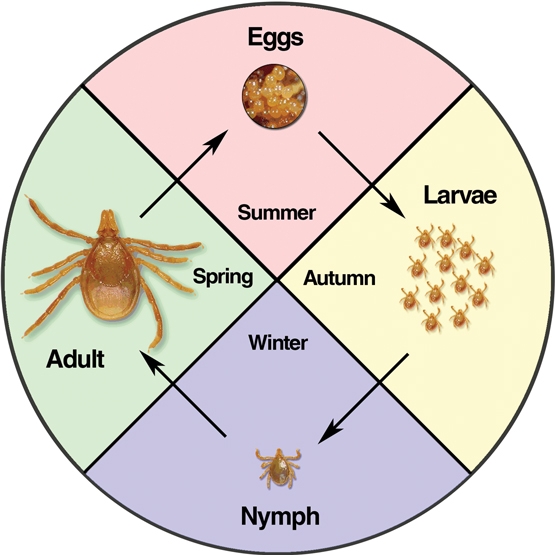
* Reproduced with permission from Stephen L Doggett; Department of Medical Entomology, NSW Health Pathology, Institute for Clinical Pathology and Medical Research, Westmead Hospital, Sydney, NSW.
Box 2 – Mammalian meat allergy: a worldwide phenomenon (initial reports)
|
Year |
Country |
Tick |
n |
Reference |
|||||||||||
|
|
|||||||||||||||
|
2007 |
Australia |
Ixodes holocyclus |
25 |
||||||||||||
|
2009 |
United States |
Amblyomma americanum |
24 |
||||||||||||
|
2009 |
France |
Ixodes ricinus |
2 |
||||||||||||
|
2011 |
Spain |
Ixodes ricinus |
5 |
||||||||||||
|
2012 |
Germany |
Ixodes ricinus |
21 |
||||||||||||
|
2012 |
Korea |
Ixodes nipponensis? |
1 |
||||||||||||
|
2012 |
Japan |
Ixodes nipponensis? |
1 |
||||||||||||
|
2013 |
Sweden |
Ixodes ricinus |
2 |
||||||||||||
|
2014 |
Switzerland |
Ixodes ricinus |
3 |
||||||||||||
|
2014 |
Panama |
Amblyomma cajennense |
4 |
||||||||||||
|
2015 |
United Kingdom |
Ixodes ricinus |
1 |
||||||||||||
|
2016 |
Italy |
Ixodes ricinus? |
1 |
||||||||||||
|
2016 |
South Africa |
? |
2 |
||||||||||||
|
2016 |
Japan |
Haemaphysalis longicornis? |
30 |
||||||||||||
|
2016 |
Brazil |
Amblyomma sculptum? |
1 |
||||||||||||
|
2016 |
Ivory Coast |
Amblyomma variegatum? |
1 |
||||||||||||
|
2017 |
Norway |
Ixodes ricinus |
1 |
||||||||||||
|
|
|||||||||||||||
|
|
|||||||||||||||
Box 3 – Distribution of Ixodes holocyclus (Australian paralysis tick)*
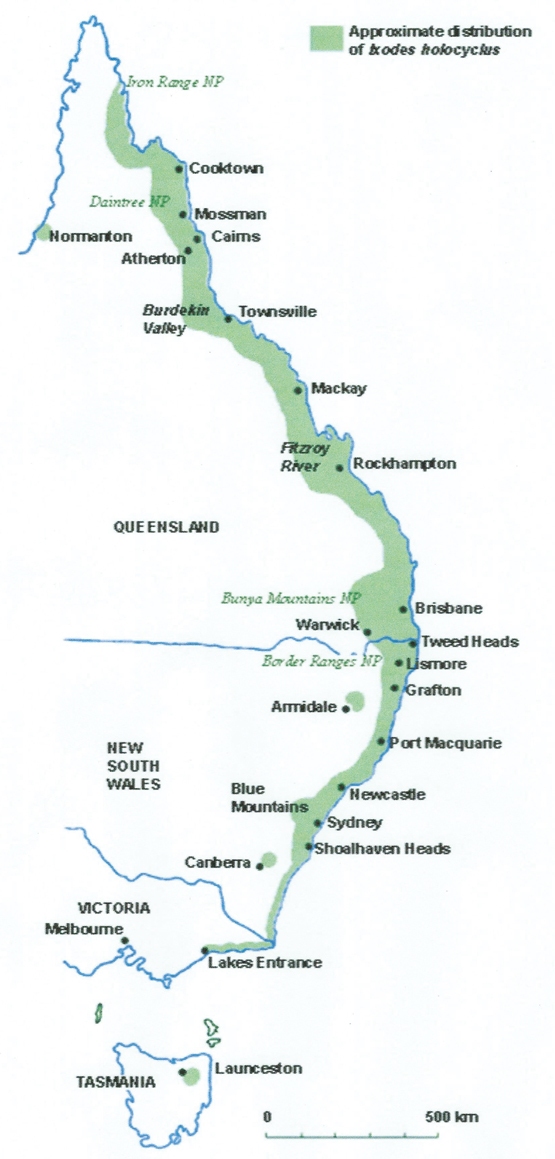
* Map adapted from Roberts FHS. Australian ticks. Yeerongpilly, QLD: CSIRO; 1970, by TAGS, Conroy B and Fischer N.
Box 4 – Clinical features of mammalian meat allergy after tick bites
|
Clinical features |
References |
||||||||||||||
|
|
|||||||||||||||
|
• Patients with a history of tick bites present with allergic reactions after ingesting mammalian meat (or meat products) — reactions which are typically delayed (ie, “middle of the night” anaphylaxis) and often severe |
|||||||||||||||
|
• The interval between mammalian meat ingestion and the allergic reaction is 2–10 hours, usually 3–6 hours, depending on exposure to cofactors (eg, alcohol or exercise) |
|||||||||||||||
|
• Anaphylaxis occurs in up to 60% of patients, delayed urticaria or angioedema features and gut symptoms may occur alone |
|||||||||||||||
|
• There is a history of previous tick bite. Occasionally, evidence for the tick bite can be obscure |
|||||||||||||||
|
• A history of a large local reaction to a tick bite is not uncommon |
|||||||||||||||
|
• Bites from either nymphs or adult ticks may provoke the condition |
|
||||||||||||||
|
• Individuals with mammalian meat allergy will almost invariably have α-gal-specific IgE detectable in their serum, and/or positive skin tests to raw, organic mammalian meats and/or cetuximab |
|||||||||||||||
|
|
|||||||||||||||
|
|
|||||||||||||||
Box 5 – Pitfalls in the diagnosis of tick bite-induced mammalian meat allergy
|
Characteristics |
References |
||||||||||||||
|
|
|||||||||||||||
|
• Lack of awareness in doctor or patient of the existence of the condition (axiom: where certain tick species are endemic and humans are bitten, mammalian meat allergy will occur) |
|
||||||||||||||
|
• Interpreting the presence of α-gal-specific IgE (in the absence of a supportive clinical history) as indicating the patient has a clinical allergy to mammalian meat* |
|
||||||||||||||
|
• Mammalian meat allergy is an “any time” but not an “every time” allergy (ie, cofactors are very influential in its expression) |
|||||||||||||||
|
• Challenge design is difficult due to delayed reactions and the crucial role of cofactors |
|||||||||||||||
|
|
|||||||||||||||
|
* The presence of allergen-specific IgE in serum or a positive skin test to any allergen does not equate to the patient having an allergy to that allergen, unless it can be established clinically that the allergen is causing the symptoms being experienced at this time in their life. α-Gal sensitisation may be present in the absence of clinical allergy to mammalian meats.28 |
|||||||||||||||
Box 6 – Clinical features of tick anaphylaxis
|
Tick anaphylaxis: |
References |
||||||||||||||
|
|
|||||||||||||||
|
• is only seen with bites from adult ticks |
|||||||||||||||
|
• is becoming more commonly seen in tick-endemic areas in Australia |
|||||||||||||||
|
• is uncommon in countries other than Australia |
|||||||||||||||
|
• is usually severe (> 74% Mueller grade III or IV) |
|||||||||||||||
|
• may be fatal (four lethal reactions in Australia) |
|||||||||||||||
|
• may be provoked when the tick is disturbed or removed inappropriately |
|||||||||||||||
|
• is very unlikely to occur if the tick is killed in situ |
|||||||||||||||
|
• is more likely to occur in older individuals (> 50%, > 50 years of age) |
|||||||||||||||
|
|
|||||||||||||||
|
|
|||||||||||||||
Competing interests
No relevant disclosures.
References
- van Nunen S. Tick-induced allergies: mammalian meat allergy, tick anaphylaxis and their significance. Asia Pac Allergy 2015; 5: 3-16.
- van Nunen S. Galactose-alpha-1,3-galactose, mammalian meat and anaphylaxis: a world-wide phenomenon? Curr Treat Options Allergy 2014; 1: 262-277.
- Rappo TB, Cottee AM, Ratchford AM, Burns BJ. Tick bite anaphylaxis: incidence and management in an Australian emergency department. Emerg Med Australas 2013; 25: 297-301.
- van Nunen S, O’Connor KS, Fernando SL, et al. The association between Ixodes holocyclus tick bite reactions and red meat allergy. Intern Med J 2007; 39: A132.
- van Nunen SA, O’Connor KS, Clarke LR, et al. An association between tick bite reactions and red meat allergy in humans. Med J Aust 2009; 190: 510-511.
- Commins SP, Satinover SM, Hosen J, et al. Delayed anaphylaxis, angioedema, or urticaria after consumption of red meat in patients with IgE antibodies specific for galactose-alpha-1,3-galactose. J Allergy Clin Immunol 2009; 123: 426-433.
- Jacquenet S, Moneret-Vautrin DA, Bihain BE. Mammalian meat-induced anaphylaxis: clinical relevance of anti-galactose-alpha-1,3-galactose IgE confirmed by means of skin tests to cetuximab. J Allergy Clin Immunol 2009; 124: 603-605.
- Nuñez R, Carballada F, Gonzalez-Quintela A, et al. Delayed mammalian meat-induced anaphylaxis due to galactose-α-1,3-galactose in 5 European patients. J Allergy Clin Immunol 2011; 128: 1122-1124.e1.
- Jappe U. Update on meat allergy. α-gal: a new epitope, a new entity? Hautarzt 2012; 63: 299-306.
- Lee JH, Kim JH, Kim TH, Kim SC. Delayed mammalian meat-induced anaphylaxis confirmed by skin test to cetuximab. J Dermatol 2013; 40: 577-578.
- Sekiya K, Fukutomi Y, Nakazawa T, et al. Delayed anaphylactic reaction to mammalian meat. J Invest Allergol Clin Immunol 2012; 22: 446-447.
- Hamsten C, Tran TAT, Starkhammar M, et al. Red meat allergy in Sweden: association with tick sensitization and B-negative blood groups. J Allergy Clin Immunol 2013; 132: 1431-1434.
- Michel S, Scherer K, Heijnen IA, Bircher AJ. Skin prick test and basophil reactivity to cetuximab in patients with IgE to alpha-gal and allergy to red meat. Allergy 2014; 69: 403-405.
- Wickner PG, Commins S. The first central American cases of delayed meat allergy with galactose-alpha-1,3-galactose positivity clustered among field biologists in Panama. Abstract 736; American Academy of Allergy, Asthma and Immunology Annual Meeting; San Diego, CA (US); 28 Feb – 4 Mar 2014.
- Shepherd M. Anaphylaxis shock warning over Highland tick bites. Edinburgh: Royal Environmental Health Institute of Scotland; 2015. https://www.rehis.com/sites/default/files/rehis_september_2015_e-newsletter_120915_1.pdf (viewed Feb 2018).
- Calamari AM, Poppa M, Villalta D, Pravettoni V. Alpha-gal anaphylaxis: the first case report from Italy. Eur Ann Allergy Clin Immunol 2015; 47: 161-162.
- Gray CL, van Zyl A, Strauss L. “Midnight anaphylaxis” to red meat in patients with alpha-gal sensitisation: a recent discovery in the food allergy world and a case report from South Africa. Curr Allergy Clin Immunol 2016; 29: 102-104.
- Chinuki Y, Ishiwata K, Yamaji K, et al. Haemaphysalis longicornis tick bites are a possible cause of red meat allergy in Japan. Allergy 2016; 71: 421-425.
- Cocco RR, Ensina LF, Aranda CS, Solé D. Galactose-α-1,3-galactose (alpha gal) allergy without anaphylaxis: a case report in Brazil. Clin Transl Allergy 2017; 7: 7.
- Kaloga M, Kourouma S, Kouassi YI, et al. Allergy to red meat: a diagnosis made by the patient and confirmed by an assay for IgE antibodies specific for alpha-1,3-galactose. Case Rep Dermatol 2016; 8: 10-13.
- Lied GA. Red meat allergy induced by tick bite: a Norwegian case report. Eur Ann Allergy Clin Immunol 2017; 49: 186-188.
- McGain F, Welton R, Solley GO, Winkel KD. First fatalities in tick anaphylaxis. J Allergy Clin Immunol Pract 2016; 4: 769-770.
- Mullins RJ, Wainstein BK, Barnes EH, et al. Increases in anaphylaxis fatalities in Australia from 1997 to 2013. Clin Exp Allergy 2016; 46: 1099-1110.
- van Wye JE, Hsu YP, Lane RS, et al. IgE antibodies in tick bite-induced anaphylaxis. J Allergy Clin Immunol 1991; 88: 968-970.
- van Wye JE, Hsu YP, Terr AI, Moss RB. Anaphylaxis from a tick bite. N Engl J Med 1991; 324: 777-778.
- Moneret-Vautrin DA, Beaudouin E, Kanny G, et al. Anaphylactic shock caused by ticks (Ixodes ricinus). J Allergy Clin Immunol 1998; 101: 144-145.
- Fernández-Soto P, Dávila I, Laffond E, et al. Tick-bite-induced anaphylaxis in Spain. Ann Trop Med Parasitol 2001; 95: 97-103.
- Fischer J, Yazdi AS, Biedermann T. Clinical spectrum of α-gal syndrome: from immediate-type to delayed immediate-type to mammalian innards and meat. Allergo J Int 2016; 25: 55-62.
- Acero S, Blanco R, Bartolomé B. Anaphylaxis due to a tick bite. Allergy 2003; 58: 824-825.
- Valls A, Pineda F, Belver M, et al. Anaphylactic shock caused by tick (Rhipicephalus sanguineous). J Investig Allergol Clin Immunol 2007; 17: 279-280.
- Mateos-Hernández L, Villar M, Moral A, et al. Tick-host conflict: immunoglobulin E antibodies to tick proteins in patients with anaphylaxis to tick bite. Oncotarget 2017; 8: 20630-20644.
- Gauci M, Loh RKS, Stone BF, Thong YH. Allergic reactions to the Australian paralysis tick, Ixodes holocyclus: diagnostic evaluation by skin test and radioimmunoassay. Clin Exp Allergy 1989; 19: 279-283.
- Graft DF, Schuberth KC, Kagey-Sobotka A, et al. A prospective study of the natural history of large local reactions after Hymenoptera stings in children. J Pediatr 1984; 104; 664-668.
- Galili U, Clark MR, Shohet SB, et al. Evolutionary relationship between the natural anti-gal antibody and the gal-alpha-1,3-gal epitope in primates. Proc Natl Acad Sci U S A 1987; 84: 1369-1373.
- Galili U, Mandrell RE, Hamadeh RM, et al. Interaction between human natural anti-alpha-galactosyl immunoglobulin G and bacteria of the human flora. Infect Immun 1988; 56: 1730-1737.
- Galili U. Evolution and pathophysiology of the human natural anti-α-galactosyl IgG (anti-gal) antibody. Springer Semin Immunopathol 2004; 15: 155-171.
- Commins S, Lucas S, Hosen J, et al. Anaphylaxis and IgE antibodies to galactose-alpha-1,3-galactose (alphaGal): insight from the identification of novel IgE ab to carbohydrates on mammalian proteins. J Allergy Clin Immunol 2008; 121: S25.
- Gauci M, Stone BF, Thong YH. Detection in allergic individuals of IgE specific for the Australian paralysis tick, Ixodes holocyclus. Int Arch Appl Immunol 1988; 85: 190-193.
- Gauci M, Stone BF, Thong YH. Isolation and immunological characterisation of allergens from salivary glands of the Australian paralysis tick, Ixodes holocyclus. Int Arch Appl Allergy Immunol 1988; 87: 208-212.
- Broady KW. Presentation of findings: tick allergens; TiARA (Tick-induced Allergies Research and Awareness) Committee Meeting. Royal North Shore Hospital; Sydney (Australia), 20 Aug 2013.
- Dorey C. Allergens of the Australian paralysis tick, Ixodes holocyclus [dissertation]. Sydney: University of Technology Sydney, 1998.
- Padula MP. The development of proteomic techniques to study the Australian paralysis tick [dissertation]. Sydney: University of Technology Sydney, 2008.
- Cooper PJ. Interactions between helminth parasites and allergy. Curr Opin Allergy Clin Immunol 2009; 9: 29-37.
- Tyagi N, Farnell EJ, Fitzsimmons CM, et al. Comparisons of allergenic and metazoan parasite proteins: allergy the price of immunity. PLoS Comput Biol 2015; 11: e1004546.
- Commins SP, Platts-Mills TA. Tick bites and red meat allergy. Curr Opin Allergy Clin Immunol 2013; 13: 354-359.
- James HR, Commins SP, Kelly LA, et al. Further evidence for tick bites as a cause of the IgE responses to alpha-gal that underlie a major increase in delayed anaphylaxis to meat. J Allergy Clin Immunol 2011; 127: AB243.
- Kennedy JL, Stallings AP, Platts-Mills TA, et al. Galactose-α-1,3-galactose and delayed anaphylaxis, angioedema and urticaria in children. Pediatrics 2013; 131: e1545-e1552.
- Mullins RJ, James H, Platts-Mills TA, Commins S. Relationship between red meat allergy and sensitization to gelatin and galactose-α-1,3-galactose. J Allergy Clin Immunol 2012; 129: 1334-1342.e1.
- Renaudin J, Jacquenet S, Metz-Favre C, et al. Interest of specific IgE measurement for galactose-alpha-1,3-galactose in unexplained urticaria and angioedema, predominantly nocturnal: about 6 cases. J Allergy Clin Immunol 2012; 129: AB177.
- Morisset M, Richard C, Astier C, et al. Anaphylaxis to pork kidney is related to IgE antibodies specific for galactose-alpha-1,3-galactose. Allergy 2012; 67: 699-704.
- Morisset M, Richard C, Zanna H, et al. Allergy to cow’s milk related to IgE antibodies specific for galactose-alpha-1,3-galactose. Abstract 1617. European Academy of Allergology and Clinical Immunology Congress and World Allergy Organization; Milan (Italy); 22-26 June 2013.
- Caponetto P, Fischer J, Biedermann T. Gelatin-containing sweets can elicit anaphylaxis in a patient with sensitization to galactose-α-1,3-galactose. J Allergy Clin Immunol Pract 2013; 1: 302-303.
- Hamsten C, Starkhammar M, Tran TA, et al. Identification of galactose-α-1,3-galactose in the gastrointestinal tract of the tick Ixodes ricinus; possible relationship with red meat allergy. Allergy 2013; 68: 549-552.
- Jappe U, Platts-Mills T, Przybilla B, et al. IgE-reactivity to galactose-[alpha]-1,3-galactose: a prospective multicentre study on meat allergy, urticaria and anaphylaxis [abstract #202]. Proceedings for the Thirty-first European Academy of Allergy and Clinical Immunology Congress; Geneva, Switzerland; 2012 June 16–20.
- Baumgart KW, Mok A, Sivertsen T, et al. Allergen-specific IgE after anaphylaxis to tick or mammalian/marsupial meat in Australia. European Academy of Allergy and Clinical Immunology Congress; Copenhagen (Denmark); 7–11 June 2014. Allergy 2014; 69: 1-646.
- Platts-Mills TA, Commins SP. Emerging antigens involved in allergic responses. Curr Opin Immunol 2013; 25: 769-774.
- Fischer J, Yazdi A, Biedermann T. Mammalian meat allergy: a diagnostic challenge. Allergo J Int 2015; 24: 81-83.
- van Nunen SA, Said MG, Batty G. Use of expanded search criteria in diagnosing mammalian meat allergy provoked by previous tick bites in individuals who do not live where ticks are endemic. Abstract 2602. European Academy of Allergy and Clinical Immunology Congress and World Allergy Organization; Milan (Italy); 22-26 June 2013.
- Wölbing F, Fischer J, Köberle M, et al. About the role and underlying mechanisms of cofactors in anaphylaxis. Allergy 2013; 68: 1085-1092.
- Versluis A, van Os-Medendorp H, Kruizinga A, et al. Cofactors in allergic reactions to food: physical exercise and alcohol are the most important. Immun Inflamm Dis 2016; 4: 392-400.
- Commins SP, James HR, Stevens W, et al. Delayed clinical and ex vivo response to mammalian meat in patients with IgE to galactose-alpha-1,3-galactose. J Allergy Clin Immunol 2014; 134: 108-115.
- Gonzalez-Quintela A, Dam Laursen AS, Vidal C, et al. IgE antibodies to alpha-gal in the general population: relationship to tick bites, atopy, and cat ownership. Clin Exp Allergy 2014; 44: 1061-1068.
- Olafson PU. Ticks and the mammalian meat allergy. Beef Research 2014; 4: 1-3.
- Fischer J, Lupberger E, Hebsaker J, et al. Prevalence of type I sensitization to alpha-gal in forest service employees and hunters. Allergy 2017; 72: 1540-1547.
- McKay WJS. Tick bite and allergy. Med J Aust 1940; 1: 458-459.
- Trinca JC. Insect allergy in Australia. Results of a five-year survey. Med J Aust 1964; 2: 659-663.
- Banfield JF. Tick bites in man. Med J Aust 1966; 2: 600-601.
- Kemp A. Tick bites. Med J Aust 1986; 144: 615.
- Brown AF, Hamilton DL. Tick bite anaphylaxis in Australia. J Accid Emerg Med 1998; 15: 111-113.
- Sánchez M, Venturini M, Blasco A, et al. Tick bite anaphylaxis in a patient allergic to bee venom. J Investig Allergol Clin Immunol 2014; 24: 284-285.
- van Nunen S, Basten A, Cowdery N, et al. Tick removal techniques practised by tick anaphylaxis sufferers. Intern Med J 2014; 44: 1-37.
- Gauci M, Stone BF, Thong YH. Detection in allergic individuals of IgE specific for the Australian paralysis tick, Ixodes holocyclus. Int Arch Allergy Appl Immunol 1988; 85: 190-193.
- Gauci M, Stone BF, Thong YH. Isolation and immunological characterisation of allergens from salivary glands of the Australian paralysis tick Ixodes holocyclus. Int Arch Allergy Appl Immunol 1988; 87: 208-212.
- Galili U. Anti-gal: an abundant human natural antibody of multiple pathogeneses and clinical benefits. Immunology 2013; 140: 1-11.
- Pointreau Y, Commins SP, Calais G, et al. Fatal infusion reactions to cetuximab: role of immunoglobulin E-mediated anaphylaxis. J Clin Oncol 2012; 30: 334; author reply 335.
- Stone CA, Hemler JA, Commins SP, et al. Anaphylaxis after zoster vaccine: implicating alpha-gal allergy as a possible mechanism. J Allergy Clin Immunol 2017; 139: 1710-1713.e2
- Naso F, Gandaglia A, Bottio T, et al. First quantification of alpha-gal epitope in current glutaraldehyde-fixed heart valve bioprostheses. Xenotransplantation 2013; 20: 252-261.
- Fournier PE, Thuny F, Grisoli D, et al. A deadly aversion to pork. Lancet 2011; 377: 1542.
- Mozzicato SM, Tripathi A, Posthumus JB, et al. Porcine or bovine valve replacement in 3 patients with IgE antibodies to the mammalian oligosaccharide galactose-alpha-1,3-galactose. J Allergy Clin Immunol Pract 2014; 2: 637-638.
- Fischer J, Eberlein B, Hilger C, et al. Alpha-gal is a possible target of IgE-mediated reactivity to antivenom. Allergy 2017; 72: 764-771.
- Commins SP, Jerath MR, Cox K, et al. Delayed anaphylaxis to alpha-gal, an oligosaccharide in mammalian meat. Allergol Int 2016; 65: 16-20.
- Australasian Society of Clinical Immunology and Allergy. Tick allergy [website]. Sydney: ASCIA; 2016. https://www.allergy.org.au/patients/insect-allergy-bites-and-stings/tick-allergy (viewed Nov 2017).
- Stone BF. Dealing with ticks affecting humans in Australia, especially the Australian paralysis tick Ixodes holocyclus. St Lucia (Australia); Department of Microbiology and Parasitology, School of Molecular and Microbial Sciences, University of Queensland; 2000.
- Due C, Fox W, Medlock JM, et al. Tick bite prevention and tick removal. BMJ 2013; 347: f7123.
- Ferreira BR, Silva JS. Successive tick infestations selectively promote a T-helper 2 cytokine profile in mice. Immunology 1999; 96: 434-439.
- Jyo T, Kuwabara M, Kodommari Y, et al. Cases of immediate-type allergy in oyster shuckers due to galacto-oligosaccharide. J Hiroshima Med Assoc 1993; 25: 19-26.
- Goh DL, Chua KY, Chew FT, et al. Immunochemical characterization of edible bird’s nest allergens. J Allergy Clin Immunol 2001; 107: 1082-1087.
- Araujo RN, Franco PF, Rodrigues H, et al. Amblyomma sculptum tick saliva: α-gal identification, antibody response and possible association with red meat allergy in Brazil. Int J Parasitol 2016; 46: 213-220.
- Commins SP, Karim S. Development of a novel murine model of alpha-gal meat allergy. J Allergy Clin Immunol 2017; 139: AB193.
Linked content
-
MJA InSight: Tick bites and meat allergy: a backyard BBQ dilemma
-
MJA Podcast: A/Prof Sheryl van Nunen
Provenance: Commissioned; externally peer reviewed.
Rhabdomyolysis After COVID-19
Navya Kataria, Abel Devadass, Lana Sundac, Laura De Souza, Nabeel Sheikh, Samantha Ng, Scott Campbell, Yishen Wang, Ross S. Francis
Technological advances in the search for a CURE for asthma
Sara Quon, Timothy M Johanson, Ridhima Wadhwa, Alen Faiz, Anthony Flynn, Gary P Anderson, Amanda J Cox, Nicholas P West, Michael P Menden, Rhys S Allan
The CURE Asthma roadmap
Gary P Anderson, Anthony Flynn, Phil G Bardin, John D Blakey, Shyamali C Dharmage, Paul Foster, Peter G Gibson, Adam Jaffe, Alan James, Christine R Jenkins, Sundram Sivamalai, Peter D Sly, Guy B Marks, Vanessa M McDonald, Judy Wetttenhall
The first live term birth following uterus transplantation in Australia
Rebecca Deans, Brigitte Gerstl, Antonia W Shand, Sarah Lyons, Aaron Budden, Helen L Barrett, Grant Luxton, Mangalee Fernando, Kenneth Yong, Karen Keung, Kaushalya Arulpragasam, Henry Pleass, King Man Wan, Eva Kehag, Jana‐Emily Pittman, Mianna Lotz, Maria Fenn, Erin Nesbitt‐Hawes, Lily Byun, Katrina Tang, Mats Brannstrom, Jason Abbott
The public health impacts of mining in Australia
Javier Cortes‐Ramirez, Ruby N Michael, Leisa‐Maree Toms, Melissa Haswell
Lingual Raynaud phenomenon
Michael Taggart, Mina John