




Reflections
Obituary
Volume 206 - Issue 3
Bill Williams
Authors: Tilman A Ruff and Jim S Rossiter
Med J Aust 2017; 206 (3): 117. || doi: 10.5694/mja16.01169
Published online: 20 February 2017
Published online: 20 February 2017
22 September 1958, Geelong - 12 September 2016, Torquay
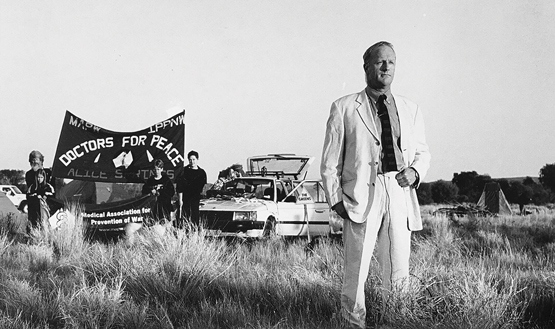
Bill Williams was born in Geelong on 22 September 1958. He studied medicine at the University of Melbourne from 1976 to 1982, and spent 1979 travelling in Latin America, where he worked in primary health care. Later in Zimbabwe, he delivered babies in war-torn hospitals and witnessed the terrible burden of preventable child deaths. Bill soon developed a strong global and historical view, a great openness and respect for diverse cultures, and a deep passion for the public health advocacy needed for major health gains.
After training at the Royal Melbourne and Geelong hospitals and at Middlesex Hospital in London, Bill spent much of the 1990s working in central Australia, especially at the Pintubi Homelands Health Service, where he continued to work periodically. In the same decade, working as a police surgeon and forensic medical officer in Geelong, he introduced lasting reforms, including that women who were victims of domestic or sexual violence be first assessed by a female doctor. Living in Torquay for most of the past two decades, Bill worked first at Corio Community Health Centre and later at Surfcoast Medical Centre in Torquay. He was treasured by colleagues for his insight, humour and wise counsel, and by patients for his exemplary care and capacity to listen.
Surfing most days, avid gardener, keen bushwalker and banjo player, devoted husband, father and grandfather, Bill’s energy and passion touched and inspired many. He published three books: Men: sex, power and survival (1989) co-authored with his wife Gisela Gardener, Kumanjayi’s Country (1999), and Bleed (2015), about Gisela’s life-threatening subarachnoid haemorrhage and their remarkable shared journey of resilience, recovery and love.
Bill became president of the Medical Association for Prevention of War and international councillor for International Physicians for the Prevention of Nuclear War, which was awarded the Nobel Peace Prize in 1985. He cofounded the International Campaign to Abolish Nuclear Weapons, launched in Melbourne in 2007, which played a major role — 2 weeks after Bill died — in a group of governments tabling a historic proposal at the General Assembly of the United Nations to negotiate in 2017 a treaty banning nuclear weapons.
Bill died peacefully in his sleep on 12 September 2016. He is survived by his wife Gisela, daughters Daisy and Lily, his mother Judith, his grandchildren and brothers.
Prisoner of war pathology in Changi, 1942–1945
Kate Ariotti, Elizabeth Roberts‐Pedersen
Should medical eponyms continue to be used in everyday practice?
Leya Nedumannil, Diana Lewis
100 years on: the first use of insulin in Australia
Sophie Templer
Reflections on the life and career of Professor Dame Valerie Beral AC DBE FRS FRCOG FMedSci (1943–2022)
Karen Canfell, Bette Liu, Emily Banks
The Honourable Dr Donald James Grimes AO
Michael Kirby, Patti Warn
From wipeout to drill out: a history of exostosis management and Australian surfing
Alon Taylor, Hannah North, Narinder P Singh, Paul A Fagan