




Volume 195 - Issue 7
Lambeth doctors
Author: Paul Gerber
Med J Aust 2011; 195 (7): 422-422. || doi: 10.5694/mja11.20923
Published online: 3 October 2011
Published online: 3 October 2011
Readers who may contemplate referring patients to practitioners of complementary medicine may be interested in the fate of Dr Frederick Axham. He was an English anaesthetist, who was struck off the medical register for medical malpractice in 1911 at the urging of the General Medical Council, having been found guilty of “covering” (ie, professionally assisting a person not on the medical register). Axham had — despite dire warnings — anaesthetised eight patients of Herbert Barker, a renowned bone setter (now a lost art), who had successfully set and stabilised the complex fractures of seven of these eight patients whose fractures had been found to be inoperable by a number of eminent surgeons.
Axham, who died in 1926 aged 86 years, still deregistered, was posthumously rehabilitated when the medical faculty of the University of Edinburgh made him a Licentiate of the Royal College of Physicians some weeks after his death.1
The whole affair caused a huge outcry throughout England, leading to a petition to Lambeth Palace, the residence of the Most Reverend Lord Randall Davidson, Archbishop of Canterbury, to make Barker a Doctor of Medicine, in reliance on the Ecclesiastical Licences Act 1533 (25 Henry VIII, c 21). The petition included not only leading members of the aristocracy, but, more importantly, Sir Henry Morris Bt, former President of the Royal College of Surgeons, Sir Alfred Downing Fripp, “Surgeon in Ordinary” to King George V, Sir William Arbuthnot Lane Bt, consulting surgeon to Guy’s Hospital, and physician Sir Bruce Bruce-Porter, all testifying to Barker’s coampetence. It also led George Bernard Shaw to write:
Until the General Medical Council, which at present exhibits every constitutional vice that a trade union or professional association can have, is completely reformed by its legal constitution, we shall continue to hasten more and more precipitously to the not far distant day when the vogue of the unregistered practitioners, already very great (Mr. Barker is only a specially famous example of a large and growing body), will become so irresistible that the registered will be shunned by the public and driven to earning a scanty wage by signing death certificates for their unregistered employers.2
Alas, the Archbishop declined to award the degree. A press cuttings file at Lambeth Palace (Davidson’s Papers Vol 404, page 110) shows that he stated on 21 June 1920:
The legislation which limits registration to men qualified by the ordinary professional training expressly, and I think rightly, provides that the status acquired by registration is not given by the Degree which the petitioners invite me to confer on Mr Barker.2
In frustration, King George V did the only thing he could do, which was to make Herbert Barker a knight of the realm. Sir Herbert continued bone setting till he died in 1946.
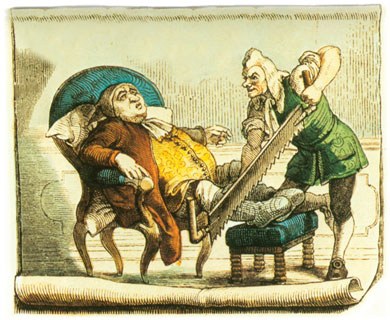
Competing interests
No relevant disclosures.
References
- Barker M. Leaves from my life. London: Hutchinson, 1927. 0_CHDEEJIG
- Bishop M. Should doctors be the judges of medical orthodoxy? The Barker case of 1920. J R Soc Med 2002; 95: 41-45. 0_BEABJDBI
Prisoner of war pathology in Changi, 1942–1945
Kate Ariotti, Elizabeth Roberts‐Pedersen
Should medical eponyms continue to be used in everyday practice?
Leya Nedumannil, Diana Lewis
100 years on: the first use of insulin in Australia
Sophie Templer
Reflections on the life and career of Professor Dame Valerie Beral AC DBE FRS FRCOG FMedSci (1943–2022)
Karen Canfell, Bette Liu, Emily Banks
The Honourable Dr Donald James Grimes AO
Michael Kirby, Patti Warn
From wipeout to drill out: a history of exostosis management and Australian surfing
Alon Taylor, Hannah North, Narinder P Singh, Paul A Fagan