




Volume 224 - Issue 7
Reorienting Allied Health Into Community-Based Care for People Experiencing Trauma and Social Disadvantage
Authors: Simon Rosenbaum, Grace McKeon, Gulsah Kurt, Oscar Lederman, Kemi Wright, Sabuj Kanti Mistry, Jackie E. Curtis, Philip B. Ward, Zachary Steel, Hamish Fibbins, Rachel Morell, Melissa C. Eaton, Andrew Watkins, Ben Harris-Roxas, Brendan Goodger, Eleanor Beck, Megan Teychenne, Joseph Firth, Davy Vancampfort, David Burns, Russell Roberts, Tristan Favaloro, Danielle Weber, Rosanna Barbero, Vasili Maroulis, Melissa Holmes, Stefan Mackenzie, Chiara Mastrogiovanni, Afsana Anwar, Uzma Choudhry, Catherine Sherrington, Jane Currie, Thomas Gadsden, Scott Teasdale
Correspondence: s.rosenbaum@unsw.edu.au
Med J Aust 2026 || doi: 10.5694/mja2.70251
Published online: 20 July 2026
Published online: 20 July 2026
Abstract
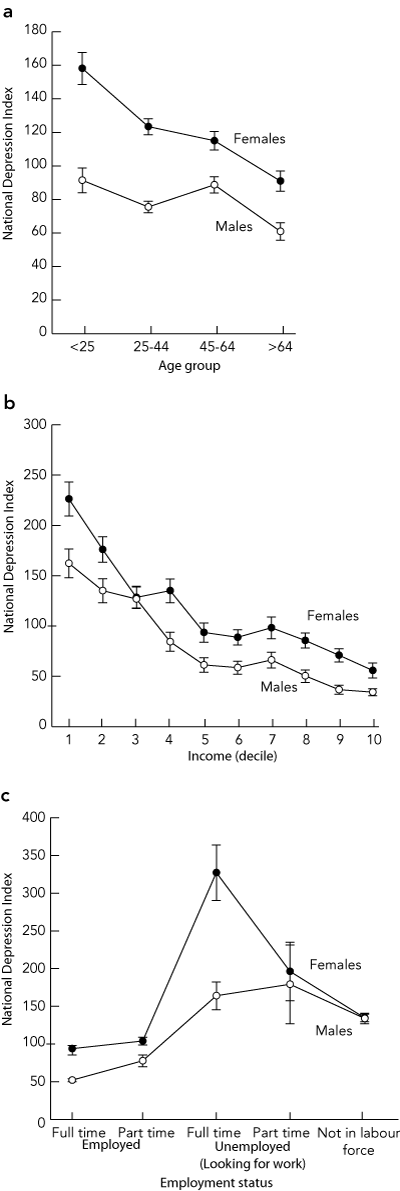
Trauma and social disadvantage are strongly associated with higher rates of chronic disease, partly driven by modifiable risk factors such as physical inactivity and poor diet. Despite strong evidence supporting exercise and dietary interventions for both physical and mental health, access to allied health professionals—particularly exercise physiologists, physiotherapists and dietitians—remains profoundly inequitable. Current prevention efforts predominantly reach individuals with stable living conditions and sufficient resources, ultimately privileging the privileged and entrenching health disparities. To close these gaps, these workforces must be reoriented: embedded within trusted community settings and delivered earlier in the care pathway, in ways that are trauma-informed and responsive to social context.
Psychosocial Hazards for Healthcare Workers: Supporting the Second Victim Also Helps the Primary Victims
Sarah Michael
Shifting focus to adolescent wellbeing and inclusive participation in the digital age
Jodie Bailie, Helen Dickinson, Briony Lipton, Marissa Shields
Shifting focus to adolescent wellbeing and inclusive participation in the digital age
Allyson R Todd, Elena Wang, Stephanie R Partridge
The CURE Asthma roadmap
Gary P Anderson, Anthony Flynn, Phil G Bardin, John D Blakey, Shyamali C Dharmage, Paul Foster, Peter G Gibson, Adam Jaffe, Alan James, Christine R Jenkins, Sundram Sivamalai, Peter D Sly, Guy B Marks, Vanessa M McDonald, Judy Wetttenhall
The first Australian evidence‐based guidelines on male infertility
Darren J Katz, Liza O’Donnell, Robert I McLachlan, Tim J Moss, Clare V Boothroyd, Veena Jayadev, Sarah R Catford