




Volume 194 - Issue 3
Doctors in the Dardanelles
Author: Peter D Byrne
Med J Aust 2011; 194 (3): 145. || doi: 10.5694/j.1326-5377.2011.tb04200.x
Published online: 7 January 2011
Published online: 7 January 2011
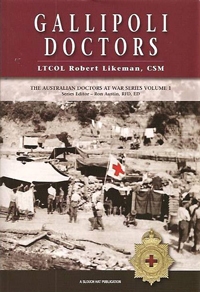
Gallipoli doctors. The Australian doctors at war series volume 1.
LtCol Robert Likeman, CSM. Melbourne: Slouch Publications, 2010 (223 pp). ISBN 9780980637335.
THIS IS THE FIRST of four volumes by Lieutenant Colonel Robert Likeman recording the history of Australian army doctors in World War I. It covers the Dardanelles Campaign and is a landmark in Australian military medical history.
LtCol Likeman is an experienced army medical commander trained in obstetrics and gynaecology, tropical medicine, and remote and rural medicine. He is also an established military medical historian and writes with clarity and elegance.
The book is the product of painstaking research using the Australian War Memorial’s nominal roll, the National Archives of Australia’s service records, the Australasian Medical Publishing Company’s library and many other sources of information.
It is a comprehensive history of 270 Australian Imperial Force (AIF) medical officers. It includes their pre- and post-campaign career achievements, including Palestine, the Western Front in France, and World War II. Australian doctors who served in the British Army or as Australian infantry officers are also noted.
The author’s note and introduction, combined with the first two chapters, provide an excellent summary of the military and medical events that led to Gallipoli. Each chapter has background information on key senior personnel, medical problems and general matters.
The medical officers’ personal data are presented on the basis of the order of battle of the Australian and New Zealand Army Corps in the Dardanelles in 1915. Summarised army unit battle histories act as preambles to the medical officer details. An alphabetical list of AIF doctors is provided, as well as a thorough overall index.
The end result of this great diligence and superb execution is a well illustrated, encyclopaedic volume that is also of a manageable, compact size. The work is a tour de force of World War I Australian military medical history, and I await the next three volumes with great anticipation.
Prisoner of war pathology in Changi, 1942–1945
Kate Ariotti, Elizabeth Roberts‐Pedersen
Should medical eponyms continue to be used in everyday practice?
Leya Nedumannil, Diana Lewis
100 years on: the first use of insulin in Australia
Sophie Templer
Reflections on the life and career of Professor Dame Valerie Beral AC DBE FRS FRCOG FMedSci (1943–2022)
Karen Canfell, Bette Liu, Emily Banks
The Honourable Dr Donald James Grimes AO
Michael Kirby, Patti Warn
From wipeout to drill out: a history of exostosis management and Australian surfing
Alon Taylor, Hannah North, Narinder P Singh, Paul A Fagan