




Volume 192 - Issue 9
Assessing elderly drivers’ roadworthiness
Author: Ilian Kamenoff
Med J Aust 2010; 192 (9): 536. || doi: 10.5694/j.1326-5377.2010.tb03622.x
Published online: 3 May 2010
Published online: 3 May 2010
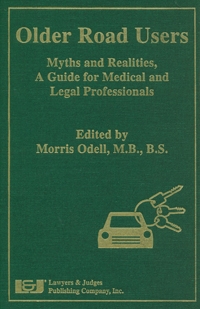
Older road users. Myths and realities, a guide for medical and legal professionals.
Morris S Odell, Editor. Tucson, Ariz: Lawyers & Judges Publishing Company, Inc, 2009 (xvi + 302 pp). ISBN 978 1 933264 70 7.
Traffic medicine is an emerging discipline, so not many resources are available on the subject. The fact that the editor of this book, Morris Odell — a Forensic Physician at the Victorian Institute of Forensic Medicine in Melbourne — is also my former teacher for whom I have great respect, made me read it with added interest.
The proportion of elderly drivers is expected to rise significantly in the next 50 years and the role of medical practitioners in assessing their medical fitness to drive will increase. At present, there are no strict guidelines for assessing elderly drivers’ medical fitness to drive since, in many instances, the evidence available is contradictory. This book acknowledges the limitations of the assessment process, but provides abundant information to help readers form their own opinions. I found this approach to be unbiased, unintrusive and fair.
The book was commissioned by VicRoads, in response to the 2003 Inquiry into Road Safety for Older Road Users by the Victorian Parliament Road Safety Committee. It addresses the main factors that affect driving skills — vision, cognition and motor function, with particularly interesting chapters on the effects of prescription drugs, and respiratory and sleep disorders. In addition, it examines different patterns of road injuries and the distinct crash epidemiology of elderly drivers.
Odell has assembled a stellar team of contributing authors and the information provided is contemporary, easy to understand and backed up by evidence.
The assessment options and principles of the assessment process of elderly drivers are explored in detail but the book stops short of recommending a particular assessment tool. Furthermore, it does not take a preferred position or make recommendations for when the elderly should not drive. This omission could be compensated by grabbing a copy of Austroad’s Assessing fitness to drive 2003, which gives strict recommendations for when people should not be driving.
Apart from these small omissions, this is a great reference that gave me a lot of answers to questions that I haven’t been able to find for years. It will benefit medical and legal professionals whose work involves elderly drivers, as well as students and young doctors who would like to learn more about the relationship between different medical conditions and their impact on driving safety.
Shifting focus to adolescent wellbeing and inclusive participation in the digital age
Allyson R Todd, Elena Wang, Stephanie R Partridge
The clinical presentation, investigation, and management of women diagnosed with endometriosis in Australian general practices, 2011–2021: an open cohort study
Danielle Mazza, Kailash Thapaliya, Sharinne B Crawford, Alissia Hui, Maryam Moradi, Luke E Grzeskowiak
The impact of the Breast Screen NSW transition from film to digital mammography, 2002–2016: a linked population health data analysis
Rachel Farber, Nehmat Houssami, Katy J L Bell
Non‐technical errors associated with deaths in surgical care, Australia, 2012–2019, by surgical specialty (Australian and New Zealand Audit of Surgical Mortality): a retrospective cohort study
Jesse Ey, Victoria Kollias, Octavia Lee, Kelly Hou, Matheesha Herath, John B North, Ellie Treloar, Suzanne Edwards, Martin Bruening, Adam J Wells, Guy J Maddern
The CURE Asthma roadmap
Gary P Anderson, Anthony Flynn, Phil G Bardin, John D Blakey, Shyamali C Dharmage, Paul Foster, Peter G Gibson, Adam Jaffe, Alan James, Christine R Jenkins, Sundram Sivamalai, Peter D Sly, Guy B Marks, Vanessa M McDonald, Judy Wetttenhall
Evidence from Australian cohort studies about asthma trajectories and transitions across the life course: a narrative review
Caroline Lodge, Xin Dai, Ingrid A. Laing, Michael P Menden, Anthony Flynn, Gary P Anderson, Sarath Ranganathan, Shyamali C Dharmage