




Volume 192 - Issue 7
A nuts-and-bolts guide to men’s health
Author: Nicholas B Cooling
Med J Aust 2010; 192 (7): 412. || doi: 10.5694/j.1326-5377.2010.tb03567.x
Published online: 5 April 2010
Published online: 5 April 2010
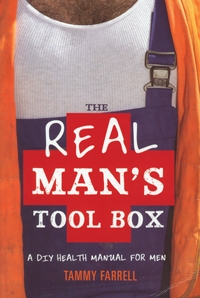
The real man’s tool box. A DIY health manual for men.
Tammy Farrell. Sydney: Hachette, 2009 (294 pp). ISBN 978 0 7336 2394 3
Written by a registered nurse and nutritionist, The real man’s tool box aims to educate the average bloke with humour, vignettes and sound advice.
The book covers common areas of men’s health, with an emphasis on cardiovascular, gastrointestinal, prostate, mental, and genital health. Given the author’s background in nutrition it is not surprising that this subject also has significant emphasis. Some less commonly discussed topics are covered, such as the Men’s Shed movement and “secret women’s business”.
The real man’s toolbox fits into the “self-help books for men” genre which includes: Every man by Derek Lllewellyn-Jones, Men’s health by Ian Hamilton Craig, Man maintenance by Jill Margo and The M factor by Andrew Pattison. Its arrival is timely and it’s probably the easiest read in this series.
The book has drawn upon many reputable sources for its information, including the Heart Foundation, beyondblue, Cancer Council and Diabetes Australia. It has an excellent bibliography of web-based references and a substantial glossary. The section on “Your personal logbook” is a lay version of the Royal Australian College of General Practitioners’ “Red book”. The information is up to date and accurate.
The target audience is the health-illiterate male, especially the ones interested in cars. The author has chosen basic, conversational-style language with plenty of anecdotes and case studies. Simple anatomy and physiology is covered using slang, often with plumbing or mechanical metaphors.
It is likely that health professionals might find this book rather hackneyed, containing too many lists and prescriptive advice. However, the target audience male patients with minimum health knowledge should benefit by gaining a practical knowledge of their bodies and how doctors could help them “get their body serviced”.
Shifting focus to adolescent wellbeing and inclusive participation in the digital age
Allyson R Todd, Elena Wang, Stephanie R Partridge
The clinical presentation, investigation, and management of women diagnosed with endometriosis in Australian general practices, 2011–2021: an open cohort study
Danielle Mazza, Kailash Thapaliya, Sharinne B Crawford, Alissia Hui, Maryam Moradi, Luke E Grzeskowiak
The impact of the Breast Screen NSW transition from film to digital mammography, 2002–2016: a linked population health data analysis
Rachel Farber, Nehmat Houssami, Katy J L Bell
Non‐technical errors associated with deaths in surgical care, Australia, 2012–2019, by surgical specialty (Australian and New Zealand Audit of Surgical Mortality): a retrospective cohort study
Jesse Ey, Victoria Kollias, Octavia Lee, Kelly Hou, Matheesha Herath, John B North, Ellie Treloar, Suzanne Edwards, Martin Bruening, Adam J Wells, Guy J Maddern
The CURE Asthma roadmap
Gary P Anderson, Anthony Flynn, Phil G Bardin, John D Blakey, Shyamali C Dharmage, Paul Foster, Peter G Gibson, Adam Jaffe, Alan James, Christine R Jenkins, Sundram Sivamalai, Peter D Sly, Guy B Marks, Vanessa M McDonald, Judy Wetttenhall
Evidence from Australian cohort studies about asthma trajectories and transitions across the life course: a narrative review
Caroline Lodge, Xin Dai, Ingrid A. Laing, Michael P Menden, Anthony Flynn, Gary P Anderson, Sarath Ranganathan, Shyamali C Dharmage