




Volume 183 - Issue 11
Herbal medicine safety
Author: Alan Bensoussan
Med J Aust 2005 || doi: 10.5694/j.1326-5377.2005.tb00031.x
Published online: 25 November 2005
Published online: 25 November 2005
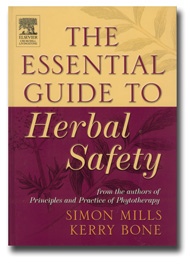
The essential guide to herbal safety.
Simon Mills, Kerry Bone. Missouri: Elsevier Churchill Livingstone, 2005 (xvi + 684 pp). ISBN 0 443 07171 3.
With the dramatic growth in the use of herbal medicines, consumers and practitioners alike need to access reliable information on the safety and efficacy of herbal medicine. The essential guide to herbal safety is extremely topical and fills a considerable gap in the literature.
This is an outstanding reference text on herbal safety that deals not only with a range of critical issues (safety monitoring of herbal medicines, herbdrug interactions, quality control), but also provides a series of exemplary monographs on herb safety. The text brings together contributions by acknowledged experts in the field.
The safety monographs contain useful information on the current regulatory status of each herb in selected jurisdictions. The LD50 data for various extracts of the herb serve to highlight the relative risk represented by different extract forms (water, ethanol, etc) and the role of individual phytochemical constituents.
Categories descriptive of known toxicity in pregnancy and lactation are provided for each herb. I would have liked the authors to provide similar toxicological categories or grades for general consumers, however this would have required substantial input by clinical toxicologists.
Overall, the text is extremely well researched, integrating various data sources. It is an excellent book to have in hand and will undoubtedly become an important resource. At just over $100, The essential guide to herbal safety represents outstanding value.
Alan BensoussanDirector, Centre for Complementary Medicine Research University of Western Sydney, NSW
Country revealing the way: evaluating Elder‐governed cultural therapy for Aboriginal and Torres Strait Islander young people with mental health conditions
Alasdair Vance, Janet McGaw, Jo Winther, Naomi Tootell, Herb Patten, Sandra Eades
No silver lining with health misinformation: argyria caused by intentional silver consumption
Luke Collins, Logesh Palanikumar, Stephen Bacchi
Hyperkalaemic cardiac arrest due to cream of tartar ingestion
Daniel Yee Lee Ng, Laksmi Govindasamy, Andrew Hughes, Hwee Min Lee
From talk to action: Indigenous Reference Groups drive practice change in kidney transplantation care
Kelli J Owen, Katie Cundale, Jaquelyne T Hughes, Stephen P McDonald, Matilda D'Antoine, Shilpanjali Jesudason
The not‐so‐natural herb: a case of exogenous Cushing syndrome
Yi‐An Pan, David Roberts, Yi‐An Pan, David Roberts
Lead poisoning outbreak from consumption of contaminated Ayurvedic medication
Mark J Ferson, Sinead Flanigan, Toni Cains