




Volume 183 - Issue 11
Can medical journals lead or must they follow?
Author: Richard Smith
Med J Aust 2005; 183 (11): 665-668. || doi: 10.5694/j.1326-5377.2005.tb00072.x
Published online: 5 December 2005
Published online: 5 December 2005
We can put issues on the agenda, but perhaps not achieve reform
For Thomas Wakley, the founder of The Lancet, an important function of his journal was to reform medicine, which he saw as full of incompetence, quackery, corruption, and nepotism. He wanted to reform as well as inform. But can journals reform? Can they lead? Are medical journals important for leadership in medicine? Or is this grandiosity on the part of editors? Aren’t journals there to follow, reflect, and comment rather than to lead?
Most editors think that journals
can lead
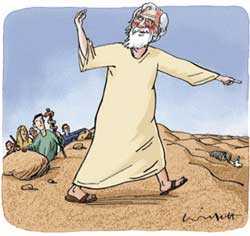
Some years ago, I asked various editors if they could provide me with examples of where journals had shown leadership. All the editors — except one — came up with examples. JAMA had led on promoting a tobacco-free society, preventing nuclear war, drawing attention to the plight of the uninsured in America, promoting the control of violence, and encouraging research into peer review. The New England Journal of Medicine had led by describing and deploring the industrialisation of medicine, encouraging health reform, and drawing attention to the importance of conflict of interest. The BMJ had led on fighting tobacco and improving the standard of statistics in medical journals. The Lancet had led with reducing the risk of nuclear war and encouraging the internationalisation of medicine. The Medical Journal of Australia had led with campaigns on smoking, promoting reform of the World Medical Association, AIDS awareness, Aboriginal health, and traffic safety. The Canadian Medical Association Journal had shown leadership by publishing a highly influential series of articles on critical appraisal of scientific papers.
One editor disagreed violently
The most interesting response came from Stephen Lock, my mentor and predecessor as Editor of the BMJ. He wrote:

There are no examples of where medical journals have led. Nor is it the journal’s role — which is to provide a forum for debate and to publish checked data. In fact, despite what editors say, I doubt whether any publication has done much leading — for instance, the Socialist landslide in [the British general election in] 1945 was probably due to the WEA [Worker’s Education Association] influence in the forces during the war rather than the Daily Mirror, while Ernest Hart’s [great editor of the BMJ in the 19th century, see below] successes owed more to the BMA parliamentary Bills Committee, and his numerous social contacts, than to the BMJ — and even Robbie Fox’s [great Lancet editor of the 20th century] often cited role in the introduction of the NHS was secondary to Moran’s [Lord Moran, Churchill’s doctor] leadership at the RCP [Royal College of Physicians] and in the Lord’s [House of Lords] debate.
Think of the contemporary issues — AIDS, health reform in the USA, and the current NHS debate — and you’ll realise how little influence the journals are having, can have, or should have.
What does follow-up tell us?
One advantage of having asked editors for examples of leadership several years ago is that it is possible to take a longer term look at whether they were examples of leadership. I deliberately did not define leadership for those editors, but my working definition of leadership by a journal is that it achieves a change that would not otherwise have happened.
Ironically, the best two examples of leadership from the list involve Stephen himself. Stephen, together with Drummond Rennie from JAMA and John Bailar, statistical adviser to The New England Journal of Medicine, played a central part in prompting the study of peer review. This process, which is fundamental to all of science not only in deciding which papers to publish but also in the giving of research grants, was largely unstudied until these three urged that it should be. There have now been five international congresses on peer review, and a body of research has been created. This has happened almost entirely within biomedicine, but its results are beginning to percolate into other areas of science. I cannot see that this would have happened without the leadership of Lock, Rennie, Bailar, and their journals.
Similarly, the work to improve the quality of statistical reporting was led by Lock and the BMJ, together with other journals. The Lancet published an important series on statistics by Austen Bradford Hill, the BMJ published a series called “Statistics at Square One” (which later as a book sold more than 100 000 copies), and Lock and other editors involved statisticians in the peer review process. Many studies showed that the standard of statistics in medical journals was woeful — it is now better (although still far from perfect). This has an importance way beyond journals themselves. Bad statistics means false conclusions. Doctors and patients were thus being misled.
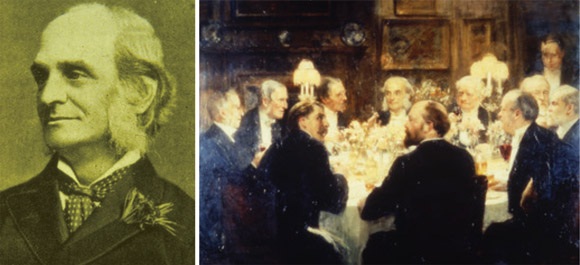
Ernest Hart, Editor of the BMJ, 18671898, made use of his extensive social contacts to promote the issue of child protection.
Can history furnish examples of journals leading?
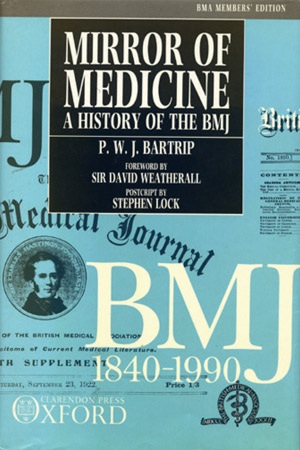
History can help us with trying to answer the question on whether journals can lead, and I want to examine a campaign of Ernest Hart, Editor of the BMJ from 1867 to 1898.1 Hart was a major public figure in a way that no BMJ editor has been before or since. He was highly controversial, believing that, “An editor needs, and must have, enemies; he can’t do without them. Woe be unto the journalist of whom all men say good things.”
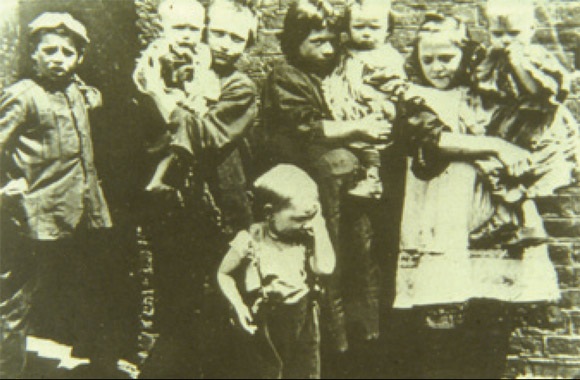
Hart tried to lead on many issues, but his most prominent campaign was against “baby farming” — giving infants (often bastards) to carers for money, knowing that the carers neglected and even murdered them. In Hart’s first year as editor, the journal carried a story on the inquest of four children who had all died under the care of the same “nurse”. The journal also published several leading articles on the subject. In 1868, Hart advertised in a newspaper as a father-to-be, offering money for adoption. He received 333 replies and identified Mrs X, who had seven malnourished infants living in her care in dreadful squalor. In the previous 2 years she had registered seven deaths of infants younger than 1 year. Articles in the journal led to questions in parliament. More cases were reported in 1870, and Hart formed with others the Infant Life Protection Society. He was also appointed chairman of the BMA’s Parliamentary Bills Committee in 1872. A bill was drafted and enacted in 1872. It proved to be a weak bill, and a much stronger bill was passed in 1877.
The problem was not solved. In 1896, Mrs Dyer of Reading was executed for strangling her charges and throwing them into the Thames. The BMJ published a six-part series on “baby farming and its evils”. The child protection movement grew enormously at this time, and the National Society for the Prevention of Cruelty to Children was founded in 1889.
Peter Bartrip in his history of the BMJ concludes: “The Journal did not singlehandedly cause the Infant Life Protection Act to be passed, but it undoubtedly exerted a powerful influence.”1 We can probably never separate out the role of the journal from broader influences, but journals seem to be good at putting issues onto the professional and public agenda.
Evidence from
media studies
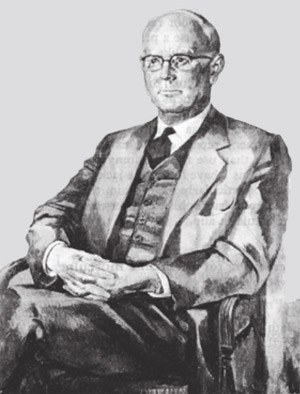
Hugh Clegg, Editor of the BMJ from 1947 to 1965 believed that: “A subject that needs reform should be kept before the public until it demands reform.”
The question of whether journals lead or follow is similar to the question of whether the mass media lead or follow, and some in the new discipline of “media studies” have addressed exactly this question. The story of Watergate is often cited as a classic case of the media leading people on what to think. It was in June 1972 that five men broke into the campaign headquarters of the Democratic Party. The incident received extensive publicity from The Washington Post, but initially there was little public interest. Yet the press kept on, and by April 1973, 90% of the American population knew the word “Watergate”. In 1974, President Nixon was forced from office.
Did the media depose the president? Clearly they did not do so alone, but they played a crucial role. Maxwell McCombs and Donald Shaw have developed the theory of “agenda setting”.2,3 This means that “We judge as important what the media judge as important.” Bernard Cohen, a political scientist from the University of Wisconsin, puts it this way: “The press may not be successful much of the time in telling people what to think, but it is stunningly successful in telling its readers what to think about.” This chimes with a saying of Hugh Clegg, Editor of the BMJ from 1947 to 1965: “A subject that needs reform should be kept before the public until it demands reform.”
McCombs and Shaw analysed the 1968 presidential race between Richard Nixon and Hubert Humphrey to see if they could work out whether the media were leading or reflecting public opinion.2 They looked at nine print and broadcast media used by Chapel Hill residents and ranked stories by position and length. They considered five major issues: foreign policy, law and order, fiscal policy, public welfare, and civil rights. They then looked at how undecided voters ranked these issues, and found that they ranked them exactly the same as the media.
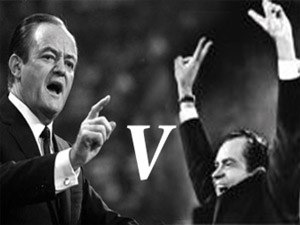
But which came first: the media agenda or the voters’ agenda? There have been subsequent studies, and the general finding is that the media interest comes first.3 Later work suggests that agenda setting works best when people are interested in a subject but uncertain about what to think.3 For example, I own a dog and hence am interested in animal experimentation, but I am very uncertain about what the risks and benefits might be.
Nobody, as far as I know, has conducted any studies like this with medical journals, but it might be that the findings can be generalised from the mass media to general medical journals. If so, journals can put issues on the agenda and do have some influence on how people think about them — a limited form of leadership.
Evidence from campaigning
Journals do sometimes consciously set out to lead, to make change happen. At the BMJ I was involved with campaigns to encourage explicit rather than implicit rationing of health care, promote an ethical code that could be used by everybody in health care, and revitalise academic medicine. All produced many fine words but none led to change. This may not be because journals cannot produce change, but because we did not conduct the programs well.
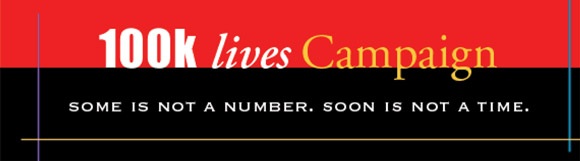
The Institute for Healthcare Improvement in the US is running a campaign to reduce unnecessary deaths in hospital, many the result of medical error. The campaign is called the “100 000 lives Campaign”, and its slogan is “Some is not a number. Soon is not a time.” (Box 1). Before launching the campaign, the institute studied political campaigns, and identified six essential features: platform, measurement, communication, field, funds, and values. The start is a clear, scientifically sound, highly developed platform or message. Measurement is essential to know if the campaign is succeeding, and communication must be constant, two-way, and involve many different media. Impact will depend on signing up many people and institutions (creating a field force), and the 100 000 lives Campaign has signed up some 2000 hospitals. Funds are essential, but so are explicit values; the values of the 100 000 lives Campaign include “all in” but “staying on message”.
I do not know of a medical journal that has campaigned so carefully, and perhaps a more important question than “Can journals lead?” is “What must they do to make change happen?”
Conclusion

My cautious conclusion is that journals can lead, in limited ways (Box 2). They might follow the example of the Institute for Healthcare Improvement and more effectively campaign, but their main contribution may be less to try and achieve precise reform and more to put issues firmly on the agenda. In my years at the BMJ, we tried to lead by promoting evidence-based medicine, encouraging doctors and patients to work in partnership, reminding the rich world constantly of its obligations to the poor world, battling against research misconduct, hastening the flow of information to the developing world, securing the independence of medicine from the pharmaceutical industry, and promoting patient safety. History will judge if we have had any success.
1 The 100 000 lives Campaign
A: The campaign poster
B: Locations of hospitals in the “100 000 lives Campaign”.
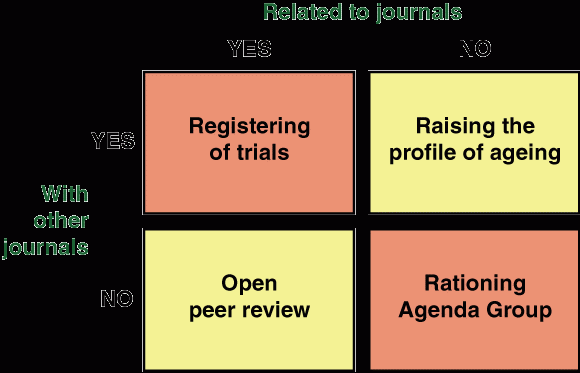
2 A hypothesis on factors that might influence the ability of medical journals to lead
One hypothesis, no more, is that journals will be most successful in leading when it is on a topic that is of direct concern to them and where they work together. The successful example shown is the registering of clinical trials. In contrast, the work of the rationing agenda group was not directly concerned with journals and involved only one journal: it failed.
Competing interests
Richard Smith was the Editor of the BMJ and the chief executive of the BMJ Publishing Group from 1991 to 2004. He is now a member of the board of the Public Library of Science.
References
- Bartrip PWJ. Mirror of medicine: a history of the BMJ. Oxford: British Medical Journal and Clarendon Press, 1990. 0_i1091630
- McCombs ME, Shaw DL. The agenda setting function of mass media. Public Opin Q 1972; 36: 176-187. 0_i1091632
- McCombs ME, Shaw DL. The evolution of agenda-setting research: twenty five years in the marketplace of ideas. J Commun 1993; 43: 58-67. 0_i1091634
Prisoner of war pathology in Changi, 1942–1945
Kate Ariotti, Elizabeth Roberts‐Pedersen
Should medical eponyms continue to be used in everyday practice?
Leya Nedumannil, Diana Lewis
100 years on: the first use of insulin in Australia
Sophie Templer
Reflections on the life and career of Professor Dame Valerie Beral AC DBE FRS FRCOG FMedSci (1943–2022)
Karen Canfell, Bette Liu, Emily Banks
The Honourable Dr Donald James Grimes AO
Michael Kirby, Patti Warn
From wipeout to drill out: a history of exostosis management and Australian surfing
Alon Taylor, Hannah North, Narinder P Singh, Paul A Fagan