




Volume 223 - Issue 2
No silver lining with health misinformation: argyria caused by intentional silver consumption
Authors: Luke Collins, Logesh Palanikumar and Stephen Bacchi
Med J Aust 2025; 223 (2): 68-70. || doi: 10.5694/mja2.52687
Published online: 21 July 2025
Published online: 21 July 2025
A 63-year-old man was brought to the emergency department after a fall with prolonged floor lie of two days, complicated by urinary retention and acute kidney injury, in the context of peripheral neuropathy
Clinical record
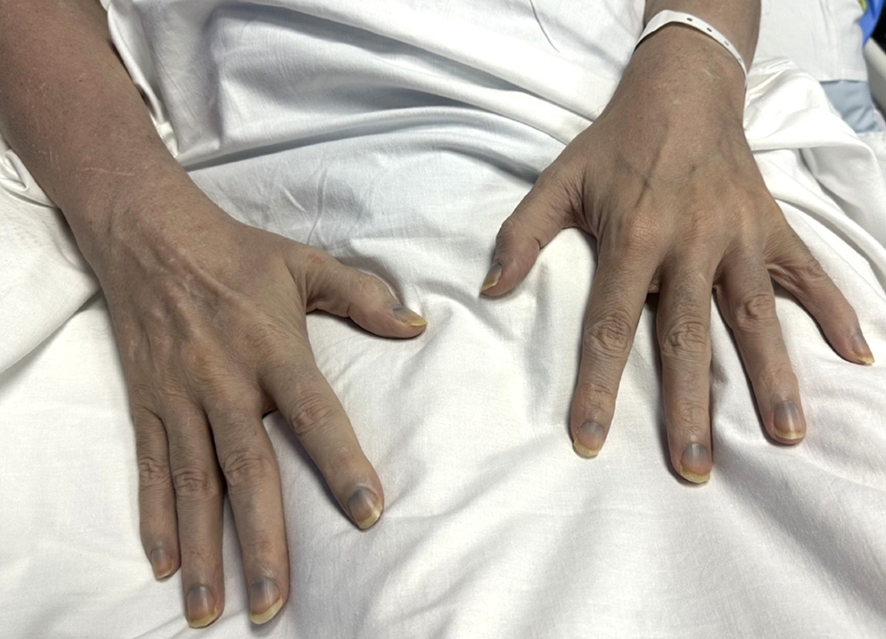
A 63‐year‐old man was brought to the emergency department after a fall with prolonged floor lie of two days, complicated by urinary retention and acute kidney injury, in the context of peripheral neuropathy. His medical history was limited to chronic fatigue syndrome, and he seldom sought medical care. He took no prescribed medications. Examination revealed blue‐grey skin discolouration, most prominent on the sun‐exposed areas of the face and neck. His fingernails showed grey pigmentation extending from the lunulae up the nail (Box 1). No other mucocutaneous abnormalities or organomegaly were noted.
Further discussion revealed that the patient had been using a homemade silver solution to treat a flu‐like illness during the coronavirus disease 2019 (COVID‐19) pandemic, as he had read online claims about the antiviral properties of silver. He stopped using the homemade solution after two months; however, he continued applying commercially available colloidal silver ointment to his legs for two years. He could not quantify his total silver consumption.
The peripheral neuropathy was attributed to type 2 diabetes mellitus, confirmed with elevated HbA1c levels; however, contribution from silver toxicity could not be excluded. Nerve conduction studies confirmed a length‐dependent axonal sensorimotor polyneuropathy. His renal function gradually normalised. Investigations revealed a serum silver concentration of 297nmol/L (reference interval, <3nmol/L) and 24‐hour urinary silver excretion of 227nmol/24h (reference interval, <15nmol/24h). A diagnosis of argyria was made clinically (see Box 2 for differential diagnosis). The patient declined a confirmatory skin biopsy. He was advised to discontinue silver use, and after two months of cessation, there was no noticeable change in skin discolouration. No additional complications of argyria were identified. He expressed a desire to resume silver use.
Discussion
Argyria is a rare but striking condition of skin pigmentation resulting from prolonged exposure to silver. Occupational silver exposure may occur in industries such as mining and jewellery‐making, although intentional consumption of colloidal silver has been an increasing concern.1,2,3 Silver accumulates in tissues, leading to characteristic blue‐grey discolouration, exacerbated by sunlight, which catalyses the reduction of silver salts and stimulates reactive melanocyte activity.1,2 Deposited silver granules are inert and not responsive to chelating agents.4,5 Although argyria is not life‐threatening, it is largely irreversible, and no highly efficacious treatment options exist.6 There is emerging evidence that laser therapy may be an effective treatment; however, it is unlikely to fully reverse discolouration.6 Affected individuals should be encouraged to stop using silver‐containing products and minimise sun exposure to prevent further aggravation of the condition. Other reported complications include renal, hepatic and neurological toxicity, although these are rare.2,3 Peripheral neuropathy has been linked to silver toxicity, although causality is usually difficult to establish.7 Case reports suggest that silver excretion can be prolonged, with elevated serum levels persisting for years after discontinuation.5
This case exemplifies the dangers of unverified health remedies, particularly when driven by internet misinformation. Public health crises, such as the COVID‐19 pandemic, foster an environment ripe for the spread of misinformation across internet platforms and social media.8,9 For many years, alternative therapies such as colloidal silver have been readily promoted online for their alleged health benefits despite lacking evidence of efficacy or safety.3 Colloidal silver products sold in major online retailers brazenly claim to eliminate bodily toxins and defend against viruses.3 False marketing claims and the widespread availability of silver products have raised concerns internationally, prompting regulatory agencies, including the United States Food and Drug Administration, to caution against their use.3
In Australia, over two‐thirds of the population report using alternative and complementary medicine products, with more than half failing to inform their health care providers.10 One in eight medicines is purchased without medical advice, while a comparable number are used based on recommendations from friends or media.11 The largest uptake of complementary medicines in Australia is among younger individuals under 35 years, who are tertiary‐educated and female‐identifying, although people with chronic diseases, including cancer and mental illness, also frequently use alternative therapies.10,12 Despite attempts to regulate herbal products by the Australian Register of Therapeutic Goods, these products are exempt from rigorous efficacy assessment and rely on manufacturer self‐evaluation. Previous review has highlighted significant non‐compliance with these regulations in terms of formulation and quality.12 Regulatory oversight does not extend to imported products for personal use. Unfortunately, this limited regulation may give a false sense of safety to consumers.
In an era where misinformation is widely and freely accessible, health care providers must be increasingly alert to the rising use of complementary and alternative medicines. Clinicians must stay proactive and informed in helping patients navigate the abundance of potentially harmful alternative therapies and be willing to foster open communication around their use and safety.
Lessons from practice
- Argyria is a rare but permanent condition caused by prolonged silver exposure, often linked to consumption of colloidal silver products.
- Early recognition of argyria and cessation of exposure is important to prevent further skin pigmentation or other complications.
- Complementary and alternative health remedies are widespread in Australia although patients may not immediately disclose their use.
- Health misinformation can have harmful consequences thus clinicians should engage patients in open communication about alternative medicines and advise them appropriately on the potential dangers.
Box 2 – Differential diagnosis of generalised argyria or skin discolouration
|
Condition |
Detail |
||||||||||||||
|
|
|||||||||||||||
|
Drug‐induced hyperpigmentation |
Often affects sun‐exposed skin. The following may cause blue‐grey discolouration: |
||||||||||||||
|
Diffuse melanosis cutis |
Progressive pigmentation over weeks to months, seen in metastatic melanoma4 |
||||||||||||||
|
Cyanosis |
Related to hypoxia or altered haemoglobin states as in methaemoglobinaemia13 |
||||||||||||||
|
Metabolic disorders (causative agent; skin change) |
|||||||||||||||
|
Other heavy metal exposures |
|||||||||||||||
|
|
|||||||||||||||
|
|
|||||||||||||||
Competing interests
Stephen Bacchi is supported by a Fulbright Scholarship.
Author contributions:
Collins L: Conceptualization, writing ‐ original draft, writing ‐ review and editing. Palanikumar L: Writing ‐ review and editing. Bacchi S: Writing ‐ review and editing, supervision.
Acknowledgements
Ethics approval was obtained from the Central Adelaide Local Health Network Human Research Ethics Committee (Reference number 20282).
References
- Chang ALS, Khosravi V, Egbert B. A case of argyria after colloidal silver ingestion. J Cutan Pathol 2006; 33: 809‐811.
- Brandt D, Park B, Hoang M, Jacobe HT. Argyria secondary to ingestion of homemade silver solution. J Am Acad Dermatol 2005; 53 Suppl 2: S105‐107.
- Griffith RD, Simmons BJ, Abyaneh MAY, et al. Colloidal silver: dangerous and readily available. JAMA Dermatol 2015; 151: 667‐668.
- Burns DA, Breathnach SM, Cox NH, Griffiths CEM. Rook's textbook of dermatology. 8th edition. New Jersey (USA): Wiley‐Blackwell, 2010.
- White JML, Powell AM, Brady K, Russell‐Jones R. Severe generalized argyria secondary to ingestion of colloidal silver protein. Clin Exp Dermatol 2003; 28: 254‐256.
- Griffith RD, Simmons BJ, Bray FN, et al. 1064 nm Q‐switched Nd: YAG laser for the treatment of argyria: a systematic review. J Eur Acad Dermatol Venereol 2015; 29: 2100‐2103.
- Naddaf E, Dyck PJ, Jannetto PJ. Peripheral neuropathy associated with silver toxicity. Neurology 2019; 92: 481‐483.
- Laato S, Islam AKMN, Islam MN, Whelan E. What drives unverified information sharing and cyberchondria during the COVID‐19 pandemic? Eur J Inf Syst 2020; 29: 288‐305.
- Marques MD, Douglas KM, Jolley D. Practical recommendations to communicate with patients about health‐related conspiracy theories. Med J Aust 2022; 216: 381‐384. https://www.mja.com.au/journal/2022/216/8/practical‐recommendations‐communicate‐patients‐about‐health‐related‐conspiracy
- Xue CCL, Zhang AL, Lin V, et al. Complementary and alternative medicine use in Australia: a national population‐based survey. J Altern Complement Med 2007; 13: 643‐650.
- Morgan TK, Williamson M, Pirotta M, et al. A national census of medicines use: a 24‐hour snapshot of Australians aged 50 years and older. Med J Aust 2012; 196: 50‐53. https://www.mja.com.au/journal/2012/196/1/national‐census‐medicines‐use‐24‐hour‐snapshot‐australians‐aged‐50‐years‐and
- Byard RW, Musgrave I, Maker G, Bunce M. What risks do herbal products pose to the Australian community? Med J Aust 2017; 206: 86‐90. https://www.mja.com.au/journal/2017/206/2/what‐risks‐do‐herbal‐products‐pose‐australian‐community
- Bracey NA, Zipursky JS, Juurlink DN. Argyria caused by chronic ingestion of silver. CMAJ 2018; 190: E139.
Provenance: Not commissioned; externally peer reviewed.
Designing Housing to Reduce Overcrowding-Related Harms: Rheumatic Heart Disease as the Canary in the Coal Mine
Simon Quilty, Veronica Matthews, Angus Baumann, James Marangou, Bo Remenyi, Gavin Wheaton, Serena Morton Nabanunga, Norman Frank Jupurrurla, Simon Robinson, Steve Mintern, Cary Duffield, Joshua R. Francis, Paul C. Memmott
Australian Climate Leadership in 2026: COP-Out or Step-Up for Health?
Catherine G. A. Pendrey, Angie Bone, Aletha Ward, Francis Nona, Michelle Isles, Paul M. Kelly, Nicholas J. Talley
The impact of the Breast Screen NSW transition from film to digital mammography, 2002–2016: a linked population health data analysis
Rachel Farber, Nehmat Houssami, Katy J L Bell
Shifting focus to adolescent wellbeing and inclusive participation in the digital age
Allyson R Todd, Elena Wang, Stephanie R Partridge
The CURE Asthma roadmap
Gary P Anderson, Anthony Flynn, Phil G Bardin, John D Blakey, Shyamali C Dharmage, Paul Foster, Peter G Gibson, Adam Jaffe, Alan James, Christine R Jenkins, Sundram Sivamalai, Peter D Sly, Guy B Marks, Vanessa M McDonald, Judy Wetttenhall
Protecting public interest journalism as a public health good
Bronwyn Fredericks, Neha Lalchandani, Melissa A Sweet, Alex Cramb, Carmel Williams