




Volume 183 - Issue 11
“The more I give, the more I receive”
Author: David Wilkinson
Med J Aust 2005; 183 (11): 659-661. || doi: 10.5694/j.1326-5377.2005.tb00071.x
Published online: 5 December 2005
Published online: 5 December 2005
Taking a risk and embracing opportunities may yield unexpected benefits
I didn’t really know back then why I had to go, but something within me was pushing, and so, I went.
I grew up in the United Kingdom and trained there in medicine. During my internship, I realised that I wanted to go to Africa for what were, then, a variety of ill-formed reasons. They included travel, adventure and an attraction to the notion of mission doctoring — doing “everything” while working in an underserved community. Without doubt I was, in part, naïve, but in 1987, straight after internship, I was on my way to Jane Furse Hospital in the black South African “homeland” of Lebowa, 3 hours’ drive north of Johannesburg. It was only later that I learned I had been employed after the other hospital doctors had left because of local violence.
Vignette 1: the changing colours of Africa
Awake. My first morning in Africa. The night before, my journey from the airport to the hospital had been a nightmare. In a decrepit truck, with companions who spoke no English. On rough roads, in a dense darkness the like of which I had never experienced before. It had taken hours and I had never felt more alien in my life.
The scene that next morning, as I wandered across the mission hospital campus, is etched in my mind. The very light itself was different. A cloudless blue sky. Deep red earth carpeted with purple flowers that had fallen from the jacaranda trees. The pinks, purples and reds of the bougainvillea. And, of course, the smiling black faces of the nurses contrasting with their radiantly white uniforms. Yes, this was where I needed to be.
I recall having said at my medical school interview that I wanted to do medicine because it offered me the opportunity to help people less fortunate than myself. I’m still not sure who cringed more — me, or the interviewer — but I did mean it. I enjoyed medical school and my internship in a district hospital in northern England, and had been accepted into a general practitioner training program in the Midlands. But first of all I was going to do a year in Africa.
Vignette 2: on practising “grass roots” medicine
Vusi was 22 years old and had been caught stealing. He was brought into our rural district hospital in poor shape, with a spear through his abdomen and lower chest — some punishment. However green I may have been, I was the only doctor available and so, with help from the nurses, I stabilised him in the emergency room before moving him, as quickly as possible, into theatre. I knew there were only two units of blood in the hospital that weekend. I intubated and anaesthetised him and handed over his care to the student nurse on duty. Then, scrubbed up and with a theatre nurse assisting, I opened his abdomen and repaired multiple small and large bowel lacerations and a liver tear. Vusi left hospital a week later and, in subsequent years, I was often greeted cheerfully by him as I moved around the village.
I had gone to Africa against the advice most teachers and mentors provided — “too risky”, “bad for your career” and “go later, do your training first”. But I went, and after a year I knew that if I wanted to make a real difference, to do something meaningful, to give, then I needed to stay. It seemed to me that those who only stayed for a year or two took more than they gave.
I stayed for 12 years and regret not a moment. I gained extraordinary clinical experience, as the workload was so high and we had so few doctors. Within 18 months of arriving, I recall noting that I had seen almost every fracture covered by my orthopaedics textbook — and had become adept at their conservative management. I gave of my limited clinical training and skills, and I received more in return by way of experience. By staying on, as I learned more and more I was able to give more. Always, I received yet more in return.
Vignette 3: from patients to protocols and programs
Mhlambe watched me, disinterested, with a dull, glassy stare. Eighteen months old but very underweight, he had all the stigma of kwashiorkor — peeling skin, oedema, and thinned red hair. He had the worst type of malnutrition, kwashiorkor plus marasmus. Malnutrition was our second most common paediatric problem (gastroenteritis was the most common). Mhlambe prompted me to develop an evidence-based protocol for the management of malnutrition in place of the previous ad hoc approach, and mortality rates fell as a result.1 A few weeks later, Mhlambe was discharged well and went on to be treated for tuberculosis through another newly developed community program. He finished treatment successfully and his mother became involved in a women’s group developing a vegetable garden and making crafts, helping to address the underlying cause of Mhlambe’s admission — poverty.
I spent most of my time at Hlabisa Hospital in KwaZulu-Natal, perched on top of a ridge looking down across the plains to massive forested sand dunes and the Indian Ocean coast. It was a 450-bed hospital with 10 000 annual admissions, serving a population of around 250 000. Usually we had about five doctors, sometimes up to around 10. At times, I was the only doctor available.
Vignette 4: evolving research
A lazy Saturday morning spent mulling over the events of the week. Obstetrics had been busy that week — I had done 15 caesarean sections, two vaginal breach deliveries and had successfully managed a shoulder dystocia. But I had also signed six stillbirth certificates on Friday. None of the bereaved mothers had been seen antemortem by a doctor and I could still hear their wailing. Something was not right.
I wandered over to the obstetrics ward and made a list, from the maternity register, of all the perinatal deaths I could find in the previous 3 months. Then, on to the medical records office where I could obtain and examine the records of these deaths. I estimated the perinatal mortality rate to be about 60 per 1000 (about 10 times higher than the best in the UK at that time). Most of the cases had never been seen by a doctor and it was obvious that at least a third were associated with an error or omission in care. Without knowing it, and with no training, I was doing some health systems research.
In response to my findings, I wrote some simple protocols, developed a training program for midwives and doctors in the hospital and village clinics, and visited all clinics monthly to implement the protocols and support the staff. I was doing public health medicine.
Within a few months, perinatal mortality was significantly down and hardly any deaths were classed as avoidable. Most importantly, we embedded the changes into routine practice, disseminated our results through publication, and helped others implement similar programs.2,3
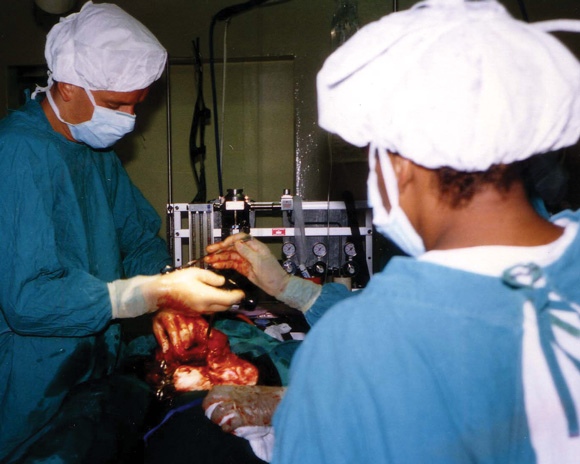
Completing one of the 2000 caesaean sections I did during my 12 years in Africa.
It soon became obvious to me that clinical services, although very necessary in this environment, were insufficient if the goal was improved population health outcomes. Organisation, systems, processes, an evidence-based and protocol-driven approach to care — all within a population health ethos — are crucial too. In reality, there is no divide and distinction between clinical medicine and public health; each feeds off and complements the other. As we organised and strengthened the clinical service, so we organised and strengthened the community services. We worked hard to integrate the hospital with the clinics, and so to develop a truly engaged service. We also worked hard on priority, high burden diseases such as tuberculosis,4-6 sexually transmitted infections and HIV/AIDS.
Vignette 5: engaging the community
Petros, thin as a rake, was coughing, bent over, almost retching with the effort. We saw hundreds of cases of tuberculosis each year; the incidence had risen dramatically as the prevalence of HIV increased. A simple audit showed that only about 20% of diagnosed TB cases could be shown to have completed the prescribed 8 months’ course of treatment. Clearly, the practice of 4 months’ hospital admission followed by 4 months’ treatment through the village clinics was not working. First, we adopted a shorter and simpler 6-month drug regimen with admission for only 2 weeks. Then we developed community-based, directly observed treatment using village clinics, with community health workers and a wide range of lay people as supervisors. Documented treatment completion rates rose to over 80%.4 The benefits of community participation included managing an ever-increased disease burden, at lower cost, and with much improved outcomes.6
I went to Africa on an impulse and against all advice. In all honesty, I considered that I was a risk and had very little to give. But I gave what I could — myself, my time, and my commitment. I received so much more in return — extraordinary clinical experience and skills, a deep appreciation of the importance of public health medicine, a range of opportunities to develop clinical, research, and leadership skills, and the privilege of meeting a wide range of fascinating people. Research based on my observations blossomed and, over time, I published more than 100 papers.
Seven years ago, I came to Australia as new opportunities and challenges presented themselves. Aspects of the transition were hard, while others were easy. My African experience certainly eased meeting the responsibilities of my appointment as Foundation Chair in Rural Health at the University of Adelaide, where I was instrumental in establishing the Department of Rural Health and the Rural Clinical School. There followed a stint in senior university management, and I am now preparing to take over as Head of the School of Medicine at the University of Queensland at the end of 2006. However, every 6 months I return to Africa to foster my ongoing research there, and for some reason it always feels like going home.
References
- Wilkinson D, Scrace M, Boyd N. Reduction in in-hospital mortality of children with malnutrition. J Trop Pediatr 1996; 42: 114-115. 0_CHDDBJHF
- Wilkinson D. Perinatal mortality: an intervention study. S Afr Med J 1991; 79: 552-553. 0_i1091580
- Wilkinson D. Reducing perinatal mortality in developing countries. Health Policy Plan 1997; 12: 161-165. 0_i1091583
- Wilkinson D. High-compliance tuberculosis treatment programme in a rural community. Lancet 1994; 343: 647-648. 0_i1091585
- Wilkinson D, Pillay M, Crump J, et al. Molecular epidemiology and transmission dynamics of Mycobacterium tuberculosis in rural Africa. Trop Med Int Health 1997; 2: 747-753.
- Floyd K, Wilkinson D, Gilks CF. Comparison of cost effectiveness of directly observed treatment (DOT) and conventionally delivered treatment for tuberculosis: experience from rural South Africa. BMJ 1997; 315: 1407-1411. 0_i1091588
Designing Housing to Reduce Overcrowding-Related Harms: Rheumatic Heart Disease as the Canary in the Coal Mine
Simon Quilty, Veronica Matthews, Angus Baumann, James Marangou, Bo Remenyi, Gavin Wheaton, Serena Morton Nabanunga, Norman Frank Jupurrurla, Simon Robinson, Steve Mintern, Cary Duffield, Joshua R. Francis, Paul C. Memmott
Australian Climate Leadership in 2026: COP-Out or Step-Up for Health?
Catherine G. A. Pendrey, Angie Bone, Aletha Ward, Francis Nona, Michelle Isles, Paul M. Kelly, Nicholas J. Talley
The impact of the Breast Screen NSW transition from film to digital mammography, 2002–2016: a linked population health data analysis
Rachel Farber, Nehmat Houssami, Katy J L Bell
Shifting focus to adolescent wellbeing and inclusive participation in the digital age
Allyson R Todd, Elena Wang, Stephanie R Partridge
The CURE Asthma roadmap
Gary P Anderson, Anthony Flynn, Phil G Bardin, John D Blakey, Shyamali C Dharmage, Paul Foster, Peter G Gibson, Adam Jaffe, Alan James, Christine R Jenkins, Sundram Sivamalai, Peter D Sly, Guy B Marks, Vanessa M McDonald, Judy Wetttenhall
Protecting public interest journalism as a public health good
Bronwyn Fredericks, Neha Lalchandani, Melissa A Sweet, Alex Cramb, Carmel Williams