





Volume 209 - Issue 11
Understanding the use of simulation in medical teaching
Author: Benjamin B Symon
Med J Aust 2018; 209 (11): 489. || doi: 10.5694/mja18.00188
Published online: 10 December 2018
Published online: 10 December 2018
Manual of simulation in healthcare, 2nd edition
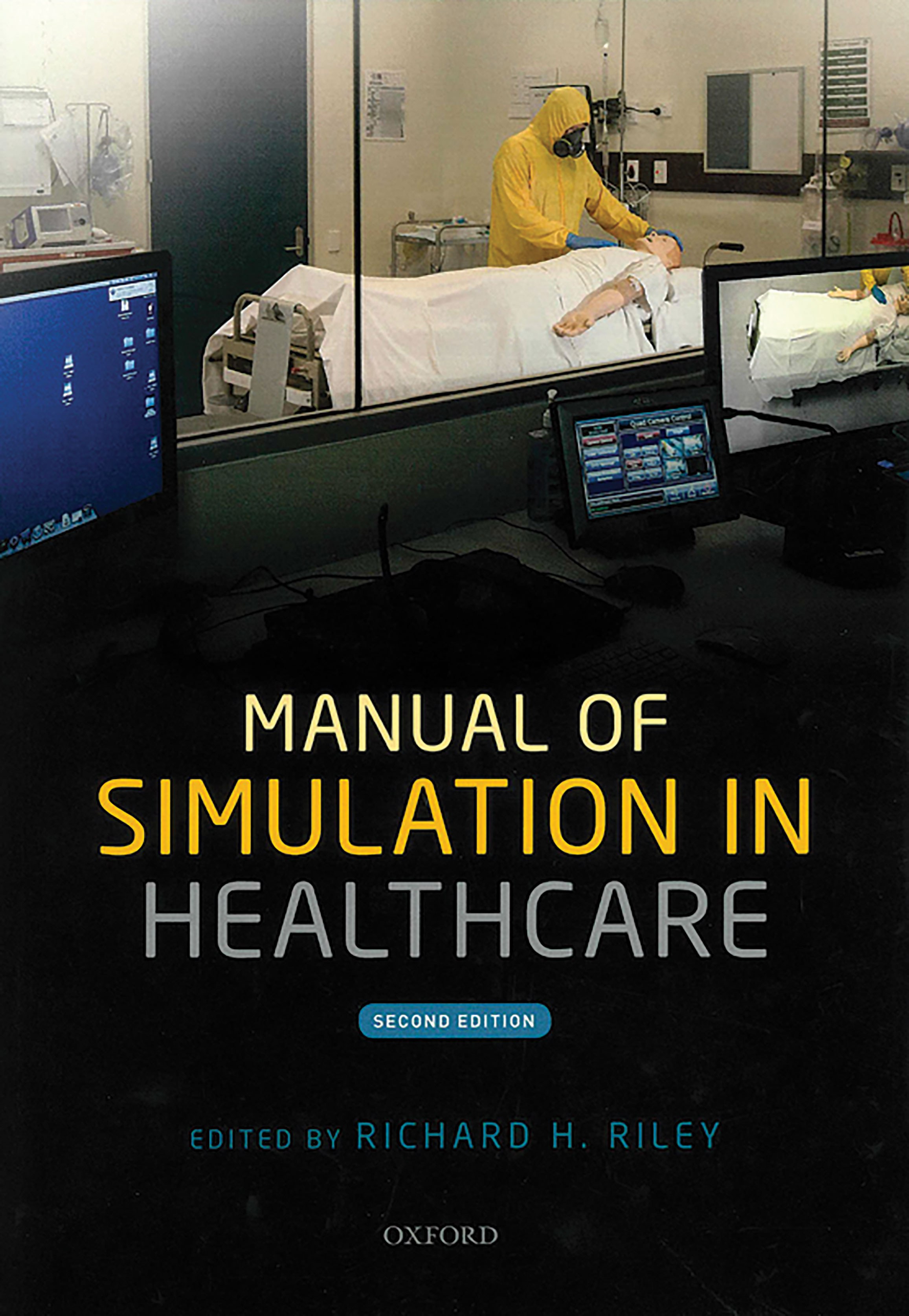
Manual of simulation in healthcare, 2nd edition. Riley RH, editor. Oxford University Press; 2015 (£61.00; 496 pp). ISBN: 9780198717621
The second edition of the Manual of simulation in healthcare, which provides a comprehensive understanding of the use of simulation teaching methodologies in the medical curricula, is an encyclopaedic guide to the educational theories, debriefing strategies and scenario design elements that underpin a successful simulation program.
Edited by Richard Riley and written by established international experts, including several from Australia and New Zealand, the context and concepts explored are relevant to an Australasian market.
The book explores a number of educational fields through the lens of simulation, and in doing so provides some eye-opening insights into the potential contributions that simulation can offer areas such as patient safety, problem-based learning, and research. Clinical educators will likely discover unexpected educational blind spots in their practice. The chapter on scenario design, for example, is a masterclass in embedding complex learning objectives organically into scenarios, while also harnessing the power of mastery learning and deliberate practice. In a similar fashion, the chapter “Research in simulation”, which provides wise insights into “consistent flaws in simulation-based educational research,” may equally make some of us wince in self-recognition.
The strength of Manual of simulation in healthcare lies in its ability to combine depth of theoretical knowledge with practical advice. Appendices are peppered with example scenarios and links to resources. The chapters devoted to subspecialties contain an exhaustive overview of the technology and equipment available to help the reader cover many highly specific procedural learning objectives.
While true of many textbooks written by a large conglomerate of authors, there is some repetition between chapters, particularly with regards to adult learning theory, the experiential learning cycle, and debriefing techniques. This repetition is perhaps more noticeable in an educational textbook than on one of a purely medical nature, in which knowledge boundaries are more clearly defined. This is not a problem if the reader wishes to pick and choose chapters of relevance to read to sharpen up on certain areas in simulation, but will likely be noticeable if a new simulation educator wishes to read the book from start to finish. As such, as in debriefing, much depends on the learner’s frame.
Competing interests
No relevant disclosures.
Using generative artificial intelligence in clinical practice: a narrative review and proposed agenda for implementation
Ian A Scott, Sandeep Reddy, Tanya Kelly, Tim Miller, Anton Vegt
The CURE Asthma roadmap
Gary P Anderson, Anthony Flynn, Phil G Bardin, John D Blakey, Shyamali C Dharmage, Paul Foster, Peter G Gibson, Adam Jaffe, Alan James, Christine R Jenkins, Sundram Sivamalai, Peter D Sly, Guy B Marks, Vanessa M McDonald, Judy Wetttenhall
CURE Asthma: a unique opportunity for Australia
Anthony Flynn, Wendy Edmondson, Alan James, Caroline Lodge, Vanessa M McDonald, Christine R Jenkins, John Blakey, Gary P Anderson
Evidence from Australian cohort studies about asthma trajectories and transitions across the life course: a narrative review
Caroline Lodge, Xin Dai, Ingrid A. Laing, Michael P Menden, Anthony Flynn, Gary P Anderson, Sarath Ranganathan, Shyamali C Dharmage
Technological advances in the search for a CURE for asthma
Sara Quon, Timothy M Johanson, Ridhima Wadhwa, Alen Faiz, Anthony Flynn, Gary P Anderson, Amanda J Cox, Nicholas P West, Michael P Menden, Rhys S Allan
Protecting public interest journalism as a public health good
Bronwyn Fredericks, Neha Lalchandani, Melissa A Sweet, Alex Cramb, Carmel Williams