




Volume 209 - Issue 11
Everything you need to know in one short book
Author: Caroline M de Costa
Med J Aust 2018; 209 (11): 488. || doi: 10.5694/mja18.01055
Published online: 10 December 2018
Published online: 10 December 2018
What it takes to be a doctor: an insider’s guide
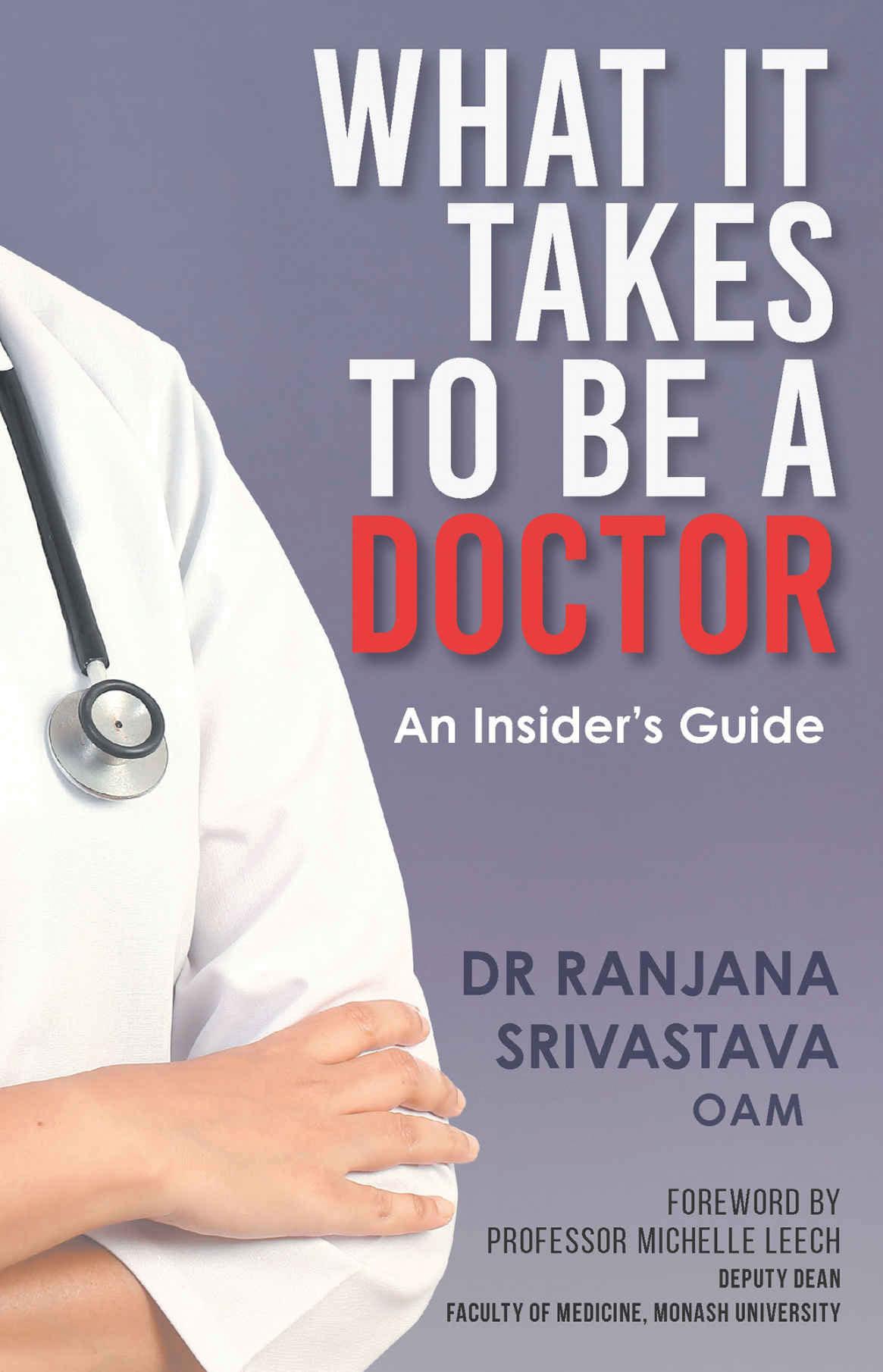
What it takes to be a doctor: an insider’s guide. Srivastav R, OAM. Simon and Schuster Australia, 2018 ($19.99; 144 pp). ISBN 9781925791730
In 1964, aged 17, I dropped out of first-year medicine in Sydney, unsure I wanted to be a doctor. In 1967, having worked and travelled, I dropped back in, and this time completed the course in the College of Surgeons in Dublin. So it was with this experience in mind that I embarked on oncologist Ranjana Srivastava’s short but highly readable account of “what it takes to be a doctor”, addressed exclusively to students considering applying for medicine and their parents.
In the clear prose familiar to all her readers in The Guardian, Srivastava asks students to examine why they aspire to study medicine (“my parents want it”, “I’ll be rich”, “I’ll save the world”…), explains the protracted processes and stringent criteria for entry to medical school, the years of study and exams, the harsh realities of medical practice (long hours, sadness, boredom, stress …), discusses specialisation and includes a chapter for parents of budding doctors. In particular, she urges would-be students to undertake relevant work experience while still at school, consider gap years, and find part-time jobs during their years as medical students, to widen their experience of the world outside medicine. This is all precious information that needs to be accessible to all students in high school or who have completed other degrees, in Australia but also elsewhere, and regardless of what they think they already know about the topic.
Recently, I gathered with my (somewhat diminished) class of 1973 in Dublin and we talked about the intervening 45 years. All of those present had pursued medical practice, in a variety of settings, throughout their careers. What’s more, everyone said they had, by and large, enjoyed their work, found it fulfilling and had no regrets about having chosen medicine. Srivastava too enjoys her work, and hopes that those of her readers who are accepted into medicine and do pursue a medical career feel contented in theirs. While her intended market is a very particular one, she has done a comprehensive job of describing “what it takes”; I recommend What it takes to be a doctor: an insider’s guide to everyone contemplating this career choice for themselves or their children. I would have appreciated it when I was 17.
Competing interests
No relevant disclosures.
Advancing Gender Equality in Australian Healthcare Leadership: Why National Targets Matter and What It Means for Healthcare Employers
Belinda Garth, Nicole Pope, Jenny Proimos, Helena J. Teede
Centring Aboriginal and Torres Strait Islander Voices: A Framework for Culturally Safe and Racism-Free Healthcare
Elissa Elvidge, Roianne West, Karen Nicholls, Kiara Harvey, Yeena Thompson, Geraint B. Rogers, Yin Paradies
Medical Colleges Have an Obligation to Ensure Full Participation in Clinical Quality Registries
Robert J. Aitken, Julian A. Smith, Guy J. Maddern
Medical Colleges Have an Obligation to Ensure Full Participation in Clinical Quality Registries
Thomas J. Hugh
Roadmap to Support International Medical Graduates for Satisfying Rural General Practice Careers: A Realist Evaluation Approach
Belinda G. O'Sullivan, Kim J. Omond, Neysan Sedaghat