




Volume 195 - Issue 11
Mushroom poisoning: a personal vignette
Author: Lindsay C Mollison
Med J Aust 2011; 195 (11): 720-721. || doi: 10.5694/mja11.10828
Published online: 12 December 2011
Published online: 12 December 2011
An inquisitive physician explores the effects of a poisonous mushroom first-hand
Illness from eating mushrooms is a worldwide phenomenon.1 In Australia, poisoning appears rare but deaths have occurred in recent years,2,3 perhaps partly due to the changing ethnic mix of the country to include cultures more comfortable with eating wild mushrooms despite knowledge of the risks involved.1
The usual outcome of eating a poisonous mushroom is gastrointestinal disturbance. This may be severe and can lead to death via dehydration and electrolyte changes; children, cats and dogs are particularly vulnerable.4
Here, I present my personal case, which illustrates the typical symptoms of poisoning due to Chlorophyllum molybdites.
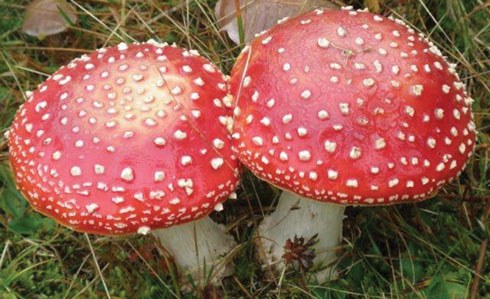
Amanita muscaria, another mushroom present in Australia, known for its hallucinogenic properties. Image kindly provided by Michael Egan.
Clinical record
I (a 53-year-old man of Anglo-Celtic-Saxon ancestry) observed a crop of mushrooms in a lawn in the Perth suburb of Wembley near dusk. Some were flat with a white top and underbelly (gills), with brown scales covering most of the top. I immediately recognised these as being inedible. However, nearby were several small button shaped mushrooms with pale cream tops, and pale white or pink under-surfaces. I picked some of these and examined them more closely indoors. As I became convinced that these were not related to the large inedible mushrooms nearby and believed they were typical button mushrooms, even though they did not have a brown underbelly, I tasted them. I had two small bites of about 5 g each from two mushrooms. The taste was sweet, nutty, typically mushroom-like, and indeed very pleasant.
I went on with normal activities, ate a normal evening meal (that did not contain mushrooms) and settled down for the evening.
About 2 hours after ingesting the mushrooms, I felt nauseated. I retired to bed and about 30 minutes later waves of nausea overtook me, and over the next 90 minutes, I vomited over 40 times in total. At this point, profuse watery diarrhoea also occurred and after the second bout of this I was overcome with intense sweating, and a feeling of impending syncope. Unable to move from the toilet for fear of blacking out, I lowered myself to the floor where I lay in a drenching sweat, feeling faint and with a self-measured pulse rate of 30 beats/min.
After some minutes, I gathered some strength and crawled through the house to the room of one of my children. She described me as extremely pale, drenched in sweat, and confused.
I was taken to the emergency department by ambulance. My heart rate was 56 beats/min and my blood pressure was 110/60 mmHg. An intravenous line was inserted (on the third attempt), and 4 L of fluid were given over 2 hours. A single dose of ondansetron was administered intravenously.
I had one further episode of diarrhoea and no further vomiting. Blood testing showed an elevated white cell count (15.1 × 10⁹/L; reference interval [RI], 4.0–11.0 × 10⁹/L) and a raised neutrophil count (13.9 × 10⁹/L; RI, 2.0–7.5 × 10⁹/L). Haemoglobin, urea, creatinine and bicarbonate levels and liver function tests were normal.
I recovered after fluid resuscitation and felt well enough to return home, although no urine was passed while in the emergency department. Subsequently, I noted no ill effects other than feeling a little tired the next day.
The mushroom
Initial attempts to identify the mushroom via the Western Australian Poisons Information Centre and various WA Government and university departments were unsuccessful due to lack of suitably qualified staff.
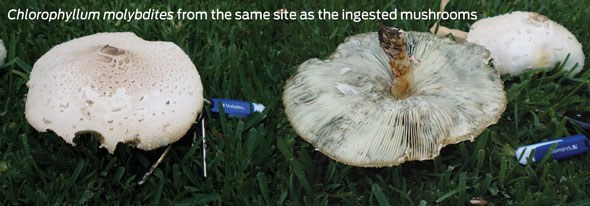
Extensive internet searching revealed a website with useful pictures of many of the local mushrooms,5 but further exploration of the eight or so that might have matched did not seem to yield features consistent with the ingested mushroom — remnants of which were still held, and relatives of which continued to grow at the same site (Box).
However, after several more days of observation it was clear that the small button mushrooms became the flat-topped cream, brown-scaled ones, and that later these grew quite large (up to 15 cm wide) and their gills became pale green (Box). This change allowed a definitive identification as C. molybdites, the green-gilled mushroom,5 with further confirmation coming from two experts (Neale Bougher, WA Department of Environment and Conservation, and Heino Lepp, Australian Government Department of Sustainability, Environment, Water, Population and Communities, personal communication).
Discussion
The green-gilled mushroom is the species responsible for most mushroom poisoning in the United States.6 It resembles an edible mushroom (Chlorophyllum brunneum — the common brown parasol), but the green gills are characteristic. The US has maintained a mushroom poisoning database for many years, but despite this epidemiological breakthrough, fewer than 2900 cases have been reported to it.
Several syndromes are associated with mushroom poisoning.6 The most common is similar to that associated with the green-gilled mushroom with gastrointestinal side effects, often with marked cramping abdominal pain and muscarinic effects. Heart rate may be raised or slowed, presumably depending on the balance of toxin and dehydration. Occasional deaths have been reported from ingestion of the green-gilled mushroom and other species that cause this syndrome.7 One death has been reported in Australia due to a muscarinic syndrome caused by a Rubinoboletus species, a large pink-brown mushroom with a wavy surface and white gills.8
The most dangerous ingestion is that associated with mushrooms that produce amatoxins, in particular Amanita phalloides (deathcap mushroom). These often produce minimal initial effects, but after a window of 24–48 hours, acute liver failure occurs and is often fatal. Worldwide, around 50% of ingestions of these mushrooms result in death. In the US, the mortality rate has fallen to around 10% with supportive care and liver transplantation.1,6 Unfortunately, these mushrooms were imported into Australia and are now established around Canberra, in some suburbs of Melbourne, and have also been reported in Adelaide.3 A cluster of cases including one death in Canberra was reported in the Journal in 2006.2 Other mushroom ingestion syndromes include predominantly cholinergic, hallucinogenic, glutaminergic or disulfiram-like reactions.4,9
The take-home message here is the cornerstone of all advice from all experts regarding the eating of wild mushrooms — namely, never eat any mushrooms with white gills nor any wild mushrooms, and even more simply — do not eat any mushrooms that you do not positively know.10
Competing interests
No relevant disclosures.
Acknowledgements
I thank Heino Lepp and Neale Bougher for their identification of the offending mushroom. Dr Bougher was the first to identify this mushroom in the local area.11
References
- Beug, M. An overview of mushroom poisonings in North America. The Mycophile 2004; 45 (2): 4-5. 0_CHDFCGFH
- Trim GM, Lepp H, Hall MJ, et al. Poisoning by Amanita phalloides (“deathcap”) mushrooms in the Australian Capital Territory. Med J Aust 1999; 171: 247-249. 0_CHDEHHBJ
- Lepp H, Fagg M. Deathcap mushroom. Amanita phalloides. Canberra: Australian Government Department of Environment and Water Resources, 2011. http://www.anbg.gov.au/fungi/deathcap.html (accessed Sep 2011).
- Benjamin DR. Gastrointestinal syndrome. In: Mushrooms: poisons and panaceas — a handbook for naturalists, mycologists and physicians. New York: WH Freeman and Company, 1995: 351-377. 0_i1115668
- Bougher NL. Fungi of the Perth region and beyond. Perth: Western Australian Naturalists’ Club, 2009. http://www.fungiperth.org.au/Fieldbook-all/Perth-Fungi-Field-Book.html (accessed Nov 2011).
- Beug MW, Shaw M, Cochran KW. Thirty-plus years of mushroom poisoning: summary of the approximately 2,000 reports in the NAMA case registry McIlvanea 2006; 16 (2): 47-68. 0_i1115672
- Volk T. Tom Volk’s fungus of the month for August 1999. La Crosse, Wis: Thomas J. Volk, University of Wisconsin-La Crosse, 1999. http://botit.botany.wisc.edu/toms_fungi/aug99.html (accessed Sep 2011).
- Pauli JL, Foot CL. Fatal muscarinic syndrome after eating wild mushrooms. Med J Aust 2005; 182: 294-295. 0_i1115676
- Barbato MP. Poisoning from accidental ingestion of mushrooms. Med J Aust 1993; 158: 842-847. 0_i1115678
- Hoffmann H, Bougher NL. Recognising edible field mushrooms. Garden note no. 4422, 2010. Perth: Western Australia Department of Agriculture and Food, 2010. 0_i1115680
- Bougher N. The poisonous green-gilled fungus Chlorophyllum molybdites in south Western Australia. Australian Mycologist 1999; 18: 60-62, 80. 0_i1115682
Gabapentinoid Poisoning Presentations to Victorian Emergency Departments: A 15-Year Trend Analysis
Bishaal Tej Gurung, Amy McNeilage, Angus Skeen, Tina Lam, Joanna F. Dipnall, Jane Hayman, Suzanne Nielsen, Ting Xia
Self-Poisoning With Prazosin and Its Off-Label Use in Australia, 2014–2024: Analysis of NSW Poisons Information Centre Data
Olivia B. E. Lal, Nicholas A. Buckley, Rose Cairns
The risk of death after hospitalisation following intentional self‐poisoning: a retrospective observational study (PAVLOVA‐2)
Firouzeh Noghrehchi, Nicholas A Buckley, Rose Cairns
The public health impacts of mining in Australia
Javier Cortes‐Ramirez, Ruby N Michael, Leisa‐Maree Toms, Melissa Haswell
No silver lining with health misinformation: argyria caused by intentional silver consumption
Luke Collins, Logesh Palanikumar, Stephen Bacchi
Hyperkalaemic cardiac arrest due to cream of tartar ingestion
Daniel Yee Lee Ng, Laksmi Govindasamy, Andrew Hughes, Hwee Min Lee