




Volume 194 - Issue 8
Breast cancer guide
Author: Elaine Arnold
Med J Aust 2011; 194 (8): 417. || doi: 10.5694/j.1326-5377.2011.tb03035.x
Published online: 18 April 2011
Published online: 18 April 2011
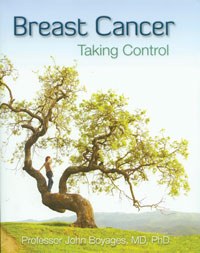
Breast cancer: taking control.
John Boyages. Sydney: Boycare Publishing, 2010. (367 pp, $39.99). ISBN 978098063111.
RIGHT FROM when you first pick up this book, it captures your attention — starting with a cover that pictures a delightful old tree supporting a woman gazing into the distance. The author, Professor John Boyages, an oncologist with nearly 30 years’ experience treating the disease, uses a gardening analogy to introduce a very tough subject.
His aim is to enable patients and their families to understand the experience of having a diagnosis of breast cancer and to take control of its management. Key information is explained in a direct and easy manner that addresses the anxiety and shock experienced in this situation.
Boyages takes the reader through the different parts of “the garden” and the decisions that need to be made for gaining the best outcomes. He continues to use the gardening metaphor to describe medical pathology and techniques, thus simplifying information that could otherwise be overwhelming.
The book has a practical design. Its 20 “control points”, or important steps or decisions, are divided into three parts according to the phases of treatment, and I felt like I was referring to a trusty roadmap or GPS (global positioning system) that would help me to reach my destination safely.
Colour coding the key control points as “red for stop”, “amber for caution” and “green for proceed with care” makes it easier for readers to understand the treatment options and decision-making process.
The use of real-life stories enables the reader to relate to these experiences.
All the explanations are evidence-based and well referenced, to help patients make informed choices.
Although this book is primarily for women and men diagnosed with breast cancer, and their families and friends, it is also a valuable resource for health professionals.
It is well illustrated and includes over 75 web links, 20 flowcharts and 96 figures, which make it an easy read.
I would recommend it to anyone involved with breast cancer or interested in learning more about it.
Sovereignty and Survival: Understanding Lung Cancer Outcomes for Aboriginal and Torres Strait Islander People in Australia, a Case–Control Study
Alice R. T. Bergin, Luc te Marvelde, Roger L. Milne, Benjamin J. Solomon, Kris Ivanova, Peter Savas, Stephen J. Luen, Jay Hamann, Andrea Casey, Nicole Watt, Sue M. Evans, Gail Garvey, Sherene Loi
The Changing Indications for Adult Liver Transplantation in Australia: A Narrative Review
Fadak Mohammadi, Alan J. Wigg, Ken Liu, Simone I. Strasser
Uneven Ground: Survival Differences Among Victorian Lung Cancer Patients by Location of Residence (2011–2023): A Retrospective Cohort Study
Evangeline Samuel, Eldho Paul, Mike Lloyd, Sanuki Tissera, Craig Underhill, Sagun Parakh, Phillip Parente, Inger Olesen, Javier Torres, Katharine See, Gavin M. Wright, David Langton, Thomas John, Matthew Conron, James Bartlett, Nicola Atkin, Nikolajs Zeps, Susan V. Harden, Wasek Faisal, John R. Zalcberg, Rob G. Stirling
Early-Onset Colorectal Cancer With Liver-Only Metastases: A Retrospective Cohort Study Integrating Prospectively Collected Real-World Clinical and Molecular Data From an Australian National Database (2009–2024) to Guide Treatment Planning
Savio G. Barreto, Christos S. Karapetis, Shahid Ullah, Matthew Burge, Susan Caird, Angus Campbell, Azim Jalali, Ross Jennens, Muhammad A. Khattak, Belinda Lee, Stephanie H. Lim, Shehara Mendis, Louise Nott, Timothy J. Price, Jeremy D. Shapiro, Jeanne Tie, Javier Torres, Colin Williams, Rachel Wong, Vanessa Wong, Peter Gibbs
Australian Pathways for Specialist Pain Management and Early Palliative Care for People With Pancreatic Cancer: Developed Using a Community Consensus Approach
Jennifer Philip, Melanie R. Lovell, Kylee Bellingham, Gail Garvey, Gregory B. Crawford, Nicole M. Rankin, Kara Burns, Isabel Young, Vivienne Milch, Dorothy Keefe, Katrina Anderson, James Lawson, Meinir Krishnasamy
Program Guidelines for the National Lung Cancer Screening Program: Targeted Lung Cancer Screening in High-Risk Individuals in Australia
Nicole M. Rankin, Rebecca Zosel, Lisa J. Whop, Raglan Maddox, Annette McWilliams, Miranda Siemienowicz, Jon Emery, Maria A. R. Lantin, Georgia Bartlett, Mikayla Wolfe, Abbey Diaz, Katrina Anderson, Lillian Liu, Cindy Toms, Sarah McDermott, Peter Bligh, Jeremy Chalke, Stephen Melsom, Claire E. Nightingale, Alison Brown, Sam Pope, Julia Brotherton, Anne Fidler, Michel Itel, Mark Brooke, Diane M. Pascoe, Fraser Brims, Tracy L. Leong, Emily Stone, Dorothy Keefe, Vivienne Milch