




Volume 184 - Issue 9
Salt of the earth
Author: Anthony J McMichael
Med J Aust 2006 || doi: 10.5694/j.1326-5377.2006.tb00306.x
Published online: 5 January 2005
Published online: 5 January 2005
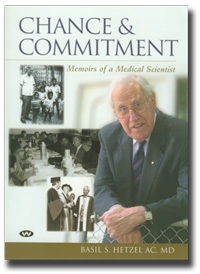
Chance and commitment. Memoirs of a medical scientist.
Basil S Hetzel. Adelaide: Wakefield Press, 2005 (xviii + 301 pp). ISBN 1 86254 686 7.
Central to this narrative is the authors 40-year commitment to elucidating iodine deficiency disorders (cretinism, neuromuscular disability and goitre), and pursuing worldwide remediation of this preventable scourge. The chance arose in the early 1960s when, as Reader in Medicine at Adelaide University, Hetzel reviewed a manuscript reporting goitre reduction by iodine supplementation of Papua New Guinea (PNG) adults. With his interest in hormones and stress physiology, Hetzels interest in iodine-dependent thyroid hormone duly heightened. His team undertook a trial in PNG that showed that pre-pregnancy iodine administration prevented cretinism.
Hetzel subsequently made two unorthodox career moves (for a clinician) first to the (Foundation) Chair of Social and Preventative Medicine at Monash University (19681976), and then to head the Commonwealth Scientific and Industrial Research Organisation (CSIRO) Division of Human Nutrition. These moves, fortuitously, facilitated further epidemiological and animal experimental studies of iodine deficiency disorders (IDD), respectively.
Commitment then became dominant. Hetzel helped establish the International Council for the Control of Iodine Deficiency Disorders (ICCIDD), and, in the late 1980s, as Executive Director of that body, persuaded the World Health Organization to support a program of IDD elimination via iodised salt. By centurys end widespread gains had been made.
With detailed recollections of family, friends and colleagues, Hetzel recounts his school days, university studies, early clinical research, stress-hormone research in New York and London, his work at Adelaide University, Monash University and the CSIRO, and, in retirement, along with his ICCIDD activities, his Deputy Governship of South Australia and Chancellorship of the University of South Australia. There were highs and lows: the death of his first wife, Helen; his subsequent marriage to Anne (and their travels together); and, along the way, many honours and tributes.
Basil Hetzels autobiography underscores how, with a little luck and risk-taking, much can be achieved via a mix of optimism, resilience, clarity of focus and commitment grounded in professional and religious conviction.
Anthony J McMichaelDirector, National Centre for Epidemiology and Population Health Australian National University, ACT
Prisoner of war pathology in Changi, 1942–1945
Kate Ariotti, Elizabeth Roberts‐Pedersen
Should medical eponyms continue to be used in everyday practice?
Leya Nedumannil, Diana Lewis
100 years on: the first use of insulin in Australia
Sophie Templer
Reflections on the life and career of Professor Dame Valerie Beral AC DBE FRS FRCOG FMedSci (1943–2022)
Karen Canfell, Bette Liu, Emily Banks
The Honourable Dr Donald James Grimes AO
Michael Kirby, Patti Warn
From wipeout to drill out: a history of exostosis management and Australian surfing
Alon Taylor, Hannah North, Narinder P Singh, Paul A Fagan