




Volume 184 - Issue 11
Tackling chronic disease in developing countries
Authors: Masoud Mirzaei and Stephen R Leeder
Med J Aust 2006 || doi: 10.5694/j.1326-5377.2006.tb00370.x
Published online: 8 May 2006
Published online: 8 May 2006
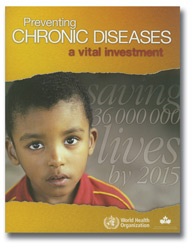
Preventing chronic diseases: a vital investment.
World Health Organization. Geneva: World Health Organization, 2005 (xiv + 182 pp). ISBN 92 4 156300 1.
Although health improvement is central to three of the eight United Nations Millennium Development Goals (MDGs) that seek to halve poverty by 2015, chronic diseases are not mentioned. This is epidemiologically way off beam and politically erratic.
This handsomely presented monograph produced by a World Health Organization team with Robert Beaglehole, an outstanding global health epidemiologist once from New Zealand but now in Geneva, as editor-in-chief, lifts the discussion about chronic disease by providing a practical approach to its prevention in developing countries.
The authors offer strategies to reduce annually projected chronic disease death rates by 2% between 2005 and 2015. This is audacious, but so are the MDGs, and so for the first time we have a goal to energise and manage our response to chronic disease.
The monograph provides a summary of the current and projected burden of chronic diseases, the urgent need for action, and a review of successful actions taken in controlling chronic diseases in less developed countries. A stepwise approach is proposed, similar to that produced by Ruth Bonita (also from NZ), and WHO colleagues for the evaluation of health gain programs more generally, as a guideline for ministries of health, beginning with core, moving on to expanded and then on to desirable actions. Each step is accompanied by milestones, which strengthen the proposed planning procedure.
The monograph departs dramatically from previous volumes about chronic diseases that, although lacking the bright cover, resembled the White Pages telephone directory in layout, tedious content and ability to inspire. Here instead are modern graphics, coloured and boxed stories of individuals struggling with chronic disease, and case studies of national success, bringing the challenge of chronic disease to life. This is done without recourse to tabloid sensationalism: the facts presented are sound and serious.
The WHO was beaten up many decades ago by organised medicine (from the United Kingdom and the United States especially) when it showed an interest in matters other than infectious disease taking business away from the lads in the white coats. Its recent efforts in tobacco control have been spectacular and exceptional but occurred at a high price to those involved, with American tobacco lobbies dealing heavy blows. Time for a change. Theres more to life and death than germs, and if this volume signals WHOs return to an interest in health as a whole, it is thrice welcome.
Masoud Mirzaei and Stephen R LeederAustralian Health Policy Institute, University of Sydney, NSW
Competing interests: Professor Stephen Leeder was one among a large panel of reviewers of drafts of the monograph.
Prisoner of war pathology in Changi, 1942–1945
Kate Ariotti, Elizabeth Roberts‐Pedersen
Should medical eponyms continue to be used in everyday practice?
Leya Nedumannil, Diana Lewis
100 years on: the first use of insulin in Australia
Sophie Templer
Reflections on the life and career of Professor Dame Valerie Beral AC DBE FRS FRCOG FMedSci (1943–2022)
Karen Canfell, Bette Liu, Emily Banks
The Honourable Dr Donald James Grimes AO
Michael Kirby, Patti Warn
From wipeout to drill out: a history of exostosis management and Australian surfing
Alon Taylor, Hannah North, Narinder P Singh, Paul A Fagan