




Volume 181 - Issue 11
A two-year placement in the Solomon Islands
Author: Rosalie Schultz
Med J Aust 2004; 181 (11): 604-605. || doi: 10.5694/j.1326-5377.2004.tb06481.x
Published online: 6 December 2004
Published online: 6 December 2004
I wanted to work somewhere exotic, experience a different lifestyle and contribute to health advancement in a developing country. So I was delighted when Australian Volunteers International offered both me and my partner, also a doctor, a 2-year placement (February 2002 to February 2004) in Makira Province, previously the Eastern Solomon Islands.
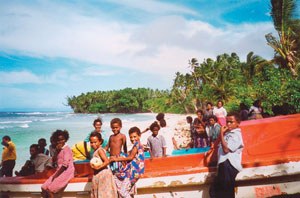
Life in the Solomon Islands
The Solomon Islands have a subsistence agricultural economy. Of a population of 450 000, 85% live self-sufficient lifestyles involving small-scale farming, fishing, fetching water, cooking on wood fires, building and weaving. Outside events, even major ones like terrorist attacks, seem far away.
Life on fertile volcanic soil surrounded by the Pacific Ocean maintains Solomon Islanders in good health. They work hard physically and enjoy a diet rich in fruit, vegetables and fish. However, they increasingly seek to supplement their traditional diet with rice, flour, canned meats and instant noodles.
Healthcare in Makira Province
The major causes of death in the Solomon Islands are infectious diseases and perinatal conditions.1,2 HIV/AIDS has not yet had a significant impact there.1
Makira Province, with 33 000 people, had no doctor working either when we arrived or when we left. Kirakira, the provincial capital, has a small hospital with 86 beds — plenty for patients, with spare beds for relatives. Coping with the hospital’s unreliable medication supply was a challenge — sometimes it was well resourced, while at other times we struggled to manage, using the most suitable medication available at the time. People suffered for want of paracetamol, and died for want of oxygen. Nurses helped us manage patients with malaria, tuberculosis and congenital syphilis, as they knew more about managing these conditions than we did. The most common diagnoses of the 2322 patients admitted during our stay are shown in the Box. There is a national referral hospital in the capital, Honiara, where we could refer patients we were unable to manage in Kirakira.
Together with specialist eye, reproductive health and tuberculosis/leprosy nurses, I established a program of touring the 34 clinics in the province to provide support to clinic staff and treat patients. Most clinics are in coastal villages, accessible by aluminium dinghy and outboard motor. As the villages may see no shipping for months, people must be totally self-sufficient. Clinic nurses manage most cases of malaria, pneumonia and gastroenteritis that are not managed at home. Under national policy, every village should be within 3 hours’ walk of a clinic, but the country’s economic situation has not enabled this policy to be fully implemented. Nevertheless, the patients I saw while touring were in remarkably good health. Common referrals to me were for back pain, hip pain, and dysmenorrhoea. It was difficult to advise the staff in the clinics that had no supplies and no means to transport patients. Australia is currently funding the purchase of solar-powered two-way radios for each clinic (radios must be solar-powered because supplies of consumables are unreliable).
Trauma and related infections
Skin and soft tissue infections, abscesses, joint and bone infections, and pyomyositis were common in Makira. These infections may be occupational hazards of subsistence farming, but young children and even neonates were affected. We drained copious amounts of pus under ketamine anaesthesia, but, unfortunately, we often had no suitable antibiotic treatment. We treated many cases, including osteomyelitis and septic arthritis, with oral doxycycline, erythromycin or chloramphenicol.
There were about 12 motor vehicles in Kirakira, and the first-ever motor vehicle accident happened during our stay. A passenger in a utility tray was crushed against another vehicle. He fractured seven ribs on one side and nine on the other. We had no intercostal catheters to manage the haemopneumothorax, no intubation facilities, and no resources to evacuate him. Yet, amazingly, he survived with analgesia, oxygen, intravenous fluids and basic physiotherapy (“Hold your chest and blow hard!”). His high level of physical fitness, as a subsistence farmer, most likely saved his life.
Non-communicable diseases
Non-communicable diet- and lifestyle-related diseases that are major causes of morbidity and mortality in Australia are only beginning to reach rural Solomon Islanders. We saw mouth cancers among betel-nut chewers, and liver and cervical cancers. Diabetes manifests with peripheral vascular disease, and hypertension with stroke. No myocardial ischaemia was diagnosed during our stay.
Challenges and rewards
The general standard of health and health services, despite the country’s economic difficulties, highlights the fine personal qualities of the people. Nurses continued working during periods when they were not paid. I recall one nurse who visited the hospital on a day when she was off duty. Noting that no nurses were working, she went home, put on her uniform, and returned to cover the day’s shift.
As there was no stationery provided for health services, people carried exercise books for their health records. Patient-held records provide continuity of care from village health workers to visiting overseas specialists, and also give patients ready access to the information.3
We spent a memorable 2 years in the Solomon Islands, proving to me that overseas volunteer work is enriching and rewarding. It provides an opportunity to support colleagues in countries where healthcare staff are difficult to recruit and retain.
Common diagnoses of patients admitted to Kirakira Hospital (excluding admissions for childbirth), Jan 2002–Dec 2003
Discharge diagnosis* |
Infants |
Children 1–5 years |
Children 5–15 years |
Adults |
Total |
||||||||||
Malaria |
45 |
77 |
81 |
336 |
539 |
||||||||||
Skin infections, abscesses, cellulitis, carbuncles, impetigo |
12 |
37 |
32 |
129 |
210 |
||||||||||
Trauma |
0 |
9 |
37 |
82 |
128 |
||||||||||
Pneumonia |
48 |
29 |
9 |
27 |
113 |
||||||||||
Gastroenteritis |
11 |
17 |
0 |
13 |
41 |
||||||||||
Osteomyelitis, pyomyositis, septic arthritis |
0 |
3 |
13 |
21 |
37 |
||||||||||
Tuberculosis |
2 |
1 |
3 |
17 |
23 |
||||||||||
Cancer |
1 |
0 |
0 |
19 |
20 |
||||||||||
* Not mutually exclusive. |
|
|
|
|
|
||||||||||
References
- Government of Solomon Islands. Solomon Islands: Human Development Report 2002. Building a nation. Volume 1: Main report. Windsor, Queensland: Mark Otter Publications, 2002. i1085758
- World Health Organization. The World Health Report 2002: reducing risks, promoting healthy life. Geneva: WHO, 2002. i1085760
- World Health Organization. Home-based maternal records: guidelines for development, adaptation and evaluation. Geneva: WHO, 1994. CHDBCGBF
Dousing the burning inequity of global warming for people experiencing homelessness
Timothy English, Alejandro Vásquez Hernández, Glenn Miller, Nuala Fogarty, Charles Cosgrove, Paul Rosenthal, Matthew Larkin, Jon Swain, Danielle Austin, Jo River
The contribution of evidence‐based practice and the practice‐based evidence approaches to contemporary Australian psychology: implications for culturally safe practice
Paul Gray (Wiradjuri), Dawn Darlaston‐Jones, Pat Dudgeon AM (Bardi), Kate Derry, Joanna Alexi, William Smith (Wiradjuri and Wemba Wemba), Tanja Hirvonen (Jaru and Bunuba), David Badcock, Shraddha Kashyap, Belle Selkirk (Noongar)
Explaining risk in chronic conditions: the Yolŋu science of signs
Emma Haynes, Alison Mitchell, Minitja Marawili (Yolŋu), Dawn C Bessarab (Bardi)
Is it time to retire the label “CALD” in public health research and practice?
Sabine Allida, Della Maneze
What do Aboriginal people in the Northern Territory value during the operation journey? A qualitative study
Edith B Waugh, Marita Hefler, Sophie Pascoe, Mark Mayo, Matthew JL Hare, David A Story, Neil Wilkshire, Peter Henwood, David Croker, Jampijinpa Ross
Fulfilling First Nations health, cultural safety and equity accreditation standards in primary medical education: reflections from a First Nations desktop review team
Paul Saunders, Nicole Mercer, Maria Mackay, Ian Lee, Madelyne Hudson‐Buhagiar, Miriam Cavanagh, Emma Milliss, Melody Muscat, Kathleen Martin, Adam Shipp, Melissa Johnson, Belinda Gibb