




Medical education
Lessons from practice
Volume 215 - Issue 11
Pill aspiration: an under‐recognised clinical entity
Authors: Elliot T Bowden, Paul Smith and Karen M Dwyer
Med J Aust 2021; 215 (11): 505-506. || doi: 10.5694/mja2.51337
Published online: 13 December 2021
Published online: 13 December 2021
An 85-year-old man with a history of type 2 diabetes, vascular disease and chronic kidney disease awoke with central sharp pleuritic pain radiating through to his back
Clinical record
An 85‐year‐old man with a history of type 2 diabetes, vascular disease and chronic kidney disease awoke with central sharp pleuritic pain radiating through to his back. He had been otherwise well leading up to this presentation. On examination, he had a temperature of 37.9°C, tachypnoea (respiratory rate, 25–30 breaths per minute), shallow breathing, and oxygen saturation of 88% on room air. Auscultation of his chest revealed vesicular breath sounds throughout both lung fields. Investigations showed a total white cell count of 16.6 × 10⁹/L (reference interval, 4.0–11.0 × 10⁹/L) and a C‐reactive protein level of 26 mg/L (reference interval, < 5mg/L). Chest x‐rays were unrevealing (Supporting Information). Differential diagnoses of pulmonary emboli, pulmonary sepsis and aortic dissection were considered. Computed tomography pulmonary angiography revealed a foreign body in the inferior portion of the right bronchus intermedius with the features of a pill (Box). On specific questioning, the patient reported having difficulties swallowing metformin the previous night, which was part of his therapeutic regimen for diabetes, although he did not report choking or coughing. Unfortunately, the patient suffered an unrelated fatal stroke before undergoing his planned bronchoscopy.
Discussion
Medicinal pills are estimated to constitute 7% of foreign body aspirations.1 Diagnosis can be difficult and pill aspiration is likely an under‐recognised clinical entity, as recollection of an aspiration event is variable, with only half of adult patients providing a clear history of such an event.2
Patients may have variable presentations owing to the different mechanisms through which the airways are affected following aspiration of a pill. The history may range from the classic acute episode of a choking sensation followed by cough, wheeze and unilateral decreased air entry resulting from airway obstruction, to a more chronic picture similar to asthma as a consequence of the aspirated pill dissolving within the bronchial mucosa with secondary airway injury.2,3,4 An intractable cough is another potential presentation.5 Pills may not be evident on chest x‐ray due to varying degrees of radiolucency, and a high index of suspicion is therefore required if a patient reports a history that could align with pill aspiration.
The inflammatory reaction caused by a pill when aspirated is dependent on its chemical composition. Much of the literature focuses on iron supplements, which incite a specific and well documented aspiration syndrome involving airway inflammation and histological iron deposits within bronchial biopsies. Metformin, thought to be the offending tablet in this case, may cause severe airway inflammation and recurrent obstruction due to concentric necrotic material within the affected bronchus.3 However, accurately predicting the consequences of untreated pill aspiration is difficult because of the vast array of medications available and individual chemical composition.
When approaching a case of potential pill aspiration, early bronchoscopy and pill removal are key to avoiding long term sequelae.1,2,4,5 If airway injury has occurred, the focus should shift to maintaining airway patency. This may require ongoing bronchoscopic surveillance, and interventions such as balloon dilatation. Some patients with more severe airway injury will require surgical interventions such as lobectomy or pneumonectomy.
Lessons from practice
- Pill aspiration is relatively common and under‐recognised. Clinicians should be mindful of this entity when caring for patients who are at high risk of aspiration.
- Clinical presentation is variable and chest x‐rays may be unrevealing. Clinicians require a high degree of suspicion, and early bronchoscopy is the best method of evaluation.
- Management includes the early removal of the pill via bronchoscopy. Clinicians should be aware of secondary airway inflammation and stenosis leading to long term morbidity, occasionally requiring surgical intervention.
Box – Contrast‐enhanced computed tomography pulmonary angiography of the chest
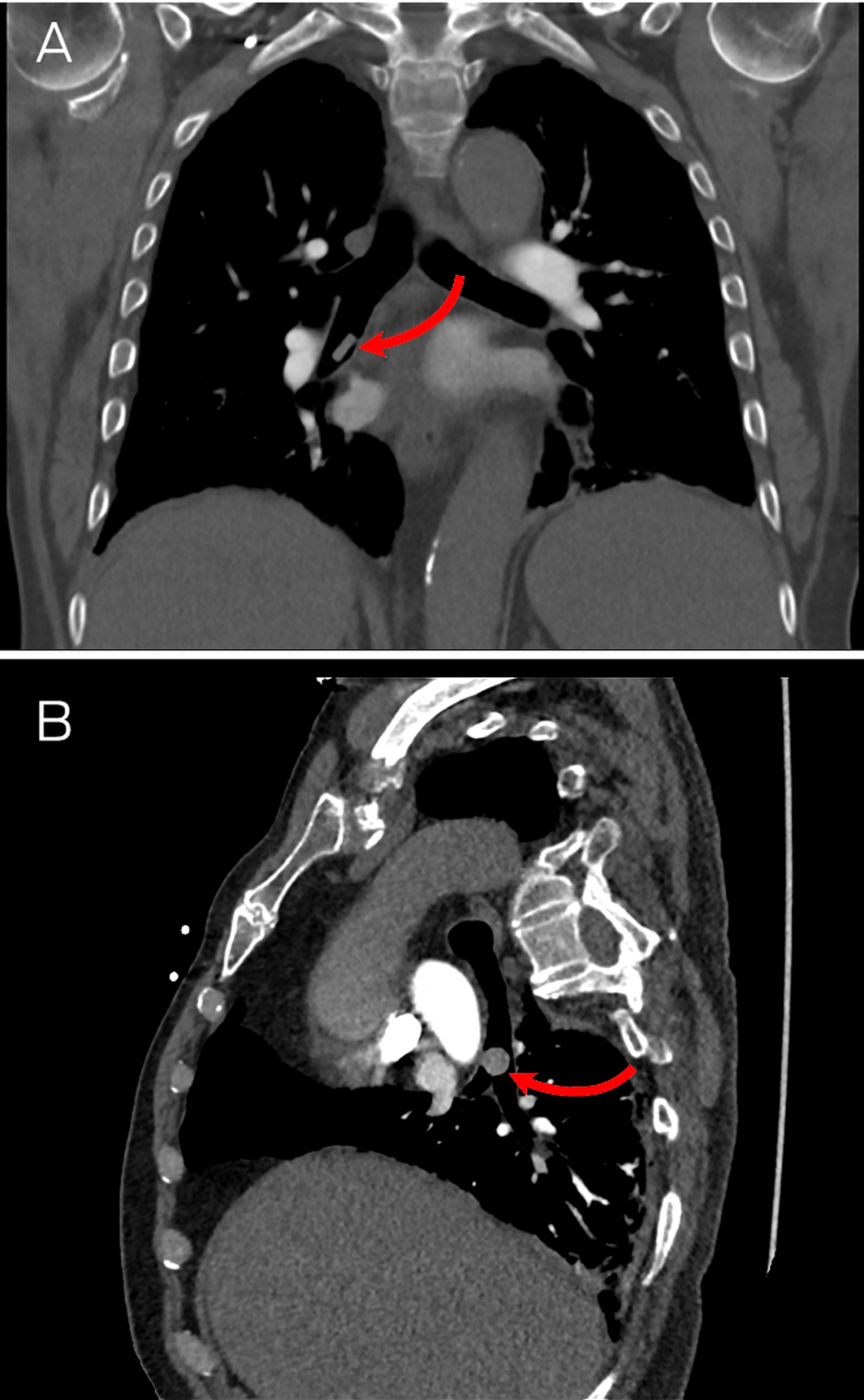
A: Coronal view, showing linear density within the right bronchus intermedius (arrow), suggestive of an inhaled foreign body with incomplete obstruction. No pulmonary embolus was identified. B: Sagittal curved reformat, showing that the abnormal density was also round and greater than that of the surrounding airways.
Competing interests
No relevant disclosures.
References
- Mehta AC, Khemasuwan D. A foreign body of a different kind: pill aspiration. Ann Thorac Med 2014; 9: 1–2.
- Mickelson J, O’Shea Paudel EE, Oliveira PJ. Pill aspiration: metformin induced bronchial stenosis masquerading as asthma. Am J Resp Crit Care Med 2019; 199: A4685.
- Küpeli E, Khemasuwan D, Lee P, Mehta AC. “Pills” and the air passages. Chest 2013; 144: 651–660.
- Kinsey CM, Folch E, Majid A, Channick CL. Evaluation and management of pill aspiration: case discussion and review of the literature. Chest 2013; 143: 1791–1795.
- Hewlett JC, Rickman OB, Lentz RJ, et al. Foreign body aspiration in adult airways: therapeutic approach. J Thorac Dis 2017; 9: 3398–3409.
Provenance: Not commissioned; externally peer reviewed.
Rapid Growth in Diagnostic CT Knee Imaging in Australia: Implications for Imaging Stewardship
Hanwen Chen, Rachelle Buchbinder, Sean Docking, Ian A Harris
Disease‐specific survival for people with chronic myeloid leukaemia, South Australia, 1980–2020: a retrospective cohort study
Kerri Beckmann, Brendon J Kearney, Naranie Shanmuganathan, David Yeung, Tim Hughes
Technological advances in the search for a CURE for asthma
Sara Quon, Timothy M Johanson, Ridhima Wadhwa, Alen Faiz, Anthony Flynn, Gary P Anderson, Amanda J Cox, Nicholas P West, Michael P Menden, Rhys S Allan
Who gets asthma, and why?
Denby J Evans, Peter D Sly, Paul Foster, Chantal Donovan
The first Australian evidence‐based guidelines on male infertility
Darren J Katz, Liza O’Donnell, Robert I McLachlan, Tim J Moss, Clare V Boothroyd, Veena Jayadev, Sarah R Catford
Sex differences in management and outcomes of people with ST‐elevation myocardial infarction, New South Wales, 2011–2020: a retrospective cohort study
Samia Kazi, Simone Marschner, Haeri Min, Desi Quintans, James JH Chong, Ehsan Khan, David B Brieger, Clara K Chow