




Volume 214 - Issue 2
We need a model of health and aged care services that adequately supports Australians with dementia
Author: NHMRC National Institute for Dementia Research Special Interest Group in Rehabilitation and Dementia
Med J Aust 2021; 214 (2): 66-68.e1. || doi: 10.5694/mja2.50911
Published online: 1 February 2021
Published online: 1 February 2021
Australian services for people with dementia are fragmented, challenging to navigate and hard to access
The coronavirus disease 2019 (COVID‐19) pandemic has led to reflections around reforming Australia’s health care system.1 In view of future reforms, this article is intended to provoke policy and clinical discussion regarding what an effective, efficient model of service delivery meeting the needs of people with dementia and their families may look like. The opinion presented here belongs to the members of the National Health and Medical Research Council (NHMRC) National Institute for Dementia Research Special Interest Group in Rehabilitation and Dementia.
For the purposes of this article, we define a model of service delivery as the systemic framework through which services are organised, accessed, funded and delivered.
Services in Australia for people with dementia are inadequate
Dementia is the leading cause of disability, the second leading cause of death in Australians aged over 65 years, and the leading cause of death in women in Australia. In 2020, it is estimated that Australia will spend $8.1 billion on health care and $3.8 billion on social services for people with dementia, with a further $6.1 billion in lost productivity and earnings.2
Australian services for people with dementia are often fragmented, challenging to navigate and hard to access.3 It can be difficult for people with dementia to obtain a diagnosis, there are limited health and social services for early dementia, including post‐diagnostic support, and existing services are often poorly coordinated.3,4 Services face workforce shortages and gaps in worker knowledge and skills related to dementia.5
People with dementia and their care partners have called for support and information after diagnosis; flexibly delivered services that support their quality of life, including meaningful activity; and inclusion in decision making.6 A philosophical and societal shift in thinking is required: from provision of care to enablement, where people living with dementia are empowered to continue to direct their own lives.7
We are not meeting the human rights of people with dementia to health care
Australia does not currently meet the human rights of people with dementia to timely and accessible health services of appropriate quality or to participation in health care decisions.4,6 The right to quality health care is affected by the variable delivery of best‐practice dementia care by memory clinics,8 acute hospitals,9 primary care,10 and community and residential aged care,11 perhaps because the role of each of these is unclear.
Australia’s systems and context
Australia has a long‐standing commitment to a universal health system and to long term care for older people. The health and aged care systems were developed largely in isolation from one another and have failed to resolve conflicts around medical and social models of care for older people. Health care systems are slowly adapting to this era of chronic disease and population ageing,12 but person‐centredness and integration within and across acute, primary, community and residential aged care systems remain a challenge.11
Principles underpinning models of service delivery for Australians with dementia
Members of our group reviewed principles underpinning services such as the Department of Health Aged Care Sector and the Council of Australian Governments National Disability Insurance Scheme. 13,14 We reached a consensus that the following principles should apply to models of service delivery for dementia that:
- has an overarching objective to maintain positive health and wellbeing of people with dementia, their care partners and families;
- recognises dementia as a disability, consistent with the World Health Organization Convention on the Rights of Persons with Disabilities, and promotes autonomy, social participation and rehabilitation;
- takes into account the cognitive disability of people with dementia in accessing support and being a partner (along with their families) in planning care through supported decision making;
- is delivered by a multidisciplinary workforce who have knowledge and skills around dementia;
- is accessible for all people with dementia and care partners;
- is ongoing, cost‐effective and economically sustainable;
- is needs‐based, not capped according to central budgets;
- is integrated for seamless experience for people with dementia and care partners, within and across primary, acute and subacute health care, aged care and social services; and
- is evidence‐based.
Review of possible models of service delivery for dementia
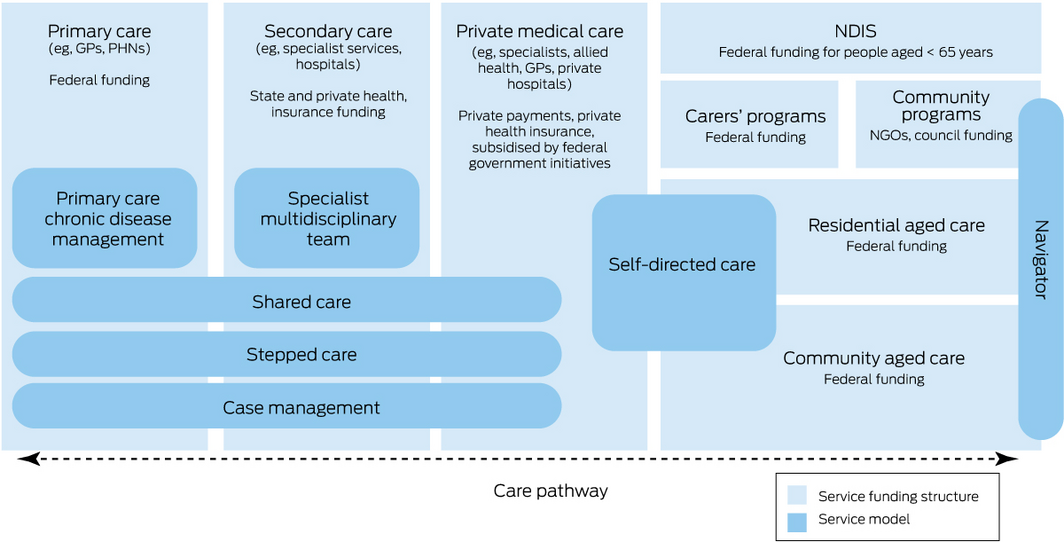
We identified models of service delivery for dementia and other chronic conditions based on input from our broad authorship group and searching the peer‐reviewed and grey literature. These models are described in the and considered in terms of fit with the principles above. We included care pathways even though these are not a model because they are often used to improve service access and integration. In addition, we map the models of service delivery to our health and aged care funding systems, illustrating the limited integration across systems (Box).
Learnings from these models:
- The self‐directed approach places the needs of the person with dementia centrally but may require processes to ensure supported decision making. Information is also needed regarding the risks and benefits of self‐management versus budget holding or service provider management, integration with health care, and consideration of costs.
- Case management improves outcomes for the person with dementia and could be flexible and needs‐based if sufficient workforce and integration across systems could be achieved. However, it would require a significant investment of resources.
- Strengths of the primary care chronic disease management model include equity and familiarity of access, and care coordination by a trusted health professional or practice team. Weaknesses include the limited amount of treatment (ie, current cap of five subsidised allied health consultations per year), limited dementia management skills in some general practitioners and practice nurses, and often poor integration with aged care.
- Shared and stepped care models may be able to be adapted to combine the strengths of the primary care chronic disease and specialist approaches, but integration of aged care services would be essential. Stepped care may not be the best fit for people diagnosed with dementia in other settings (eg, hospitals or residential care facilities).
- A specialist team approach with a skilled workforce is well equipped to provide evidence‐based care, although this is unlikely to be made universally accessible (eg, in regional areas) and may be cost‐prohibitive.
- Navigator and care pathway approaches may increase access to services, but do not improve the type or amount of supports or treatment available.
None of the models of service delivery that we identified in Australia or overseas appear to sufficiently meet the principles above. There is no clear recognition that dementia is both a social and a medical issue. Australia has moved strongly in the direction of recognising the rights of people with disabilities including social participation but there is limited appreciation of this need in respect to most models for dementia. Recognition of dementia as a disability is only apparent in the self‐directed care model. The models also do not sufficiently consider the needs of the person with dementia and care partners together. Barriers to all the current models are the poor dementia knowledge and the tendency to stigmatise people with dementia by many health and aged care professionals.15
Next step: investment in model development
We need to combine desirable elements in the primary care chronic disease management, case management, and specialist multidisciplinary care models. Having a system with a point of entry through primary care could maximise accessibility. Having a dementia and aged care specialist (eg, dementia nurse or case manager) working with GPs would bring the required skills and knowledge. A close partnership with a specialist multidisciplinary team (in person or using telehealth) would assist with diagnosis, ongoing support and management of complex cases, with possibly the most complex cases being managed by the specialist team.
There needs to be investment to develop a model that is accessible, integrated and effective in meeting the needs of people with dementia. Our service delivery model needs to be co‐designed with people with dementia, their care partners, health, aged care, and state and federal government stakeholders, including treasury departments. Public health, social equity and human rights principles should underpin model design. Research is needed to explore proposed models and their elements with current recipients, service planners and providers. Methodologies may include service mapping; gap, risk and unintended consequence analysis; and economic modelling. Potential models will then need to be tested in a coordinated series of pilots and rigorous health system trials building towards national implementation. History has shown that piecemeal demonstration pilots and practice improvement projects will not bring about large‐scale change.
Australia’s last National Framework for Action on Dementia 2015–2019 has just lapsed.16 Our new framework should include the development of a model of service delivery that considers accessible pathways to diagnosis and effective and seamless ongoing support of health and wellbeing throughout the course of dementia.
Competing interests
No relevant disclosures.
Acknowledgements
Lee‐Fay Low is funded by a National Health and Medical Research Council Boosting Dementia Research Leadership Development Fellowship.
References
- Scott A, Braithwaite J. COVID‐19 is opening up fault lines in the health care system. InSight+ 2020; 6 Apr. https://insightplus.mja.com.au/2020/13/covid-19-is-opening-up-fault-lines-in-the-health-care-system/ (viewed June 2020).
- Brown L, Hansnata E, La HA. The economic cost of dementia in Australia 2016–2056. Canberra: Institute for Governance and Policy Analysis, University of Canberra, 2017. https://www.dementia.org.au/files/NATIONAL/documents/The-economic-cost-of-dementia-in-Australia-2016-to-2056.pdf (viewed June 2020).
- Ng NSQ, Ward SA. Diagnosis of dementia in Australia: a narrative review of services and models of care. Aust Health Rev 2018; 43: 415–424.
- Low LF. Why Australia urgently needs post‐diagnostic support and treatment for dementia. Aust J Dement Care 2019; 8: 30–32.
- Aged Care Workforce Strategy Taskforce. A matter of care: Australia’s aged care workforce strategy. Canberra: Department of Health, Commonwealth of Australia; 2018. https://www.health.gov.au/resources/publications/a-matter-of-care-australias-aged-care-workforce-strategy (viewed June 2020).
- Swaffer K. Human rights, disability and dementia. Aust J Dement Care 2018; 7: 25–28.
- Nancy R, David H. Dementia as a disability and human rights issue. Healthc Pap 2016; 16: 45–51.
- Hameister I, Kochan NA, Naismith S, et al. Establishing national assessment standards for cognitive decline and dementia in Australia: ADNeT’s Memory Clinics consortium [conference abstract]. Australian Dementia Forum; Hobart, Tasmania, 2019.
- Travers C, Gray L, Martin‐Khan M, Hubbard R. Evidence for the safety and quality issues associated with the care of patients with cognitive impairment in acute care settings: a rapid review. Sydney: Australian Commission on Safety and Quality in Health Care, 2013. https://www.safetyandquality.gov.au/publications-and-resources/resource-library/evidence-safety-and-quality-issues-associated-care-patients-cognitive-impairment-acute-care-settings-rapid-review (viewed June 2020).
- Speechly CM, Bridges‐Webb C, Passmore E. The pathway to dementia diagnosis. Med J Aust 2008; 189: 487–489. https://www.mja.com.au/journal/2008/189/9/pathway-dementia-diagnosis
- Tracey R, Briggs L. Royal Commission into Aged Care Quality and Safety interim report: neglect. Canberra: Commonwealth of Australia, 2019. https://agedcare.royalcommission.gov.au/publications/Pages/interim-report.aspx (viewed June 2020).
- Harris MF, Harris‐Roxas B, Knight AW. Care of patients with chronic disease: achievements in Australia over the past decade. Med J Aust 2018; 209: 55–57. https://www.mja.com.au/journal/2018/209/2/care-patients-chronic-disease-achievements-australia-over-past-decade
- Department of Health. Aged care sector statement of principles. Canberra: Commonwealth of Australia, 2015. https://www.health.gov.au/resources/publications/aged-care-sector-statement-of-principles (viewed June 2020).
- Council of Australian Governments (COAG). Principles to determine the responsibilities of the NDIS and other service systems. Canberra: Council of Australian Governments, 2013. https://www.coag.gov.au/sites/default/files/communique/NDIS-Principles-to-Determine-Responsibilities-NDIS-and-Other-Service.pdf (viewed June 2020).
- Cations M, May N, Crotty M, et al. Health professional perspectives on rehabilitation for people with dementia. Gerontologist 2020; 60: 503–512.
- Australian Health Ministers Advisory Council, Department of Health. National Framework for Action on Dementia 2015–2019. Canberra: Commonwealth of Australia. 2015. https://www.health.gov.au/resources/publications/national-framework-for-action-on-dementia-2015-2019 (viewed Dec 2020).
Linked content
-
MJA Letter: We need a model of health and aged care services that adequately supports Australians with dementia
-
InSight+: Dementia care: we are not respecting human rights
Provenance: Not commissioned; externally peer reviewed.
Motor Neuron Disease Mortality Trends in Australia From 1986 to 2023: A Population-Based Study
Carol M. Y. Lee, Rupendra N. Shrestha, Julian Gold, Mark Stevenson, Kelly L. Williams, Lyndal Henden, Sandrine K. K. Chan Moi Fat, Zoe Zussa, Amanda Wright, Martin Jude, Mark A. S. Laidlaw, Willem J. R. Fokkink, Dominic B. Rowe
Mild traumatic brain injury and concussion and persisting post‐concussion symptoms: new guidelines to support evidence‐based assessment and management in Australia and Aotearoa New Zealand
Karen M Barlow, Jennie L Ponsford, Alice Theodom, Gill Cowen, Gavin A Davis, Vicki Anderson, Franz E Babl, David Cole, Jennifer Cullen, Stuart R Dalziel, Melinda Fitzgerald, Howard Flavell, Caroline Yates, Rebecca Kimble, John H Olver, Rhonda Orr, Mark Ralfe, Michael Rose, Nick Rushworth, Julia Treleaven, Gary Browne, Nathan Delang, Sarah Harris, Gary Mitchell, Sean Tweedy
The prevalence of and variation in indicators of the quality and safety of long term aged care in Australia, 2019: a cross‐sectional population‐based study
Tesfahun C Eshetie, Gillian E Caughey, Catherine Lang, Olivia Ryan, Renuka Visvanathan, Craig Whitehead, Keith Evans, Janet K Sluggett, Jyoti Khadka, Carolyn Dawkins, Helena Williams, Miranda Starke, Sara Blunt, Anne Liddell, Megan Corlis, Anna Sheppeard, Penelope Lello, Marilyn Thien, Steven L Wesselingh, Maria C Inacio
Health and economic benefits of improving pre‐hospital identification of stroke in Australian women: a modelling study
Thomas Gadsden, Lei Si, Emily R Atkins, Cheryl Carcel, Xia Wang, Stephen Jan, Mark Woodward, Laura E Downey
Symptom burden, quality of life, and diagnostic journey of people with postural orthostatic tachycardia syndrome, Australia, 2021–24: a descriptive patient registry data study
Marie‐Claire Seeley, Gemma Wilson, Eric Ong, Amy Langdon, Jonathan Chieng, Danielle Bailey, Kristina Comacchio, Amanda Page, Dennis H Lau, Celine Gallagher
The intersection of rurality and dementia prevalence in Australia for Aboriginal and Torres Strait Islander and non‐Indigenous peoples
Antonia J Clarke, Marwan Ahmed, Judith M Katzenellenbogen, John Towney (Wiradjuri), Anna H Balabanski, Adrienne Withall (Dharawal Yuin), Kylie Radford, Amy Brodtmann