




Volume 209 - Issue 2
Care of patients with chronic disease: achievements in Australia over the past decade
Authors: Mark F Harris, Ben Harris-Roxas and Andrew W Knight
Med J Aust 2018; 209 (2): 55-57. || doi: 10.5694/mja18.00333
Published online: 16 July 2018
Published online: 16 July 2018
Despite progress made in chronic disease management in Australia, there is an ongoing need for better quality of care and services integration, as rates of chronic disease and multimorbidity continue to rise
Rising rates of chronic disease and multimorbidity require better quality of care and services integration
A decade ago, our review called for better integrated and more comprehensive chronic disease management.1 Chronic conditions continue to be the major challenge confronting the Australian health system, with more than half of the adult population reporting long term conditions.2 Premature mortality rates have declined, especially for cardiovascular disease, although it remains the leading cause of preventable death.3 Survival from cancer has increased — with greater demands on patients and services as survivors may have complications or comorbidities.4 Addressing smoking, poor nutrition, hazardous alcohol consumption, and physical inactivity as behavioural risk factors is essential to the control of long term conditions and their complications. There has been some success with tobacco use declining to 13% of the population, although it still accounts for the largest contribution to the burden of disease. Nevertheless, other risk factors have not improved. For example, the proportion of Australians who are overweight or obese (body mass index, ≥ 25 kg/m2) increased from 61% in 2007–08 to 63% in 2014–15.5
Primary care continues to play a central role in the detection and management of long term conditions, with increased emphasis on multimorbidity. In 2015–16, the BEACH (Bettering the Evaluation and Care of Health) study reported that chronic problems were managed in more than half of general practice encounters — a similar rate to 2007.6 The proportion of patients aged 65 years and over with two or more long term conditions has risen from more than half in 2007 to three-quarters of patients in 2015.7
Changes to the model of care
The approach to the management of chronic disease has developed considerably in Australia over the past decade. The previous National Chronic Disease Strategy in 2006 focused on five priority conditions (ie, asthma, cancer, diabetes, cardiovascular diseases and musculoskeletal conditions) and the policy drivers were the need for prevention and planned multidisciplinary rather than episodic care.8 This strategy has been replaced by a framework that has a broader view, including a focus on shared determinants and risk factors for chronic disease and multimorbidities and is more aligned with the United Nations and the World Health Organization policy.9,10 While the chronic care model still has salience, there has been increasing emphasis on the need for greater integration of care between primary and specialist services. This is in recognition of the significant gaps in our fragmented health system.11,12 Measures introduced to improve the integration of care include the development of codified assessment and referral pathways and shared information systems, including the establishment of My Health Record (www.myhealthrecord.gov.au), although this does not yet allow sharing of care plans. The role of practice nurses has developed, especially in the prevention, assessment and planning of chronic disease care.13 Self-management support and coaching is more available, and efforts at care coordination have been initiated through state health services.14 There has also been some limited use of telehealth, risk stratification and proactive outreach to patients enrolled in coordinated care.
Access and quality
Access to primary care in Australia is high compared with Organisation for Economic Cooperation and Development countries.15 However, barriers to access exist for both low income individuals and people in rural areas.16,17 There are also major challenges in ensuring that care is appropriate to the patients’ level of health literacy, culture and language.18 The use of the national telephone interpreter service is free for general practitioners, but other health professionals do not have the same level of access.19 Most Australians have low health literacy, yet there are no systematic efforts to improve population health literacy or to deal with the complexity of the web of services they need to navigate.20,21 There is increasing recognition that patients with long term physical conditions such as diabetes are at risk of depression and that these require collaborative models of care, which has not been widely addressed.22 Furthermore, many patients with serious mental illness or drug and alcohol problems still receive poor preventive care and management of their long term conditions, contributing to their low life expectancy.23
Care planning and multidisciplinary team care
Care planning has been a major strategy for achieving more systematic care of long term conditions. Research on patients with diabetes suggests that reviews of care plans and multidisciplinary care involving practice nurses and allied health services are associated with reducing the risk of hospitalisation.24-26 The use of GP Management Plans and Team Care Arrangements has climbed steadily since their introduction in 2005 (Box 1). The number of case conferences has increased but is still much lower than the other items. The claims for practice nurse and allied health services in association with the GP care planning items have also increased dramatically since 2007 (Box 2). Despite this trend, multidisciplinary teams within primary care and collaborative care with specialist services are infrequent even in services designed to achieve this.27
Incentives for structured chronic disease management exist in the current Practice Incentives Program (PIP) for diabetes and asthma care. There is some limited evidence for the positive impact of these processes of care on hospitalisation.25 The Australian Government has foreshadowed that these and other PIP incentives will change to have more emphasis on data collection for quality improvement. The ability of general practice to extract practice data on population and chronic disease management indicators is now reasonably widespread, which is partly the legacy of the Australian Primary Care Collaboratives Program. However, data capture and analysis at the Primary Health Network level are not fully developed.
Barriers
Chronic disease management in Australian primary care has matured since 2007. Despite this, barriers remain, with up to a third of patients with chronic conditions not receiving optimal management and reporting problems with care coordination.16,28,29 Box 3 outlines some of these barriers and suggests some possible ways in which these could be managed. The health service and system context in which innovations in chronic disease management have been implemented is complex and requires providers to understand the change, be committed to it and make a continuing investment in changes to roles, resources and relationships.30
Australia is looking abroad for models of care that can deal with some of these barriers and deliver better outcomes for patients with, or at risk of, chronic disease in primary care. Considerable hope is placed on the patient-centred medical home model, with the establishment of a trial by the Australian Government in 179 practices and Indigenous community-controlled health services in ten Primary Health Networks. The trial includes enrolment of patients with chronic disease, risk stratification, individual shared care plans, and bundled payment. Its evaluation should inform debate about the value of capitated compared with fee-for-service payment for patients with chronic disease.
Conclusion
Some progress has been made in chronic disease management in Australia over the past decade. However, there is an ongoing need for better quality of care and integration between primary care and specialist and hospital services, and for scaling up the promising activities that have still not been fully implemented. This need has become more acute as rates of chronic disease and multimorbidity continue to rise, placing greater demands on the health system and costs for the community.
Box 1 – Medicare claims for chronic disease management in general practice, 2005–2017
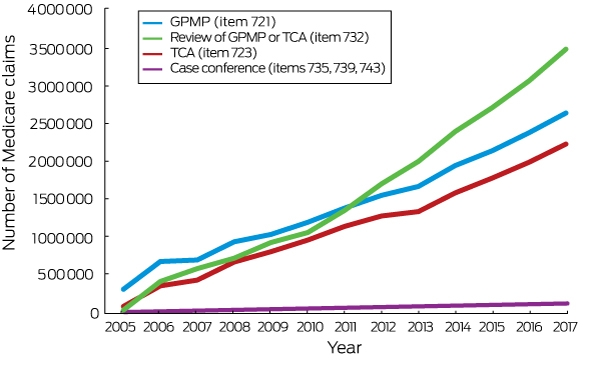
GPMP = GP Management Plan. TCA = Team Care Arrangement. Items 735, 739 and 743 are for organising a case conference. Source: Australian Government Department of Human Services. Medicare items processed from January 2005 to December 2017.
Box 2 – Nursing and allied health item claims for patients with chronic disease, 2005–2017
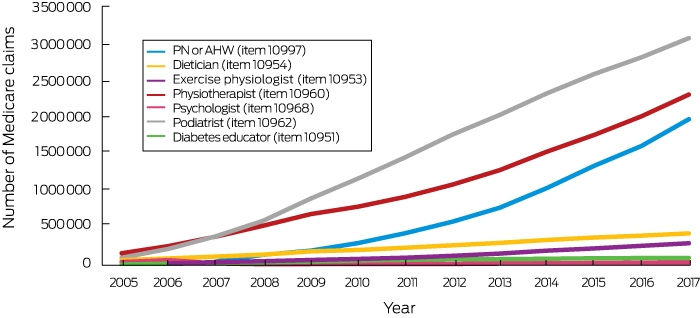
AHW = Aboriginal and Torres Strait Islander Health Practitioner health worker. PN = practice nurse. Source: Australian Government Department of Human Services. Medicare items processed from January 2005 to December 2017.
Box 3 – Some current barriers to optimal management of chronic conditions in general practice
|
Barrier |
Contributing factors |
Potential solutions |
|||||||||||||
|
|
|||||||||||||||
|
Effective integration of care |
Despite team care plans and some attempts at collocated models, there is fragmentation between services |
Interoperable information systems |
|||||||||||||
|
Tailoring care to patients |
Self-management programs and coaching programs not tailored to variability in patients’ health literacy, culture, language skills and level of patient activation |
Increased availability of multilingual programs |
|||||||||||||
|
Management of practice population |
Few practices have systematically assessed the level of risk for chronic diseases of their practice population to tailor proactive care |
Enrolment |
|||||||||||||
|
Funding models |
Fee-for-service funding which does not adequately fund services which are not face-to-face time or share team responsibility |
Flexible funding based on enrolled patients with long terms conditions |
|||||||||||||
|
|
|||||||||||||||
|
|
|||||||||||||||
Competing interests
No relevant disclosures.
References
- Harris MF, Zwar NA. Care of patients with chronic disease: the challenge for general practice. Med J Aust 2007; 187: 104-107.
- Australian Institute of Health and Welfare. Australia’s health 2016 (AIHW Cat. No. AUS 199; Australia’s Health Series No. 15). Canberra: AIHW; 2016. https://www.aihw.gov.au/getmedia/9844cefb-7745-4dd8-9ee2-f4d1c3d6a727/19787-AH16.pdf.aspx?inline=true (viewed May 2018).
- Dunbar JA, Duggan M, Fetherston H, et al. Heart health: the first step to getting Australia’s health on track. Technical paper no. 2017–02. Melbourne: Australian Health Policy Collaboration, Victoria University; 2017. https://www.vu.edu.au/sites/default/files/ahpc-heart-health-technical-paper.pdf (viewed May 2018).
- Australian Institute of Health and Welfare. Burden of cancer in Australia: Australian Burden of Disease Study 2011. Canberra: AIHW; 2011. https://www.aihw.gov.au/getmedia/a1aec7bd-ddb7-416f-9a7e-f2133cd5d4cb/20965.pdf.aspx?inline=true (viewed May 2018).
- Australian Institute of Health and Welfare. Overweight and obesity in Australia: a birth cohort analysis. Canberra: AIHW; 2017. https://www.aihw.gov.au/getmedia/be8da99a-46d1-4d27-a391-c057e30d3299/aihw-phe-215.pdf.aspx?inline=true (viewed May 2018).
- Britt H, Miller GC, Henderson J, et al. General practice activity in Australia 2015–16. Sydney: Sydney University Press; 2016. https://ses.library.usyd.edu.au/bitstream/2123/15514/5/9781743325148_ONLINE.pdf (viewed May 2018).
- Britt H, Miller GC, Henderson J, et al. A decade of Australian general practice activity 2005–06 to 2014–15. Sydney: Sydney University Press; 2015. http://ses.library.usyd.edu.au/bitstream/2123/13974/4/9781743324554_ONLINE.pdf (viewed May 2018).
- National Health Priority Action Council (NHPAC). National Chronic Disease Strategy. Canberra: Australian Government Department of Health and Ageing; 2006. http://webarchive.nla.gov.au/gov/20141215061219/http://www.health.gov.au/internet/main/publishing.nsf/Content/pq-ncds-strat (viewed May 2018).
- World Health Organization. Global action plan for the prevention and control of noncommunicable diseases 2013–2020. Geneva: WHO; 2013. http://africahealthforum.afro.who.int/IMG/pdf/global_action_plan_for_the_prevention_and_control_of_ncds_2013-2020.pdf (viewed May 2018).
- Australian Health Ministers’ Advisory Council. A 2017 National Strategic Framework for Chronic Conditions. Canberra: Australian Government. 2017 https://www.health.gov.au/internet/main/publishing.nsf/Content/A0F1B6D61796CF3DCA257E4D001AD4C4/$File/National%20Strategic%20Framework%20for%20Chronic%20Conditions.pdf (viewed May 2018).
- Osborn R, Moulds D, Schneider EC, et al. Primary care physicians in ten countries report challenges caring for patients with complex health needs. Health Aff (Millwood) 2015; 34: 2104-2112.
- Hall J. Australian health care — the challenge of reform in a fragmented system. N Engl J Med 2015; 373: 493-497.
- Eley DS, Patterson E, Young J, et al. Outcomes and opportunities: a nurse-led model of chronic disease management in Australian general practice. Aust J Prim Health 2013; 19: 150-158.
- Dennis SM, Harris M, Lloyd J, et al. Do people with existing chronic conditions benefit from telephone coaching? A rapid review. Aust Health Rev 2013; 37: 381-388.
- Davis K, Ballreich J. Equitable access to care — how the United States ranks internationally. N Engl J Med 2014; 371: 1567-1570.
- Osborn R, Squires D, Doty MM, et al. In new survey of eleven countries, US adults still struggle with access to and affordability of health care. Health Aff 2016; 35: 2327-2336.
- Carey TA, Wakerman J, Humphreys JS, et al. What primary health care services should residents of rural and remote Australia be able to access? A systematic review of “core” primary health care services. BMC Health Serv Res 2013; 13: 178.
- Joshi C, Jayasinghe UW, Parker S, et al. Does health literacy affect patients’ receipt of preventative primary care? A multilevel analysis. BMC Fam Pract 2014; 15: 171.
- Phillips CB, Travaglia J. Low levels of uptake of free interpreters by Australian doctors in private practice: secondary analysis of national data. Aust Health Rev 2011; 35: 475-479.
- Nutbeam D. Building health literacy in Australia. Med J Aust 2009; 191: 525-526.
- Beauchamp A, Buchbinder R, Dodson S, et al. Distribution of health literacy strengths and weaknesses across socio-demographic groups: a cross-sectional survey using the Health Literacy Questionnaire (HLQ). BMC Public Health 2015; 15: 678.
- Gunn JM, Ayton DR, Densley K, et al. The association between chronic illness, multimorbidity and depressive symptoms in an Australian primary care cohort. Soc Psychiatry Psychiatr Epidemiol 2012; 47: 175-184.
- Lawrence D, Hancock KJ, Kisely S. The gap in life expectancy from preventable physical illness in psychiatric patients in Western Australia: retrospective analysis of population based registers. BMJ 2013; 346: f2539.
- Wickramasinghe LK, Schattner P, Hibbert ME, et al. Impact on diabetes management of general practice management plans, team care arrangements and reviews. Med J Aust 2013; 199: 261-265.
- Comino EJ, Tran DT, Taggart JR, et al. A preliminary study of the relationship between general practice care and hospitalisation using a diabetes register, CARDIAB. Aust Health Rev 2013; 37: 210-217.
- Comino EJ, Islam MF, Tran DT, et al. Association of processes of primary care and hospitalisation for people with diabetes: a record linkage study. Diabetes Res Clin Pract 2015; 108: 296-305.
- Lane R, Russell G, Bardoel EA, et al. When colocation is not enough: a case study of General Practitioner Super Clinics in Australia. Aust J Prim Health 2017; 23: 107-113.
- Turner LR, Harris MF, Mazza D. Obesity management in general practice: does current practice match guideline recommendations? Med J Aust 2015; 202: 370-372.
- National Association of Diabetes Centres. Australian National Diabetes Audit: ANDA–AQCA final report 2016. Sydney: NADC; 2016. http://nadc.net.au/wp-content/uploads/2016/04/ANDA-AQSMA-2016-Final-Report-Dec.pdf (viewed May 2018).
- May C. Agency and implementation: understanding the embedding of healthcare innovations in practice. Soc Sci Med 2013; 78: 26-33.
Provenance: Commissioned; externally peer reviewed.
Shifting focus to adolescent wellbeing and inclusive participation in the digital age
Allyson R Todd, Elena Wang, Stephanie R Partridge
The clinical presentation, investigation, and management of women diagnosed with endometriosis in Australian general practices, 2011–2021: an open cohort study
Danielle Mazza, Kailash Thapaliya, Sharinne B Crawford, Alissia Hui, Maryam Moradi, Luke E Grzeskowiak
The impact of the Breast Screen NSW transition from film to digital mammography, 2002–2016: a linked population health data analysis
Rachel Farber, Nehmat Houssami, Katy J L Bell
Non‐technical errors associated with deaths in surgical care, Australia, 2012–2019, by surgical specialty (Australian and New Zealand Audit of Surgical Mortality): a retrospective cohort study
Jesse Ey, Victoria Kollias, Octavia Lee, Kelly Hou, Matheesha Herath, John B North, Ellie Treloar, Suzanne Edwards, Martin Bruening, Adam J Wells, Guy J Maddern
The CURE Asthma roadmap
Gary P Anderson, Anthony Flynn, Phil G Bardin, John D Blakey, Shyamali C Dharmage, Paul Foster, Peter G Gibson, Adam Jaffe, Alan James, Christine R Jenkins, Sundram Sivamalai, Peter D Sly, Guy B Marks, Vanessa M McDonald, Judy Wetttenhall
Evidence from Australian cohort studies about asthma trajectories and transitions across the life course: a narrative review
Caroline Lodge, Xin Dai, Ingrid A. Laing, Michael P Menden, Anthony Flynn, Gary P Anderson, Sarath Ranganathan, Shyamali C Dharmage