




Medical education
Snapshot
Volume 212 - Issue 3
Pretibial metastatic basal cell carcinoma
Author: Phillip Cantwell
Med J Aust 2020; 212 (3): 108-108.e1. || doi: 10.5694/mja2.50441
Published online: 17 February 2020
Published online: 17 February 2020
A 72-year-old immunocompromised woman
presented with a 6-month history of a rapidly growing right pretibial lesion and a
palpable right groin lump
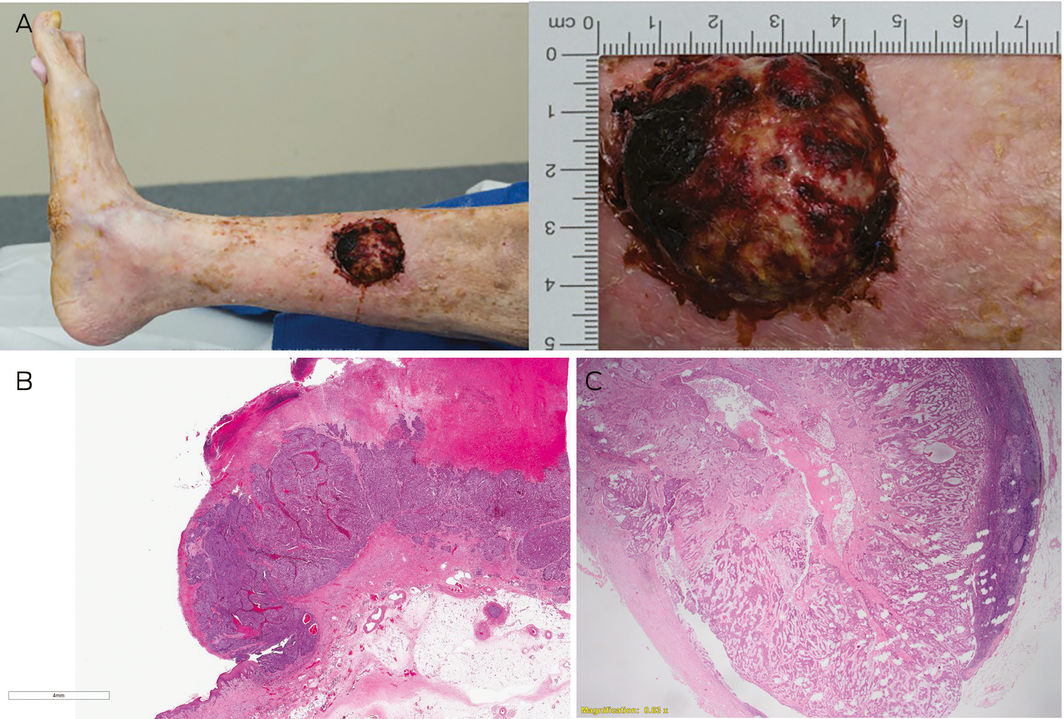
A 72‐year‐old immunocompromised woman presented with a 6‐month history of a rapidly growing right pretibial lesion (Figure, A) and a palpable right groin lump. Excision biopsy (Figure, B) demonstrated a pretibial basal cell carcinoma (BCC) with nodular and infiltrative growth, extensive lymphovascular invasion, but no perineural invasion. Basosquamous features were not present. An ultrasound with fine needle aspirate indicated BCC metastasis to the right groin lymph nodes. Positron emission tomography (PET) scan identified no other metastasis. A right groin clearance confirmed metastatic BCC (Figure, C). The tumour cells showed diffuse positive staining with BerEP4 and were largely negative for epithelial membrane antigen.
Rates of BCC metastasis range from 0.0028% to 0.1%.1 Large tumour size (> 5 cm), ionising radiation exposure, head and neck tumour location, immunosuppression, and perineural invasion are all recognised metastatic BCC risk factors.1,2 Metastatic BCC should be considered in patients with these risk factors.
Competing interests
No relevant disclosures.
References
- Alimoglu Y, Kilic E, Mercan H, Inci E. Metastatic basal cell carcinoma. J Craniofac Surg 2011; 22: 1134–1136.
- Gropper AB, Girouard SD, Hojman LP, et al. Metastatic basal cell carcinoma of the posterior neck: case report and review of the literature. J Cutan Pathol 2012; 39: 526–534.
Diagnosing Acute Kava Dermopathy: A Case Report of a Characteristic Cutaneous Eruption
Ali Abid, Nicholas Allen, Abeer Hagelamin, Christopher Henderson, Artiene Tatian
Localised Herpes Simplex Following Midline Laparotomy
Jessica S. Bulluss, Paul Chee, Matthew J. Verheyden
No silver lining with health misinformation: argyria caused by intentional silver consumption
Luke Collins, Logesh Palanikumar, Stephen Bacchi
Lingual Raynaud phenomenon
Michael Taggart, Mina John
Melasma in the male: a less well recognised entity
Tim Aung, Rowland Noakes
Age group‐specific changes in keratinocyte cancer treatment rates in Australia, 2012–2021: a retrospective cohort study based on MBS claims data
Catherine M Olsen, Nirmala Pandeya, Rachel E Neale, David C Whiteman