




Volume 211 - Issue 11
A Christmas message: be careful of the confetti stars
Authors: Paul Heyworth and Ryan Shulman
Med J Aust 2019; 211 (11): 510-510. || doi: 10.5694/mja2.50424
Published online: 9 December 2019
Published online: 9 December 2019
Christmas is known for
festive decorations
To the Editor: Christmas is known for festive decorations. Many a table will be laced with confetti stars and other paraphernalia this season. We believe the potential dangers associated with ingestion of these particular foreign bodies deserve attention.
A 9‐month‐old girl presented to hospital after a choking episode in which her mother noted some blood streaking in the child's saliva. No features of the history suggested foreign body inhalation. Physical examination was unremarkable, and she was discharged as having choked on her own saliva.
The girl returned 2 days later with increased work of breathing, fevers, cough and reduced oral intake. Examination revealed a respiratory rate of 68 breaths per minute, erythematous throat, and intermittent wheeze. She was diagnosed with bronchiolitis and received inpatient treatment for 3 days.
Fevers, persistent cough and marked reduction in oral intake ensued. She re‐presented 6 days later with worsening lethargy, left neck mass, and drooling. Examination revealed pyrexia (39.4°C), normotension (106/70 mmHg), tachypnoea, peripheral hypoperfusion, erythematous throat and a large left submandibular mass. She was diagnosed with a viral upper respiratory tract infection with possible lymphadenitis.
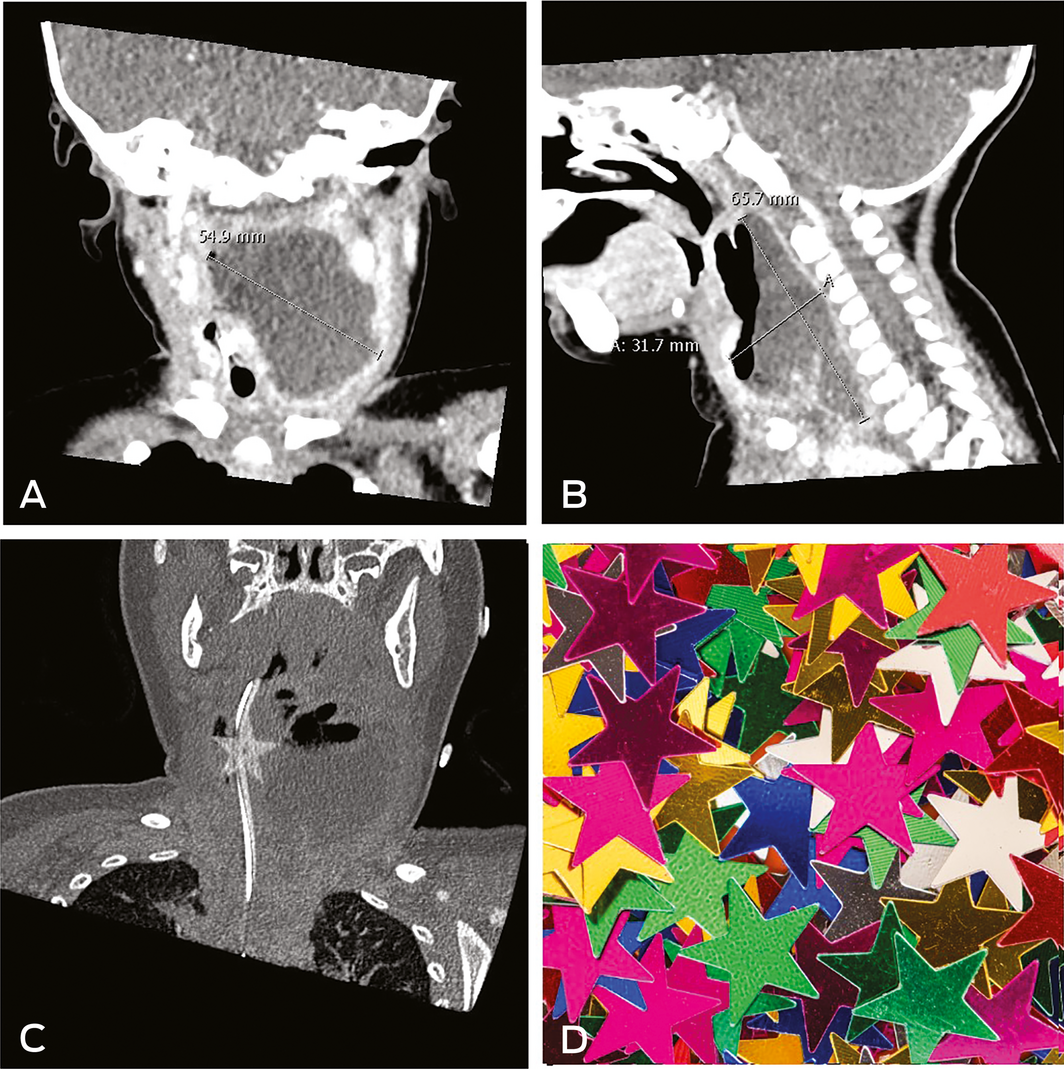
Ultrasound was performed, with appearances suggestive of abscess. Subsequent computed tomography of the neck demonstrated a large retropharyngeal abscess markedly narrowing the airways. In addition, a star‐shaped density was discovered at the margin of the abscess (Box). During emergency incision and drainage in theatre, a plastic star embedded within the posterior hypopharyngeal wall was removed. Discharge occurred after 5 days of intravenous antibiotics. No complications have been recorded to date.
Despite their flexible nature, the sharp points of confetti stars appear to increase the risk of lodgement in the upper aerodigestive tract, and their reflective surfaces attract the interests of young children with a propensity to place things in their mouths. While uncommon, the potential for similar cases to present over these Christmas holidays exists. Wider dissemination of these illustrative cases to primary care physicians and the public as well as a review of warning labels on these decorations may be prudent.
Box – Coronal computed tomography (CT) neck scan (A) and sagittal CT neck scan (B) showing the size of the abscess. CT reconstruction with the ingested star clearly outlined beside the abscess with overlying nasogastric tube (C). Confetti star of the same make that was found during surgery* (D)
*Open‐source image.
Competing interests
No relevant disclosures.
Decolonising Indigenous Health Research Requires Redefining Sex, Sexuality and Gender
Shakara Liddelow-Hunt, James H. L. Hill, Kate Daglas, Kaiwarr Clancy, Madi Day, Alistair Ott
Reducing Nitrous Oxide Emissions Across the Melbourne Biomedical Precinct
Ross Robertson, Andrew Downey, Daryl Williams, Bjorn Makein, Ben Dunne, Tugce Ozturk, Ying Gu, Rebecca McIntyre
Multimorbidity Clusters Among People Aged 65 Years and Over in Australia: A Nationwide Cross-Sectional Data Linkage Study
Weisi Chen, Christine Y. Lu, Sarah N. Hilmer, Alice A. Gibson, Edwin C. K. Tan
When ‘Liver Enzymes’ Are Not Hepatic: Late-Onset Pompe Disease
Shauna Madigan, Georgina England, Wayne Rankin
West Nile virus Kunjin subtype in rural NSW
Emily Gibson, Megan Whitley, Peter Murray, Linda Hueston, Jane Bennett, Raguharan Kathiresu, David N Durrheim
The impact of the Breast Screen NSW transition from film to digital mammography, 2002–2016: a linked population health data analysis
Rachel Farber, Nehmat Houssami, Katy J L Bell