




Volume 209 - Issue 2
An unexpected orbital foreign body
Authors: Matthew H Lee and Elaine Chong
Med J Aust 2018; 209 (2): 63. || doi: 10.5694/mja17.01049
Published online: 16 July 2018
Published online: 16 July 2018
A 61-year-old man presented with left periorbital swelling and an upper lid laceration after a fall onto a chair
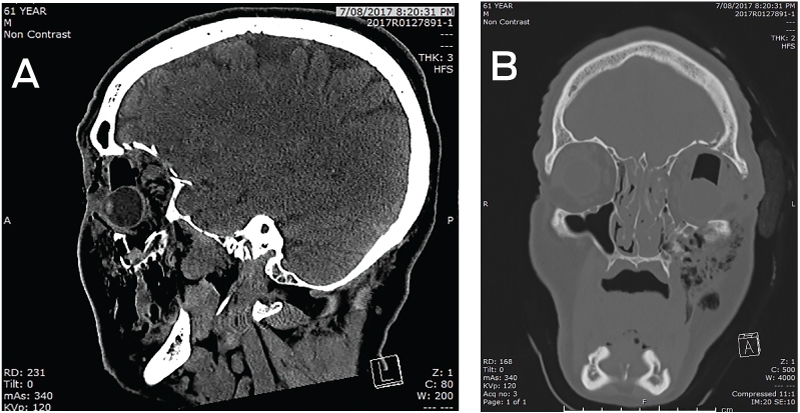
A 61-year-old man presented with left periorbital swelling and an upper lid laceration after a fall onto a chair. An orbital radiolucent foreign body was seen on a brain computed tomography scan along with decompressive fractures of all walls of the orbit leaving an intact globe and resultant dural tear (Figure, A and B). After the extraction of the foreign body via the lid wound, it was identified as the plastic capping that sits on the ends of metal tube chairs. Ocular examination under anaesthesia was normal. The dural tear along the orbital roof, rim fractures and lid laceration were then repaired.
‘Once Bitten’: A Case of Tetanus Following Snakebite in Australia
Adrian A. S. Doherty, Naomi N. E. Clarke, Sarah Fletcher, Sarah Huffam, Camille V. Awburn, Eugene Athan
Epidemiology and Quality of Care for Aboriginal and Torres Strait Islander Peoples Treated by Emergency Medical Services for Stroke in Victoria, Australia: Retrospective Analysis of Linked Data
Candice Menezes, Ziad Nehme, Luke J. Burchill, Tegwyn McManamny, Angela Dos Santos, Michelle Crilly, Luke P. Dawson, Benjamin Clissold, David Anderson, Emily Nehme
Intranasal Adrenaline Use for the Management of Insect Venom-Induced Anaphylaxis
Thomas J. Young, Wilhelmina R. F. Johnson, Braydon L. Pennington, Troy Wanandy, Wun Y. Lau, Thanh-Thao A. Le
Gabapentinoid Poisoning Presentations to Victorian Emergency Departments: A 15-Year Trend Analysis
Bishaal Tej Gurung, Amy McNeilage, Angus Skeen, Tina Lam, Joanna F. Dipnall, Jane Hayman, Suzanne Nielsen, Ting Xia
They Brought the Hospital to Me
Hugh N. Burrill
Predictors of Ambulance Transport to Hospital for Older People Living in Tasmanian Aged Care Facilities: A Retrospective Cohort Study
Sharon Andrews, Pieter F. Fouche, Belinda Flanagan, Michael McDermott, Melanie Greenwood