




Medical education
Lessons from practice
Volume 209 - Issue 2
The scourge of the C
Authors: Alicia R Jones and Kavita Kumareswaran
Med J Aust 2018; 209 (2): 62-63. || doi: 10.5694/mja17.00876
Published online: 16 July 2018
Published online: 16 July 2018
A 58-year-old woman was admitted with chronic lower limb ulcers
Clinical record
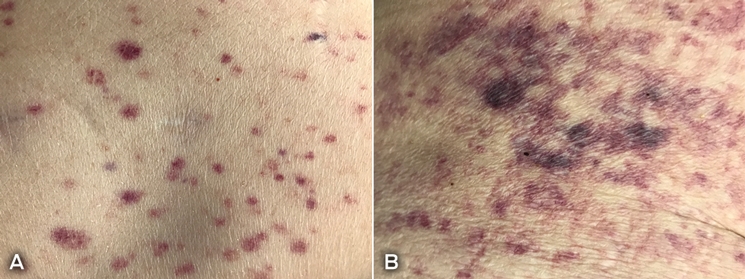
A 58-year-old woman was admitted with chronic lower limb ulcers. The medical history included insulin-requiring type 2 diabetes with macrovascular and microvascular complications, dialysis-independent Stage 4 chronic kidney disease, ischaemic heart disease and congestive cardiac failure. She lived alone and was an active cigarette smoker with a 40-pack-year smoking history. On examination, she was edentulous, had bilateral ischaemic toe ulcers and several shin ulcers in keeping with calciphylaxis. In addition, there was a petechial rash across her limbs and torso (Box 1, A and B). Skin biopsy of this rash showed non-specific mild perivascular chronic inflammatory infiltrate.
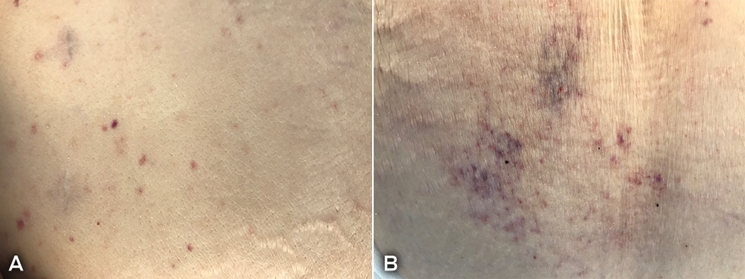
Laboratory investigations indicated mild normocytic anaemia (haemoglobin 110 g/L; reference interval [RI], 115–165), elevated C-reactive protein (75 mg/L; RI, 0–10), hypoalbuminaemia (albumin 20 g/L; RI, 36–49) and undetectable plasma vitamin C (< 5 μmol/L; RI, 10–115). Screenings for connective tissue diseases, thrombophilia, viral hepatitis, herpes viruses and cryoglobulins were negative. Dietary history confirmed a diet predominantly composed of meat, puffed rice cereal and diet cola, with minimal intake of fruit or vegetables. She was commenced on oral ascorbic acid 1000 mg daily. After 7 days, the rash had markedly improved (Box 2, A and B).
Most animals produce ascorbic acid (vitamin C) via glucose metabolism, but humans, along with higher order primates, guinea pigs and fruit bats, are unable to synthesise endogenous ascorbic acid, and hence rely on dietary sources.1 Vitamin C is a necessary cofactor in collagen synthesis and enhances other enzyme reactions, such as tyrosine metabolism and carnitine and noradrenaline synthesis. Non-enzymatic actions include defence against oxidative stress, enhancing iron absorption and modulating immune function.1 It is therefore not surprising that vitamin C deficiency has a wide range of symptoms.
The syndrome of vitamin C deficiency, commonly referred to as scurvy, was first described by Sir James Lind in 1753, when he noted symptoms among sailors and subsequent resolution with consumption of citrus fruits.2 With the availability of fresh fruit and vegetables, scurvy is thought to be uncommon in high income countries. Nevertheless, a study of low income residents in the United Kingdom in 2008 showed that 25% of men and 16% of women had a vitamin C deficiency (< 11 μmol/L).3 The prevalence in Australia is unknown, but recent reports suggest it may be widespread and largely undiagnosed.4 Risk factors for vitamin C deficiency include poor dietary intake, overcooking vegetables, male gender, smoking and alcoholism. Renal impairment and diabetes may also be associated with this deficiency, and, in the case of diabetes, it may be related to restricting fruit intake to aid glycaemic control.4
Symptoms of vitamin C deficiency manifest after about 1–3 months of insufficient intake.1 Dermatological manifestations occur early and reflect the impairment of collagen synthesis and stability, with a petechial rash, perifollicular haemorrhages, ecchymoses and corkscrew hairs. Gingival disease includes hypertrophy and bleeding, and occurs only in dentulous patients. Fatigue, impaired wound healing, arthralgias and myalgias are also common; however, overlap between vitamin C deficiency and other nutritional deficiencies may be responsible for these non-specific symptoms.1,5
Laboratory investigations may indicate normocytic anaemia or microcytic anaemia, due to concurrent iron deficiency, and elevated erythrocyte sedimentation ratio or C-reactive protein level.5 A low plasma vitamin C level is supportive of the diagnosis, but may be falsely reduced in the setting of inflammation, or falsely elevated after recent intake.5 Leucocyte vitamin C concentration via high performance liquid chromatography reflects total body stores, so it is not influenced by recent intake.5 Although the leucocyte vitamin C level also reduces in acute inflammation, as immature leucocytes containing minimal vitamin C are released from the bone marrow, they rapidly take up plasma vitamin C and the level recovers within several days despite ongoing inflammation. These levels may therefore be more accurate in patients with chronic inflammation. The test is however not widely available, and was not available in our institution. The resolution of symptoms with treatment provided further evidence of the diagnosis.
Treatment is simple, and resolution of symptoms occurs rapidly within days after commencing replacement.3,4 Although as little as 10 mg ascorbic acid daily has been found to treat and prevent scurvy adequately, demands may be higher in smokers, pregnant women and people with chronic inflammation, and so most adult patients are treated with 500–1000 mg daily.1,3 Given the association of vitamin C deficiency with malnutrition, other indices of nutrition such as albumin, folate, iron and micronutrients (eg, vitamin B12) should also be assessed and replaced as required, and formal dietary advice provided.
In summary, vitamin C deficiency should be considered in at-risk patients with suggestive signs, and a nutrition history should be elicited.Lessons from practice
Vitamin C deficiency still remains common.
Risk factors for vitamin C deficiency include poor dietary intake, smoking, alcoholism and male gender. Renal impairment and diabetes may also play a role.
Key signs include a petechial rash, perifollicular haemorrhages, ecchymoses, corkscrew hairs and gingival bleeding.
Vitamin C levels can be readily measured in plasma.
Competing interests
No relevant disclosures.
References
- Levine M. New concepts in the biology and biochemistry of ascorbic acid. N Engl J Med 1986; 314: 892-902.
- Lind J. A treatise of the scurvy: in three parts. Containing an inquiry into the nature, causes, and cure of that disease, together with a critical and chronological view of what has been published on the subject. Edinburgh: Sands, Murray and Cochran for A Kincaid and A Donaldson; 1753.
- Mosdøl A, Erens B, Brunner EJ. Estimated prevalence and predictors of vitamin C deficiency within UK’s low-income population. J Public Health 2008; 30: 456-460.
- Christie-David DJ, Gunton JE. Vitamin C deficiency and diabetes mellitus — easily missed? Diabet Med 2017; 34: 294-296.
- Weinstein M, Babyn P, Zlotkin S. An orange a day keeps the doctor away: scurvy in the year 2000. Pediatrics 2001; 108: e55.
Provenance: Not commissioned; externally peer reviewed.
Beyond Fibrosis Stratification: Integrating Behavioural, Metabolic and Policy-Level Interventions in Metabolic Dysfunction-Associated Steatotic Liver Disease
Yousef Hakimi, Prarthana Thiagarajan, Michael Braude
Fatty Liver Disease in Australia: A Narrative Review on the Epidemiology, Natural History, Prognostication and Management in People With Metabolic Dysfunction
Karl Vaz, Daniel Clayton-Chubb, William W. Kemp, Stuart K. Roberts, Ammar Majeed
When ‘Liver Enzymes’ Are Not Hepatic: Late-Onset Pompe Disease
Shauna Madigan, Georgina England, Wayne Rankin
Fatty Liver Disease in Australia: A Narrative Review on the Epidemiology, Natural History, Prognostication and Management in People With Metabolic Dysfunction
Karl Vaz, Daniel Clayton-Chubb, William W. Kemp, Stuart K. Roberts, Ammar Majeed
The early implementation phase of the Omega‐3 Test‐and‐Treat Program for reducing the risk of preterm birth, South Australia, 2021–22: an implementation evaluation study
Karen P Best, Celine Northcott, Lucy A Simmonds, Philippa Middleton, Lisa N Yelland, Vanessa Moffa, Khoa Lam, Penelope Coates, Cornelia Späth, Carol WK Siu, Karen Glover, Rhiannon Smith, Robert Gibson, Maria Makrides
Cause‐specific mortality among Queensland people with cirrhosis, by cirrhosis aetiology and decompensation status, 2007–22: a retrospective cohort study
Vikas Bhasker, Jessica R Fong, Paul J Clark, Gunter F Hartel, Richard Skoien, James O’Beirne, Elizabeth E Powell, Patricia C Valery