




Volume 209 - Issue 1
Managing the disconnect between scientific discovery and its translation into practice
Author: David Brain
Med J Aust 2018; 209 (1): 13. || doi: 10.5694/mja17.00478
Published online: 2 July 2018
Published online: 2 July 2018
Bioscience: lost in translation? How precision medicine closes the innovation gap
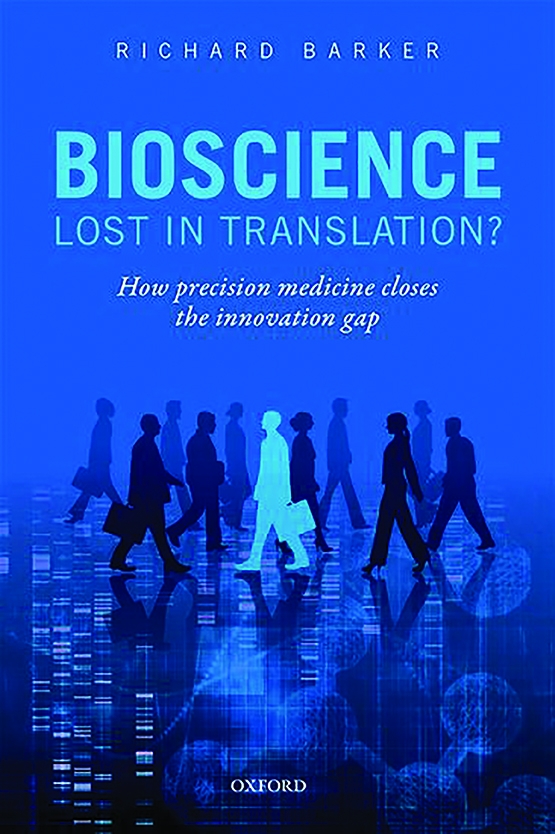
Bioscience: lost in translation? How precision medicine closes the innovation gap. Barker R. Oxford University Press, 2016 (£29.99; 240 pp). ISBN 9780198737780
You don’t believe there is an issue with translating bioscience into practice? This title is not for you then. This one is for the believers — those believers who come from diverse disciplines but share common ground in having human health at the core of their concern. Richard Barker, founding Director of the Centre for the Advancement of Sustainable Medical Innovation in the United Kingdom, draws on his decades of experience as leader and strategic advisor on health care and life sciences to address the growing disconnect between scientific discovery and translation of such discovery into practice.
The comparatively slow uptake of innovation activities in health care is challenged in this book; the author provocatively questions why health care lags behind many other human needs sectors, such as information technology, transportation and communications.
Barker delves deep into why an innovation gap even exists and offers solid, pragmatic reasoning for how this gap could be managed in practice. Although the author is not from Australia and his examples come largely from experience in the UK, North America and Europe, the fundamental principle of the book remains valid for an Australian audience. His warnings about the gaps in translating biomedical advancement, for example, the major cultural barriers between health care providers, academics and industry are certainly relevant to the Australian setting. The challenges mentioned in Bioscience: lost in translation? are not unique to one country or continent, making the book a valuable and interesting addition to the literature on this topic.
Most impressively, the author is willing to offer his solutions for bridging the gaps in translation. Talking about problems is easy; proposing clear and actionable solutions is much more difficult, often merely paid lip service or left out of the discussion altogether. Whether one agrees or disagrees with Barker’s seven-point solution is of course up to the individual, but his willingness to explore and explain solutions gives any reader scope for reconsidering the way they contribute to the overall health care system, regardless of their role or field of interest.
Competing interests
No relevant disclosures.
Using generative artificial intelligence in clinical practice: a narrative review and proposed agenda for implementation
Ian A Scott, Sandeep Reddy, Tanya Kelly, Tim Miller, Anton Vegt
The CURE Asthma roadmap
Gary P Anderson, Anthony Flynn, Phil G Bardin, John D Blakey, Shyamali C Dharmage, Paul Foster, Peter G Gibson, Adam Jaffe, Alan James, Christine R Jenkins, Sundram Sivamalai, Peter D Sly, Guy B Marks, Vanessa M McDonald, Judy Wetttenhall
CURE Asthma: a unique opportunity for Australia
Anthony Flynn, Wendy Edmondson, Alan James, Caroline Lodge, Vanessa M McDonald, Christine R Jenkins, John Blakey, Gary P Anderson
Evidence from Australian cohort studies about asthma trajectories and transitions across the life course: a narrative review
Caroline Lodge, Xin Dai, Ingrid A. Laing, Michael P Menden, Anthony Flynn, Gary P Anderson, Sarath Ranganathan, Shyamali C Dharmage
Technological advances in the search for a CURE for asthma
Sara Quon, Timothy M Johanson, Ridhima Wadhwa, Alen Faiz, Anthony Flynn, Gary P Anderson, Amanda J Cox, Nicholas P West, Michael P Menden, Rhys S Allan
Protecting public interest journalism as a public health good
Bronwyn Fredericks, Neha Lalchandani, Melissa A Sweet, Alex Cramb, Carmel Williams