




Volume 207 - Issue 5
Corynebacterium minutissimum infection: erythrasma
Authors: Deshan F Sebaratnam and Stephen Lee
Med J Aust 2017; 207 (5): 189. || doi: 10.5694/mja16.01081
Published online: 4 September 2017
Published online: 4 September 2017
A 68-year-old man presented with a 4-month history of mildly pruritic, well circumscribed, red-brown plaques with overlying scale affecting the axillary and inguinal regions
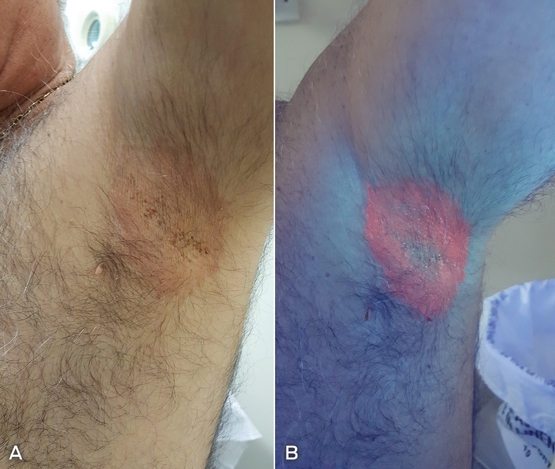
A 68-year-old man presented with a 4-month history of mildly pruritic, well circumscribed, red-brown plaques with overlying scale affecting the axillary and inguinal regions (Figure, A). Wood lamp examination showed vivid coral pink fluorescence (Figure, B) suggestive of erythrasma. Corynebacterium minutissimum infection was confirmed through bacterial culture.
C. minutissimum is a gram-positive rod with a characteristic fluorescence attributable to synthesis of coproporphyrin III. General measures include optimising weight and glycaemic control where indicated. Treatment options include topical clindamycin, fusidic acid, azole antifungals or a 2-week course of a systemic macrolide or tetracycline antibiotic for generalised or recalcitrant cases.
Competing interests
No relevant disclosures.
Provenance: Not commissioned; externally peer reviewed.
Diagnosing Acute Kava Dermopathy: A Case Report of a Characteristic Cutaneous Eruption
Ali Abid, Nicholas Allen, Abeer Hagelamin, Christopher Henderson, Artiene Tatian
Localised Herpes Simplex Following Midline Laparotomy
Jessica S. Bulluss, Paul Chee, Matthew J. Verheyden
No silver lining with health misinformation: argyria caused by intentional silver consumption
Luke Collins, Logesh Palanikumar, Stephen Bacchi
Lingual Raynaud phenomenon
Michael Taggart, Mina John
Melasma in the male: a less well recognised entity
Tim Aung, Rowland Noakes
Age group‐specific changes in keratinocyte cancer treatment rates in Australia, 2012–2021: a retrospective cohort study based on MBS claims data
Catherine M Olsen, Nirmala Pandeya, Rachel E Neale, David C Whiteman