




Volume 206 - Issue 2
The strengths and weaknesses of evidence-based medicine
Author: Jeffrey D Zajac
Med J Aust 2017; 206 (2): 69. || doi: 10.5694/mja16.01182
Published online: 6 February 2017
Published online: 6 February 2017
Evidence-based medicine: best practice or restrictive dogma
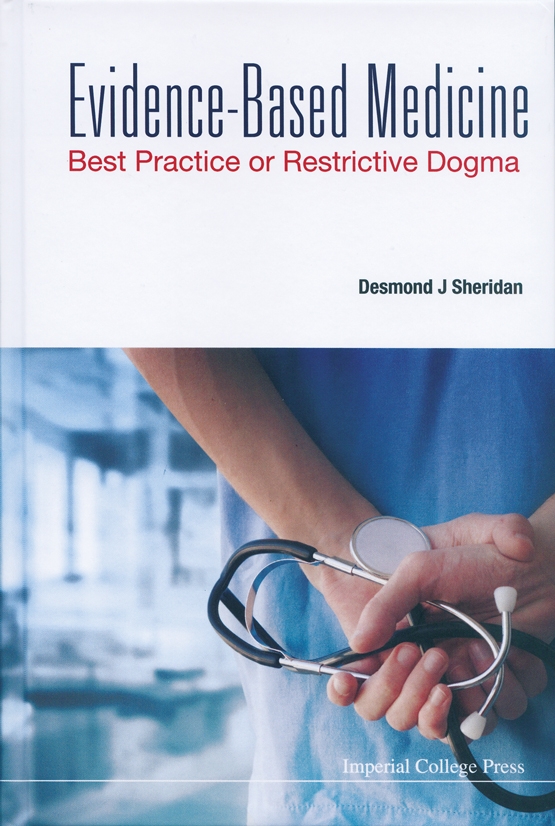
Evidence-based medicine: best practice or restrictive dogma.
Desmond J Sheridan. Imperial College Press, 2016 (228 pp, US$106.00). ISBN 9781783267620
The life of a clinician is saturated with evidence-based medicine (EBM). As this analysis notes, “no other movement has succeeded in capturing the agenda for deciding the future of clinical practice more effectively than EBM”. If you are entirely satisfied with EBM, you may feel this book is not for you. On the other hand, if you are looking for a rigorous argument displaying the flaws of EBM, you may want to read Evidence-based medicine: best practice or restrictive dogma. The argument is not so much anti-EBM (for who can be anti-evidence at present?), but more an argument for balance in the use of evidence. Is EBM new? Has it been captured by clinical epidemiologists? Is it too far removed from clinical medicine? These questions are discussed at length in the book. Sheridan, an Emeritus Professor of Cardiology at the National Health and Lung Institute, Imperial College London, makes a vigorous defence of expert opinion, experience and clinical judgement, which are levels of evidence rated very low in the EBM paradigm. There are fascinating re-assessments of evidence from the past, including the arguments for and against antiviral agents in preventing influenza, and a re-analysis of John Snow’s discovery of the link between cholera and public water supply. The author’s strongest criticism relates to what he describes as the retrospective, non-hypothesis driven, non-scientific approach of EBM. He states that the efforts of EBM “are singularly directed towards the analysis of what has gone before,” and that “EBM is not a science, but rather a concept that medical practice should be based on the best available evidence”. Chapters five and six include a complex and detailed analysis of data-driven evidence in EBM compared with hypothesis-based medical research. There is also a thorough discussion about the impact of EBM-focused research on original medical science. Overall, this book provides an interesting analysis of the strengths and weaknesses of EBM. It is short, easy to read and well referenced. It will be enjoyed and analysed, and will promote intense argument among clinicians. For those who have concerns about some elements of EBM, this book will provide ammunition. In his introduction, Sheridan writes that “some of my views may meet with disagreement”. If you read this book, you may agree. I recommend that if you have an interest in EBM, you read the book from cover to cover.
Prisoner of war pathology in Changi, 1942–1945
Kate Ariotti, Elizabeth Roberts‐Pedersen
Should medical eponyms continue to be used in everyday practice?
Leya Nedumannil, Diana Lewis
100 years on: the first use of insulin in Australia
Sophie Templer
Reflections on the life and career of Professor Dame Valerie Beral AC DBE FRS FRCOG FMedSci (1943–2022)
Karen Canfell, Bette Liu, Emily Banks
The Honourable Dr Donald James Grimes AO
Michael Kirby, Patti Warn
From wipeout to drill out: a history of exostosis management and Australian surfing
Alon Taylor, Hannah North, Narinder P Singh, Paul A Fagan