




Volume 203 - Issue 2
Hereditary leiomyomatosis and renal cell carcinoma syndrome
Authors: Nira Chinniah and Patricia Lowe
Med J Aust 2015; 203 (2): 78-79. || doi: 10.5694/mja15.00292
Published online: 20 July 2015
Published online: 20 July 2015
A rare benign carcinoma is caused by a mutation in the fumarate hydratase gene
To the Editor: A 52-year-old woman was referred in 2003 for cutaneous examination following excision and radiotherapy of a left tonsillar squamous cell carcinoma in 2000. Her personal history was remarkable for her developing asymptomatic cutaneous nodules since the age of 20 years and uterine fibroids requiring hysterectomy at 28 years; she underwent bilateral oophorectomy for symptomatic ovarian cysts at the age of 48. She had a family history of early-onset uterine fibroids.
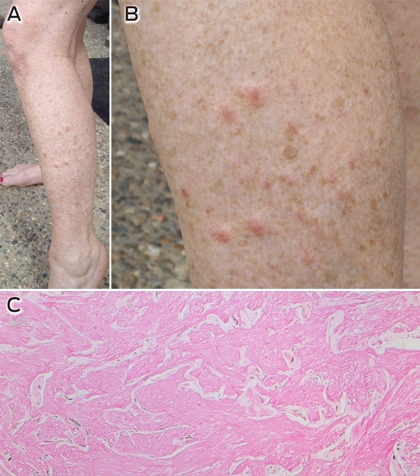
Physical examination revealed multiple firm red papules and nodules on her forearms, abdomen and legs (Box 1, A, B), clinically consistent with benign smooth muscle tumours (leiomyomas). A right arm lentigo maligna melanoma and multiple basal cell carcinomas were also detected.
Skin biopsy of a long-standing nodule revealed that the dermis was filled with irregular fascicles of pleomorphic smooth muscle cells that infiltrated the collagen bundles (Box 1), consistent with leiomyoma.
Over the following decade, the woman developed multiple benign bowel polyps, a fibroadenoma in the right breast, a lobulated cyst in the left kidney, and a lentigo maligna melanoma on the left thigh.
Her presentation was suggestive of hereditary leiomyomatosis and renal cell carcinoma syndrome (HLRCC). This rare condition is caused by a mutation in the fumarate hydratase (FH) gene on chromosome 1q. FH catalyses the conversion of fumarate to malate and acts as a tumour suppressor gene.1,2 In our case, mutational analysis revealed a heterozygous FH:c.302A > C variant in exon 3 of the FH gene.
HLRCC is inherited in an autosomal dominant manner, with more than 75 different mutations and 100 pedigrees reported worldwide. The prevalence of the syndrome, however, remains unknown. It is characterised by the development of multiple cutaneous and uterine leiomyomas, and skin lesions are the earliest feature. Importantly, renal malignancies develop in up to 16% of individuals.3 Consensus criteria for the diagnosis of HLRCC are listed in Box 2.
Although the dermatologist often makes the initial diagnosis, multidisciplinary care of the patient and at-risk family is essential, and should involve the gynaecologist, urologist and geneticist. While no official guidelines exist, baseline screening for uterine and renal tumours by ultrasound, computed tomography (CT) or magnetic resonance imaging (MRI) can reveal the extent of disease. Follow-up surveillance includes cutaneous and pelvic examinations every 1–2 years, together with abdominal and pelvic ultrasound, CT or MRI assessments, depending on the medical centre. Treatment of the benign leiomyomas is elective.
1 A, B: Papules and nodules on the leg of the 52-year-old patient. C: Skin biopsy of nodule from the patient
2 Diagnostic criteria for hereditary leiomyomatosis and renal cell carcinoma syndrome (HLRCC)4
Definitive diagnosis
- Confirmed mutation in the fumarate hydratase gene.
Major criterion
- Multiple cutaneous leiomyomas with at least one histological confirmation.
Minor criteria
- A single leiomyoma with a positive family history of HLRCC.
- Multiple early-onset uterine fibroids.
- Early-onset renal tumours (papillary type II).
The genetic finding confirms the diagnosis. HLRCC is strongly suggested by the presence of the major criterion and is supported by the presence of the minor criteria.
Competing interests
No relevant disclosures.
References
- Alam NA, Olpin S, Leigh IM. Fumarate hydratase mutations and predisposition to cutaneous leiomyomas, uterine leiomyomas and renal cancer. Br J Dermatol 2005; 153: 11-17. _Ref420939036
- Henley ND, Tokarz VA. Multiple cutaneous and uterine leiomyomatosis in a 36-year-old female, and discussion of hereditary leiomyomatosis and renal cell carcinoma. Int J Dermatol 2012; 51: 1213-1216. _Ref420939038
- Pithukpakorn M, Toro JR. Hereditary leiomyomatosis and renal cell cancer. In: Pagon RA, Adam MP, Ardinger HH, et al, editors, GeneReviews. Seattle (WA): University of Washington. Updated Nov 2010. http://www.ncbi.nlm.nih.gov/books/NBK1252/ (accessed May 2015).
- Schmidt LS, Linehan WM. Hereditary leiomyomatosis and renal cell carcinoma. Int J Nephrol Renovasc Dis 2014; 7: 253-260. _Ref421007996
Diagnosing Acute Kava Dermopathy: A Case Report of a Characteristic Cutaneous Eruption
Ali Abid, Nicholas Allen, Abeer Hagelamin, Christopher Henderson, Artiene Tatian
Localised Herpes Simplex Following Midline Laparotomy
Jessica S. Bulluss, Paul Chee, Matthew J. Verheyden
No silver lining with health misinformation: argyria caused by intentional silver consumption
Luke Collins, Logesh Palanikumar, Stephen Bacchi
Lingual Raynaud phenomenon
Michael Taggart, Mina John
Melasma in the male: a less well recognised entity
Tim Aung, Rowland Noakes
Age group‐specific changes in keratinocyte cancer treatment rates in Australia, 2012–2021: a retrospective cohort study based on MBS claims data
Catherine M Olsen, Nirmala Pandeya, Rachel E Neale, David C Whiteman