




Volume 202 - Issue 7
Hippocratic heroes
Author: Peter C Arnold
Med J Aust 2015; 202 (7): 393. || doi: 10.5694/mja15.00117
Published online: 20 April 2015
Published online: 20 April 2015
Jewish medical resistance in the Holocaust
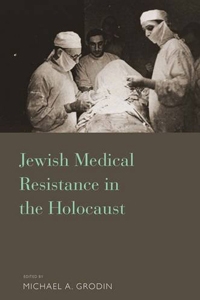
Jewish medical resistance in the HolocaustJewish medical resistance in the Holocaust.
. Michael A Grodin, editor. New York, Oxford: Berghahn Books, 2014 (308 pp, $119.99). ISBN 9781782384175. Michael A Grodin, Ed. New York/Oxford: Berghahn, xxxx (308 pp, $119.99). ISBN
“The systematic, deliberate, physical annihilation of the European Jews” was Nazi Germany's “Final Solution of the Jewish Question”, according to the United States Holocaust Memorial Museum (http://www.ushmm.org/wlc/en/article.php?ModuleId=10005477).
WHEN HITLER SEIZED POWER in 1933, around 9 500 000 Jews lived in Europe. Six million of these were killed by the Germans and their Polish, Lithuanian, Latvian and other collaborators, or died of starvation and epidemics in ghettos and concentration camps. A tiny number survived.
Questions have been asked about an apparent absence of resistance, especially in the military sense. There was some by the Bielski brothers and other bands of partisans, and in the Warsaw Ghetto in Poland.
Grodin, Professor of Health Law, Bioethics and Human Rights at the Boston University School of Public Health, and his coauthors have carefully documented a different kind of resistance — against the hazards of overcrowding in unhygienic conditions. The associated starvation, malnutrition and epidemics in the ghettos and holding camps killed tens of thousands of inmates. The survivors were packed into cattle trucks without food, water or toilet facilities, for days on end, until the hardiest reached the death camps.
Doctors, even the most prominent professors and researchers, were rounded up with the other Jews, and shared their privations. Many died. But while they lived, they resisted the killing of Jews. Within the limitations of captivity, they attended to public health measures, did what they could for the physically ill, and comforted those whose mental health had deteriorated. Creating a semblance of normality, they taught students, undertook surgery, did research … even making a typhus vaccine from urine.
A few dozen doctors, no longer alive, were among the 27 000 survivors of the ghettos and camps who found refuge in Australia. They included Eugenia (Ena) Hronsky, from the Auschwitz concentration camp in Poland, who became a general practitioner in Adelaide; Sydney GPs Abrasha Wajnryb and David van der Poorten, the former from the Vilna Ghetto in Lithuania and the latter a survivor of the Westerbork and Theresienstadt camps in the Netherlands and Czech Republic (formerly Bohemia), respectively; and Sydney obstetrician and gynaecologist Henryk Frant, from the Warsaw Ghetto.
The courage and achievements of our incarcerated colleagues warrant our recognition as truly Hippocratic heroes. Their stories merit the attention of doctors and students who, in the ideal surroundings of 21st century Australian medicine, cannot imagine medical practice in such deprived circumstances.
Competing interests
Competing interests: I am Jewish and was a friend of the late Dr Ena Hronsky, and I know descendants of the other doctors mentioned. Members of my family and of my wife's family were murdered during the German occupation of Lithuania.
Prisoner of war pathology in Changi, 1942–1945
Kate Ariotti, Elizabeth Roberts‐Pedersen
Should medical eponyms continue to be used in everyday practice?
Leya Nedumannil, Diana Lewis
100 years on: the first use of insulin in Australia
Sophie Templer
Reflections on the life and career of Professor Dame Valerie Beral AC DBE FRS FRCOG FMedSci (1943–2022)
Karen Canfell, Bette Liu, Emily Banks
The Honourable Dr Donald James Grimes AO
Michael Kirby, Patti Warn
From wipeout to drill out: a history of exostosis management and Australian surfing
Alon Taylor, Hannah North, Narinder P Singh, Paul A Fagan