




Reflections
Book review
Volume 202 - Issue 7
Balanced tribute to our ANZAC surgeons
Author: Bruce P Waxman
Med J Aust 2015; 202 (7): 392. || doi: 10.5694/mja15.00377
Published online: 20 April 2015
Published online: 20 April 2015
ANZAC surgeons of Gallipoli
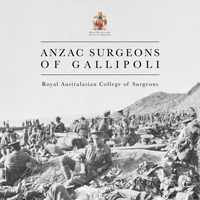
WHEREAS THE OBJECTIVE of this book is to highlight and commemorate the contribution that Australian and New Zealand surgeons made to the Dardanelles Campaign, on this centenary of the ANZAC (Australian and New Zealand Army Corps) landings at Gallipoli on 25 April 1915, it goes far beyond that, by providing a balanced appraisal of the medical and surgical services of both the Allies and the Turks, sprinkled with details of the military aspects of the campaign.
Although 15 surgeons from Australia and New Zealand — many with a military background — and college staff have contributed to the book, much of the credit for the final product should go to its editors. Milford, the Royal Australasian College of Surgeons (RACS) archivist, was responsible for some of the biographies, and the collation, editing and proofreading; and Watters, the principal surgical author and College president-elect, recruited the contributors, wrote some of the chapters and has been the driving force in the book's publication in time for its launch on 23 April 2015 at the RACS headquarters in Melbourne.
Most readers will find the biographies of the surgeons are what make the book so special. From Aberdeen to Zwar, the biographies are arranged alphabetically and interspersed between the four chapters and epilogue. All the biographies follow the same outline: exploring each surgeon's early life; time spent at Gallipoli; period of service during the First World War after Gallipoli; and professional life after the war.
Most of them were surgeons at the time of the Dardanelles Campaign, but several were medical officers or students who subsequently became surgeons, many becoming Fellows of the College when it was founded in 1927.
Of the 127 surgeons, 80 were Australians and 47 New Zealanders. Fifty-eight were involved with the landings at Anzac Cove, 16 served on ships offshore in the Dardanelles and 53 in field hospitals in the surrounding Greek islands or in Egypt. Six subsequently became presidents of the College.
Watters's introduction explores the rationale for the Gallipoli Campaign, the Mediterranean expeditionary force, Turkish preparations, medical arrangements, establishment of communications, problems with transporting casualties and the Turkish line of command. Peter Sharwood wrote the second chapter on lessons learned from the campaign, both military and medical. Harvey Broadbent wrote the chapter that deals with the Turkish medical arrangements. The final chapter covers wounds: the management of long bone fractures (Sharwood); head and scalp wounds (Jeff Rosenfeld); dental and facial issues (Peter Sharp); chest wounds (Watters); and abdominal wounds (Graeme Stewart).
The epilogue explores the military failures and repercussions for the commanders including Winston Churchill, the architect of the campaign.
In keeping with the balanced nature of the book, the epilogue finishes with an acknowledgement of Mustafa Kemal Ataturk, a Turkish commander during the campaign and the first president of the Republic of Turkey. In 1934, Ataturk's speech, which is immortalised in a memorial at Anzac Cove, indicates how the Turks greatly admired their Allied counterparts, with this tribute to the fallen:
Those heroes who shed their blood
and lost their lives …
You are now living in the soil of a friendly country.
Therefore rest in peace.
There is no difference between the Johnnies
And the Mehmets to us where they lie side by side Here in this country of ours ...
You, the mothers,
Who sent their sons from far away countries
Wipe away your tears;
Your sons are now lying in our bosom
And are in peace.
After having lost their lives in this land they have Become our sons as well.
Competing interests
I am a member of the RACS staff and contributed to a few of the biographies, but I had no role in the production and publication of the book.
Prisoner of war pathology in Changi, 1942–1945
Kate Ariotti, Elizabeth Roberts‐Pedersen
Should medical eponyms continue to be used in everyday practice?
Leya Nedumannil, Diana Lewis
100 years on: the first use of insulin in Australia
Sophie Templer
Reflections on the life and career of Professor Dame Valerie Beral AC DBE FRS FRCOG FMedSci (1943–2022)
Karen Canfell, Bette Liu, Emily Banks
The Honourable Dr Donald James Grimes AO
Michael Kirby, Patti Warn
From wipeout to drill out: a history of exostosis management and Australian surfing
Alon Taylor, Hannah North, Narinder P Singh, Paul A Fagan