




Volume 200 - Issue 1
Ancient Egyptian surgery
Author: Peter R Mayall
Med J Aust 2014; 200 (1): 51-53. || doi: 10.5694/mja12.10837
Published online: 20 January 2014
Published online: 20 January 2014
Ancient Egyptian surgeons employed skill, magic and superstition to perform an impressive array of procedures
Ancient surgical techniques may appear bizarre to modern practitioners, but persisted in Egyptian society for three millennia
People who are badly injured in our time obviously have a much better chance of surviving than did those living in ancient civilisations. We can learn about the management of trauma in ancient Egypt from ancient medical papyri (Box 1), inscriptions and representations in temples and tombs, and from existing mummified and skeletal human remains showing evidence of traumatic injuries and subsequent medical attention. In this article, I present examples of trauma management that illustrate the comprehensive and systematic approach employed by ancient Egyptians surgeons.
The management of battlefield casualties involved triaging followed by medical and, where appropriate, surgical treatment, in addition to spiritual and magical approaches. Egyptian surgeons had a pragmatic approach to triaging injured patients, indicating whether they could be treated, observed or not treated, supported by their belief that life on earth was just a stage in their progress to the afterlife, so death was not to be feared. An ancient Egyptian funerary text said:
Treatment for many injuries, including compound fractures of the humerus, skull, nasal bones and ribs, where infection was inevitable, was considered to be futile. The poor prognosis given to many patients left plenty of scope for priests and magicians to be involved.
Ancient Egyptian healers probably did not differentiate between empirical, rational medical treatment and that involving religion and magic. This rationale was consistent with the prevailing philosophy about the cause of injury and disease. Without any obvious traumatic event, as in the case of an infection or medical condition, ancient Egyptian healers believed that malevolent spirits were involved, making it appropriate for religious incantations or magical amulets to be used to counter them.
Open wounds provided a possible entry point where noxious forces could gain entry.
Something from the outside, it means the breath of an outside god or death; not the intrusion of something his flesh engenders — Edwin Smith papyrus, Case 8.2
Empirical observation (rather than the rationale behind the original application) probably determined the continued use of a specific treatment. Animal excrement and other offensive substances applied to wounds were aimed at deterring offensive agents, whereas those agents that were beneficial were encouraged by aromatic and sweet substances, such as honey. Fresh meat was applied to wounds because it was believed that healthy tissue was able to repair damaged tissue of the same type. There are records of remedies for controlling pain that contained myrtle, dill, lettuce, cumin and linseed, either taken orally or as a poultice.3 The mandrake plant was used as an analgesic and narcotic, and opium was also available.
There is no evidence that major surgery was used for anything other than traumatic injuries. However, “knife treatment” was recommended for swellings and tumours, including abscesses and haematomas. Surgical knives were made of copper as well as of flakes of flint or obsidian which were sharp, relatively sterile and disposable. Needles suitable for surgical suturing made of copper and silver have been recovered, but the only suturing actually found was in embalming wounds.
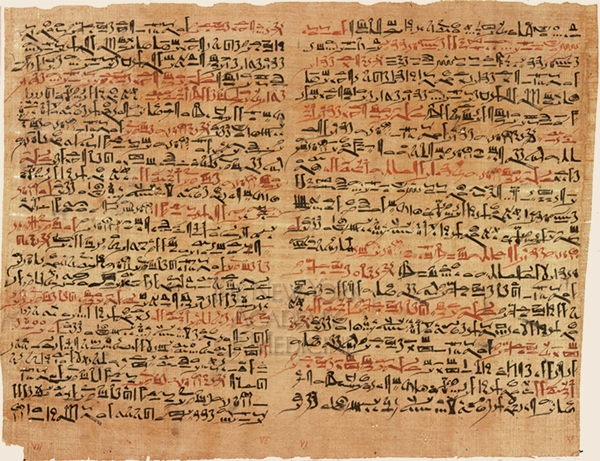
The Edwin Smith surgical papyrus (Box 1) was first written in about 2600 bce, and is the pivotal reference for the management of traumatic injuries in ancient Egypt, with numerous cases recorded.2
A gaping flesh wound over the eyebrow was treated as follows:
. . . after thou hast stitched it . . . bind fresh meat upon it on the first day . . . if the stitching is loose . . . draw it together with two strips of plaster . . . and treat it with grease and honey every day until he recovers. — Edwin Smith papyrus, Case 10.2
Material available for suturing included flax, hemp, bark fibre, hair, linen and catgut; other wounds were closed with adhesive strips of linen coated with honey and flour.
The treatment of penetrating wounds is discussed in several cases. Wounds of the mouth and nose, penetrating to the oral and nasal cavities, were treated by stitching followed by the application of honey, with the nose also being packed with two swabs of linen to control bleeding.
Wound infections were probably regarded as part of the healing process with inflammation being recognised:
. . . that wound is inflamed . . . inflammation continues to issue from the mouth of that wound . . . the two lips of that wound are ruddy, while that man continues to be feverish from it . . . the granulation in the mouth of the wound is watery, the surface is hot and secretions drop therefrom. — Edwin Smith papyrus, Case 41.2
Fresh meat was initially applied to wounds, followed by honey on subsequent days. When wounds became inflamed, a cooling application containing various leaves and dung for drawing out the inflammation was applied, then an astringent application containing copper and sodium salts to dry the wound, followed by a poultice containing various unidentified herbs.2
Abscesses must have been common sequelae, and a chest wound is described in the Edwin Smith papyrus.
. . . a man having tumours with a prominent head . . . the swellings have spread with pus over his breast, have produced redness . . . is very hot when thy hand touches him. — Edwin Smith papyrus, Case 39.2
Cautery was used for haemostasis, utilising a “fire-drill” in which a pointed stick was rapidly rotated in a hollow in a block of wood to produce a burning, glowing end which was then applied to a bleeding wound.
Injuries to bones and joints are described, including a fractured clavicle reduced by placing the patient:
. . . prostrate on his back, with something folded between his shoulder-blades . . . until that break falls into place. — Edwin Smith papyrus, Case 35.2
In the case of a fractured humerus:
. . . thou shouldst make for him two splints of linen and thou shouldst apply one of them both on the inside of his upper arm and the other on the underside of his upper arm. — Edwin Smith papyrus, Case 36.2
The linen splints were probably treated with a mineral to stiffen the splints, or made of pieces of wood or bark covered with linen. An example was found applied to a fractured forearm (Box 2). By contrast, a compound fractured humerus was regarded as fatal and not treatable:
If thou findest that wound which is over the break, with blood issuing from it and piercing through to the interior of his injury . . . An ailment not to be treated. — Edwin Smith papyrus, Case 38.2
Fractured ribs are encountered in which examination reveals:
. . . one having a break in the ribs of his breast over which a wound has been inflicted and thou findest that the ribs of his breast crepitate under his fingers. — Edwin Smith papyrus, Case 44.2
In this case, it was decided that it was “an ailment not to be treated”, which suggests that the surgeon felt that this was either really untreatable or did not require treatment.
There were successful amputations as shown in the remains of pyramid builders at Giza, some of which had healed stumps.5
Spinal injuries and their neurological sequelae were recognised:
. . . one having a dislocation in a vertebra in his neck, while he is unconscious of his two legs and his two arms and his urine dribbles — Edwin Smith papyrus, Case 31.2
This particular patient was recognised as having a hopeless prognosis. The verdict was “an ailment not to be treated”.
During battles, skull fractures were common as a result of blows to the head with a club or battleaxe; many of these were on the left side, presumably inflicted during frontal attacks by right-handed opponents. Increasingly severe examples of skull fractures are described, from a simple perforation with a relatively good prognosis, to one in which blood was coming from the ears associated with neck stiffness, and the next with fragments of bone driven into the skull. In another, the brain was exposed with the appearance of “those corrugations which appear on molten copper”. In a subsequent case, the “cord of the mandible is contracted” indicating tetanus (Cases 5–7 of the Edwin Smith papyrus2).
A further example had a skull fracture without any external wound in which the patient’s:
. . . eye is askew on the side of him having that injury . . . and he walks shuffling with his sole on the side of him having that injury. — Edwin Smith papyrus, Case 8.2
This is recognition of the effect of a cerebral injury on leg movement, and suggests an intracranial haematoma which may have been amenable to trepanation. Examples of this procedure showing healed bone margins as evidence that the patients at least survived have been identified (Box 3).
The respect and reverence for traditional teaching and the consequences of varying from the time-honoured methods of treatment was indicated by the Greek historian, Diodorus.7
The physicians administer their treatments in accordance with a written law which was composed in ancient times by many famous physicians. If they follow the rules of this law in the ancient book and are unable to save the patient they are absolved . . . but if they go contrary to the law’s prescriptions, they must submit to a trial with death as the penalty.
The extreme conservatism of Egyptian society and the absence of significant outside influences resulted in medical procedures being basically unchanged for 3000 years until the sixth century bce, when Greek medical practices were first introduced. In spite of the great contrast with modern techniques, contemporary surgeons could probably relate to some of the issues faced by their ancient Egyptian colleagues, including deciding on options for treatment and facing the consequences of failure.
2 Fractured radius and ulna with splints, from a 5th Dynasty tomb
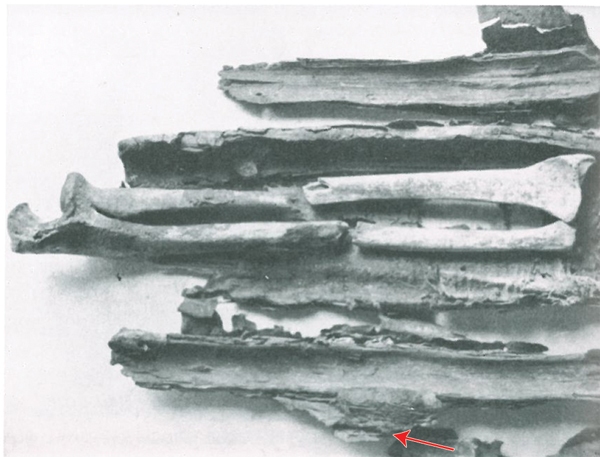
First published in the British Medical Journal in 1908.4 Reproduced with permission.
3 An Egyptian skull with a healed wound suggesting a successful trepanation
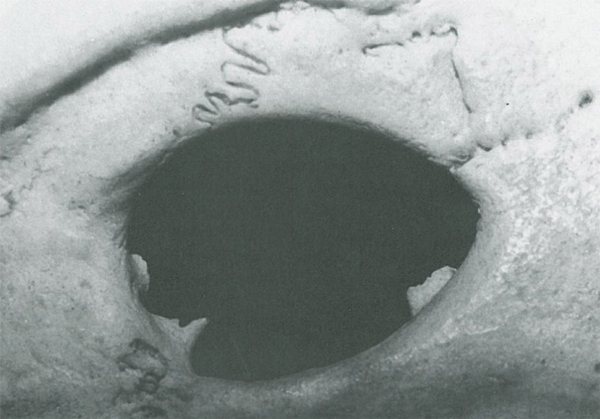
Dated to c. 600–300 ad. Photograph by Joyce Filer, first published in her book Disease.6 Reproduced with permission.
Competing interests
No relevant disclosures.
References
- Ikram S, Dodson A. The mummy in ancient Egypt: equipping the dead for eternity. London: Thames and Hudson, 1998. 0_i1115697
- Breasted JH, editor. The Edwin Smith surgical papyrus. Oxford: Oxford University Press, 1930: 374-379. 0_CHDDJGGA
- Manniche L. An ancient Egyptian herbal. London: British Museum Press, 1989. 0_i1115701
- Smith G. The most ancient splints. Br Med J 1908; 1: 732-736. 0_i1115703
- Hawass Z. The discovery of the tombs of the pyramid builders at Giza. 1997. http://www.guardians.net/hawass/buildtomb.htm (accessed Nov 2013).
- Filer J. Disease. London: British Museum Press, 1995. 0_i1115707
- Diodorus Siculus, Bibliotheca historica, Book 1: 82. 0_i1115709
Prisoner of war pathology in Changi, 1942–1945
Kate Ariotti, Elizabeth Roberts‐Pedersen
Should medical eponyms continue to be used in everyday practice?
Leya Nedumannil, Diana Lewis
100 years on: the first use of insulin in Australia
Sophie Templer
Reflections on the life and career of Professor Dame Valerie Beral AC DBE FRS FRCOG FMedSci (1943–2022)
Karen Canfell, Bette Liu, Emily Banks
The Honourable Dr Donald James Grimes AO
Michael Kirby, Patti Warn
From wipeout to drill out: a history of exostosis management and Australian surfing
Alon Taylor, Hannah North, Narinder P Singh, Paul A Fagan