




Volume 200 - Issue 1
Changing trends in venous thromboembolism-related imaging in Western Australian teaching hospitals, 2002–2010
Author: David Mountain
Med J Aust 2014; 200 (1): 26-27. || doi: 10.5694/mja13.10292
Published online: 20 January 2014
Published online: 20 January 2014
To the Editor: The article by Segard and Macdonald is interesting but has significant methodological weaknesses and reports data that do not support all of their conclusions.1
Methodologically, retrospective dataset reviews with little demographic or morbidity data to avoid confounding (it is unclear
why these were not available) are problematic. Additionally, death certificates were used as a surrogate for improved outcomes from additional diagnosis.
Segard and Macdonald ...
To the Editor: The article by Segard and Macdonald is interesting but has significant methodological weaknesses and reports data that do not support all of their conclusions.1
Methodologically, retrospective dataset reviews with little demographic or morbidity data to avoid confounding (it is unclear why these were not available) are problematic. Additionally, death certificates were used as a surrogate for improved outcomes from additional diagnosis.
Segard and Macdonald used census data to estimate growth of the at-risk population (18.9%) over the study period. However, the almost 70% growth in emergency department (ED) attendances2,3 is arguably as relevant, as most venous thromboembolism (VTE) tests are ordered by the ED (own unpublished data). During this same decade Australian patients, increasingly, were older, more obese and presented with more comorbidities — all of which increase pulmonary embolism (PE) risk.4,5
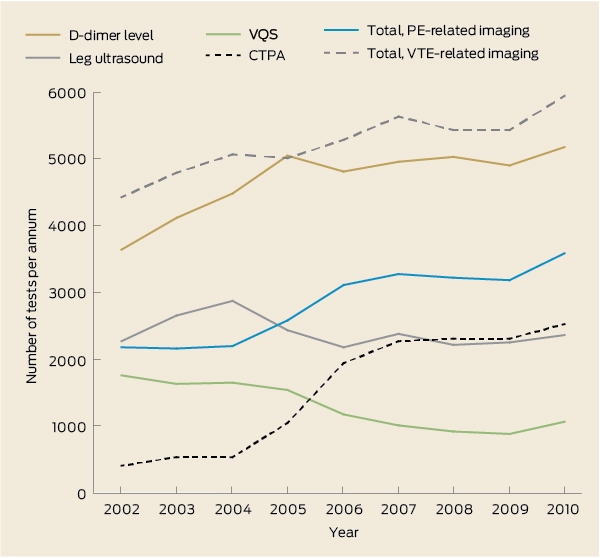
The data presented contradict the authors’ clear inference that increasing D-dimer referrals drove VTE testing. D-dimer referrals increased from 2002 to 2005 and then plateaued (Box), while computed tomography pulmonary angiography (CTPA) requests only started increasing from 2004, and plateaued from 2007.
An alternative hypothesis is that new tests that were perceived as useful increased investigation rates. Additionally, D-dimer testing probably reduced CTPA testing in low-risk patients, improving case selection and potentially reducing false-positive rates.
Using death certificates to estimate PE mortality is problematic, as up to 70% of PEs are misdiagnosed and PE is rarely certified without a premortem diagnosis.6 Per annum, treatment of 10 to 25 patients with stable PE may have been needed to save one life,7 so significant death rate changes were unlikely to be detected.
This study gives useful and important data, but does not give strong evidence that D-dimer testing or CTPA are unhelpful or harmful. The methodological issues, relatively weak surrogate outcome and temporally disconnected increases in test rates necessitate great care in making significant inferences from this study.
Competing interests
No relevant disclosures.
References
- Segard T, Macdonald WBG. Changing trends in venous thromboembolism-related imaging in Western Australian teaching hospitals, 2002–2010. Med J Aust 2013; 198: 100-103. 0_CBBJAAIE
- Australian Institute of Health and Welfare. Australian hospital statistics 2011–12: emergency department care. Canberra: AIHW, 2012. (AIHW Cat. No. HSE 126.) http://www.aihw.gov.au/publication-detail/?id=10737423042 (accessed Feb 2013).
- Australian Institute of Health and Welfare. Australian hospital statistics 2007–08. Canberra: AIHW, 2009. (AIHW Cat. No. HSE 71.) http://www. aihw.gov.au/publication-detail/?id=6442468249 (accessed Feb 2013).
- Lowthian J, Curtis A, Stoelwinder J, et al. Emergency demand and repeat attendances by older patients. Intern Med J 2013; 43: 554-560. doi: 10.1111/imj.12061. 0_pgfId-2976495
- Lynch C, Holman CDJ, Moorin RE. Use of Western Australian linked hospital morbidity and mortality data to explore theories of compression, expansion and dynamic equilibrium. Aust Health Rev 2007; 31: 571-581. 0_pgfId-2976503
- Attems J, Arbes S, Böhm G, et al. The clinical diagnostic accuracy rate regarding the immediate cause of death in a hospitalized geriatric population; an autopsy study of 1594 patients. Wien Med Wochenschr 2004; 154: 159-162. 0_i1142894
- Calder KK, Herbert M, Henderson SO. The mortality of untreated pulmonary embolism in emergency department patients. Ann Emerg Med 2005; 45: 302–310. 0_i1142895
‘Once Bitten’: A Case of Tetanus Following Snakebite in Australia
Adrian A. S. Doherty, Naomi N. E. Clarke, Sarah Fletcher, Sarah Huffam, Camille V. Awburn, Eugene Athan
Epidemiology and Quality of Care for Aboriginal and Torres Strait Islander Peoples Treated by Emergency Medical Services for Stroke in Victoria, Australia: Retrospective Analysis of Linked Data
Candice Menezes, Ziad Nehme, Luke J. Burchill, Tegwyn McManamny, Angela Dos Santos, Michelle Crilly, Luke P. Dawson, Benjamin Clissold, David Anderson, Emily Nehme
Intranasal Adrenaline Use for the Management of Insect Venom-Induced Anaphylaxis
Thomas J. Young, Wilhelmina R. F. Johnson, Braydon L. Pennington, Troy Wanandy, Wun Y. Lau, Thanh-Thao A. Le
Gabapentinoid Poisoning Presentations to Victorian Emergency Departments: A 15-Year Trend Analysis
Bishaal Tej Gurung, Amy McNeilage, Angus Skeen, Tina Lam, Joanna F. Dipnall, Jane Hayman, Suzanne Nielsen, Ting Xia
They Brought the Hospital to Me
Hugh N. Burrill
Predictors of Ambulance Transport to Hospital for Older People Living in Tasmanian Aged Care Facilities: A Retrospective Cohort Study
Sharon Andrews, Pieter F. Fouche, Belinda Flanagan, Michael McDermott, Melanie Greenwood