




Volume 195 - Issue 11
Worst-case scenario
Author: Andrew J Doley
Med J Aust 2011; 195 (11): 719. || doi: 10.5694/mja11.10864
Published online: 12 December 2011
Published online: 12 December 2011
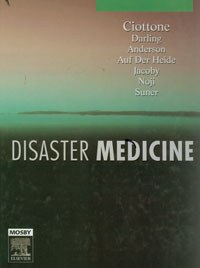
Disaster medicine.
Gregory E Ciottone. Sydney: Mosby Elsevier, 2006 (952 pp, $157.00). ISBN 03230325531.
What should you do if a terrorist organisation managed to use Q fever as a weapon? The modern world continues to throw up challenges to human survival from both manmade and natural disasters as well as deliberate attacks from terrorist organisations.
Disaster medicine is an evolving subspecialty of medicine and this extensive text covers the broad principles of the subject, with detailed references to specific examples. The editor-in-chief, Dr Gregory Ciottone, is the Director of the International Emergency Medicine Section at Harvard Medical School. In this book, he and his United States-based editorial team have brought together an impressive 200 contributions to provide guidance on more than 100 specific disaster situations. Not surprisingly, much of the detail is US-centric.
Nevertheless, the book covers an extensive range of topics, from prehospital management to public health, including the legislative changes made in response to disasters. The chapters are short, well written and informative. A disaster medicine novice would be able to readily digest the material.
The second half of the book gives short lists of practical points related to just about every conceivable attack scenario.
Disaster medicine is not for everyone. This book is an excellent text for those with a passion for the topic. For those with a lesser interest, it functions as a quick reference guide to many extremely unlikely disaster scenarios.
‘Once Bitten’: A Case of Tetanus Following Snakebite in Australia
Adrian A. S. Doherty, Naomi N. E. Clarke, Sarah Fletcher, Sarah Huffam, Camille V. Awburn, Eugene Athan
Epidemiology and Quality of Care for Aboriginal and Torres Strait Islander Peoples Treated by Emergency Medical Services for Stroke in Victoria, Australia: Retrospective Analysis of Linked Data
Candice Menezes, Ziad Nehme, Luke J. Burchill, Tegwyn McManamny, Angela Dos Santos, Michelle Crilly, Luke P. Dawson, Benjamin Clissold, David Anderson, Emily Nehme
Intranasal Adrenaline Use for the Management of Insect Venom-Induced Anaphylaxis
Thomas J. Young, Wilhelmina R. F. Johnson, Braydon L. Pennington, Troy Wanandy, Wun Y. Lau, Thanh-Thao A. Le
Gabapentinoid Poisoning Presentations to Victorian Emergency Departments: A 15-Year Trend Analysis
Bishaal Tej Gurung, Amy McNeilage, Angus Skeen, Tina Lam, Joanna F. Dipnall, Jane Hayman, Suzanne Nielsen, Ting Xia
They Brought the Hospital to Me
Hugh N. Burrill
Predictors of Ambulance Transport to Hospital for Older People Living in Tasmanian Aged Care Facilities: A Retrospective Cohort Study
Sharon Andrews, Pieter F. Fouche, Belinda Flanagan, Michael McDermott, Melanie Greenwood