




Volume 194 - Issue 11
Increasing prevalence of obesity in Australia and its possible effect on the occurrence of pulmonary thromboembolism
Authors: Roger W Byard and Hannah Rosenfeld
Med J Aust 2011; 194 (11): 612. || doi: 10.5694/j.1326-5377.2011.tb03120.x
Published online: 6 June 2011
Published online: 6 June 2011
To the Editor: A recent study of adult bodyweights recorded in 199 countries showed an increase in mean body mass index (BMI) of 0.4 kg/m2 per decade between 1980 and 2008.1 The increase in Australia was even greater: 0.9 kg/m2 for men and 1.2 kg/m2 for women.1 This increase in BMI, sometimes referred to as an “obesity epidemic”, has also been reported in coronial cases in South Australia, with the percentage of morbidly obese individuals (BMI > 40 kg/m2) undergoing autopsy rising from 1.3% to 4.8% between 1986 and 2006.2
While attention is often focused on complications of obesity such as diabetes mellitus, hypertension and cardiac disease, there is also a link to pulmonary thromboembolism (PTE). A recent prospective forensic autopsy series found that 24 of 32 cases of fatal PTE were in individuals who were overweight or obese.3 To examine this association further, we performed two analyses.
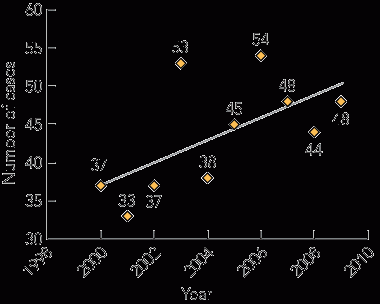
First, we recorded the numbers of sudden deaths subject to coronial autopsies in SA from 2000 to 2009 (inclusive) where the cause of death was PTE. These were divided into two periods (2000–2004 and 2005–2009) and expressed as the percentage of the total number of coronial autopsies. Second, we analysed all deaths due to PTE that were the subject of coronial autopsies in SA in 2008 (the most recent year for which complete autopsy data were available at the time that the study was initiated). Age, sex and BMI were recorded, and the group was compared with an age- and sex-matched control group taken from other coronial autopsy cases.
Despite considerable yearly fluctuations, the death rate due to PTE showed a small increase over time (Box). The rate of deaths due to PTE per total number of autopsies increased from 3.59% (198/5521) in 2000–2004 to 3.71% (239/6442) in 2005–2009.
In 2008, there were 44 individuals (21 men, 23 women) with PTE as cause of death. The age range of this group and the 44 matching controls was 27–93 years (mean, 67 years). The mean BMI for individuals dying of PTE (29.6 kg/m2; range, 19.0–51.8 kg/m2) was significantly higher than for the controls (25.9 kg/m2; range, 17.7–44.6 kg/m2) (Student t test, P < 0.05).
If PTE is conclusively found to be associated with BMI, there may be significant effects on hospital diagnostic services, coronial forensic investigation units and public expenditure in the future.
References
- Finucane MM, Stevens GA, Cowan MJ, et al. National, regional, and global trends in body-mass index since 1980: systematic analysis of health examination surveys and epidemiological studies with 960 country-years and 9.1 million participants. Lancet 2011; 377: 557-567. Epub 2011 Feb 4. 0_CBBFIEGC
- Byard RW, Bellis M. Significant increases in body mass indexes (BMI) in an adult autopsy population from 1986 to 2006 — implications for modern forensic practice. J Forensic Leg Med 2008; 15: 356-358. 0_CBBGDIBF
- Lucena J, Rico A, Vázquez R, et al. Pulmonary embolism and sudden-unexpected death: prospective study on 2477 forensic autopsies performed at the Institute of Legal Medicine in Seville. J Forensic Leg Med 2009; 16: 196-201. 0_CBBECDED
Shifting focus to adolescent wellbeing and inclusive participation in the digital age
Allyson R Todd, Elena Wang, Stephanie R Partridge
The clinical presentation, investigation, and management of women diagnosed with endometriosis in Australian general practices, 2011–2021: an open cohort study
Danielle Mazza, Kailash Thapaliya, Sharinne B Crawford, Alissia Hui, Maryam Moradi, Luke E Grzeskowiak
The impact of the Breast Screen NSW transition from film to digital mammography, 2002–2016: a linked population health data analysis
Rachel Farber, Nehmat Houssami, Katy J L Bell
Non‐technical errors associated with deaths in surgical care, Australia, 2012–2019, by surgical specialty (Australian and New Zealand Audit of Surgical Mortality): a retrospective cohort study
Jesse Ey, Victoria Kollias, Octavia Lee, Kelly Hou, Matheesha Herath, John B North, Ellie Treloar, Suzanne Edwards, Martin Bruening, Adam J Wells, Guy J Maddern
The CURE Asthma roadmap
Gary P Anderson, Anthony Flynn, Phil G Bardin, John D Blakey, Shyamali C Dharmage, Paul Foster, Peter G Gibson, Adam Jaffe, Alan James, Christine R Jenkins, Sundram Sivamalai, Peter D Sly, Guy B Marks, Vanessa M McDonald, Judy Wetttenhall
Evidence from Australian cohort studies about asthma trajectories and transitions across the life course: a narrative review
Caroline Lodge, Xin Dai, Ingrid A. Laing, Michael P Menden, Anthony Flynn, Gary P Anderson, Sarath Ranganathan, Shyamali C Dharmage