




Volume 193 - Issue 6
Cancer patients at risk from inaccurate clinical reporting in a high-profile alternative treatment story: comments and corrections
Author: Grace O Gawler
Med J Aust 2010; 193 (6): 371-373. || doi: 10.5694/j.1326-5377.2010.tb03953.x
Published online: 20 September 2010
Published online: 20 September 2010
To the Editor: I would like to correct some inaccuracies in an article by Jelinek and Gawler in the December 2008 issue of the Journal about a survivor of disseminated osteosarcoma.1
The article describes a 58-year-old man who was diagnosed in 1974, at the age of 24 years, with histologically confirmed high-grade osteosarcoma of the right femur. He underwent a full leg amputation in January 1975, but metastases recurred 11 months later, in December 1975.
The authors of the article misreported a sequence of medically significant events, altering the patient’s actual history. (The correct chronology and early clinical history of the case have been published elsewhere.2,3)
The errors and omissions in the article by Jelinek and Gawler, together with the correct sequence of events and relevant inclusions, are outlined in Box 1. In summary, the major errors in the article were as follows:
Timeline errors. The authors stated that the patient first saw Dr Meares in September 1976, after chemotherapy had failed. In fact, the patient consulted Meares as a first-line treatment approach on 12 December 1975, and did not consider chemotherapeutic options until September 1976. The authors also stated that the patient had palliative radiotherapy in September 1976. In fact, the patient had only one course of palliative radiotherapy treatment, in February 1976.
Vegan diet. The patient never followed a vegan diet.
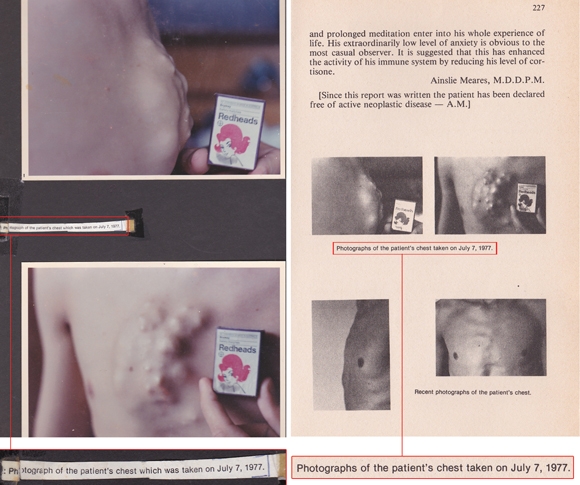
Date of photographs. The photographs in Figures B and C of the article by Jelinek and Gawler were taken on 7 July 1977 (Box 2), not at the time of first contact with Meares, as implied in the article.
An appraisal of the patient’s symptoms, combined with an accurate clinical history, reveals a more plausible scientific hypothesis for his remission than the effects of diet and meditation. Although diet and meditation may be adjuncts to a patient’s wellbeing, it is unlikely in this case that they were curative, and certainly veganism was not a relevant factor. Immunotherapy with BCG vaccine treatments, the timing of symptoms and the patient’s eventual diagnosis of tuberculosis could be associated with his remission, as postulated by his radiation oncologist in 1978.6 There is extensive scientific literature about remission of cancer, including osteosarcoma, associated with febrile conditions.5,8-15
The patient’s sporadic visits to doctors meant that metastases were not diagnosed histologically and much of the information reported on his case is anecdotal. Clearly, in this and other cases, unbiased investigative scientific research needs to be undertaken before reporting anecdotes and extrapolations as if they were fact. Teasing apart the errors in Jelinek and Gawler’s story, now on the public record and almost medical myth, is an enormous task, but one that must be done, because correctly reporting the patient’s clinical timeline is crucial in any discussion about the causes of his remission and the flow-on effect to cancer patients and their treating doctors.16
1 Corrections to errors in the article by Jelinek and Gawler1
Errors and omissions in the article |
Facts, corrections and inclusions |
||||||||||||||
|
|
||||||||||||||
|
|
||||||||||||||
|
|
||||||||||||||
|
|
||||||||||||||
|
|
||||||||||||||
|
|
||||||||||||||
2 Original photographs of patient’s chest taken on 7 July 1977
 |
|
I am in possession of these original photographs (left), which were dated 7 July 1977 (date enlarged in inset). A copy of page 227 from the original edition of You can conquer cancer7 also confirms the accurate date of the photographs as 7 July 1977 (date enlarged in inset) |
Competing interests
I am a co-founder of the Gawler Foundation and the former wife of the patient. I left the employ of the Gawler Foundation in 1996. My memoirs were published in October 2008 as an aid to correcting years of misinformation and misreporting about my former husband’s remission.
Acknowledgements
I would like to thank Professor Ray Lowenthal for his assistance and feedback, and the staff of Australian Doctor for their assistance in retrieving archived material.
References
- Jelinek GA, Gawler RH. Thirty-year follow-up at pneumonectomy of a 58-year-old survivor of disseminated osteosarcoma. Med J Aust 2008; 189: 663-665. BABCDEFI
- Gawler I. Cancer patients find strength in self-help approach. Aust Doct 1993; Sept 3: 25. i1095469
- Gawler I, editor. Inspiring people: stories of remarkable recovery and hope from the Gawler Foundation. Yarra Junction, Vic: Gawler Foundation, 1995. i1095471
- Gerson MA. Cancer therapy: results of 50 cases. New York: Station Hill Press, 1995. i1095473
- McCarthy EF. The toxins of William B Coley and the treatment of bone and soft-tissue sarcomas. Iowa Orthop J 2006; 26: 154-158. i1095475
- Allenby G. Ian Gawler: the dragon’s blessing. Sydney: Allen and Unwin, 2008. i1095477
- Gawler I. You can conquer cancer. Melbourne: Hill of Content, 1984. i1095479
- Kleef R, Jonas WB, Knogler W, Stenzinger W. Fever, cancer incidence and spontaneous remissions. Neuroimmunomodulation 2001; 9: 55-64. i1095481
- Theilmann L, Meyer U, Kommerell B, et al. [Alpha tumor necrosis factor in the serum of patients with sarcoidosis, tuberculosis or bronchial cancer] [German]. Pneumologie 1990; 44: 735-738. 9
- Hortobagyi GN, Richman SP, Dandridge K, et al. Immunotherapy with BCG administered by scarification: standardization of reactions and management of side effects. Cancer 1978; 42: 2293-2303. 10
- Gkialas I, Kalantzis A, Lykourinas M. The response of urological tumours to immunotherapy. J BUON 2005; 10: 329-336. 11
- Terlikowski SJ. Tumour necrosis factor and cancer treatment: a historical review and perspectives. Rocz Akad Med Bialymst 2001; 46: 5-18. 12
- Wiemann B, Starnes CO. Coley’s toxins, tumor necrosis factor and cancer research: a historical perspective. Pharmacol Ther 1994; 64: 529-564. 13
- Nauts HC. Osteogenic sarcoma: end results following immunotherapy (bacterial vaccines) 165 cases, or concurrent infections, inflammation or fever, 41 cases. New York: Cancer Research Institute, 1975. (CRI Monograph No. 15.) 14
- Hirshberg C, O’Regan B. Spontaneous remission: an annotated bibliography San Francisco, Calif: Institute of Noetic Sciences, 1993. i1095489
- Lowenthal RM. Can cancer be cured by meditation and “natural therapy”? A critical review of the book You can conquer cancer by Ian Gawler. Med J Aust 1989; 151: 710-715. EHGHHIED
Country revealing the way: evaluating Elder‐governed cultural therapy for Aboriginal and Torres Strait Islander young people with mental health conditions
Alasdair Vance, Janet McGaw, Jo Winther, Naomi Tootell, Herb Patten, Sandra Eades
No silver lining with health misinformation: argyria caused by intentional silver consumption
Luke Collins, Logesh Palanikumar, Stephen Bacchi
Hyperkalaemic cardiac arrest due to cream of tartar ingestion
Daniel Yee Lee Ng, Laksmi Govindasamy, Andrew Hughes, Hwee Min Lee
From talk to action: Indigenous Reference Groups drive practice change in kidney transplantation care
Kelli J Owen, Katie Cundale, Jaquelyne T Hughes, Stephen P McDonald, Matilda D'Antoine, Shilpanjali Jesudason
The not‐so‐natural herb: a case of exogenous Cushing syndrome
Yi‐An Pan, David Roberts, Yi‐An Pan, David Roberts
Lead poisoning outbreak from consumption of contaminated Ayurvedic medication
Mark J Ferson, Sinead Flanigan, Toni Cains