




Volume 193 - Issue 11
Osler and his Australian associations — part 1: during his life
Author: Milton G Roxanas
Med J Aust 2010; 193 (11): 686-689. || doi: 10.5694/j.1326-5377.2010.tb04105.x
Published online: 6 December 2010
Published online: 6 December 2010
“... the current may turn towards the [medical] schools of the great nations of the south ... the Africander, the Australian, or the New Zealander may reach a development before which even ‘the glory that was Greece’ may pale”
The influence of Sir William Osler on medicine is still apparent nearly 100 years after his death. Here, I examine what he knew about Australia, which Australians he met and how this enriched their personal and professional lives, and his influence on Australian medicine in general.
Sir William’s grandfather, Edward Osler, was the father of Featherstone (William Osler’s father) and brother of Benjamin, whose children scattered to the United States, South Africa and Australia.1 Indeed, Harvey Cushing, the contemporary eminent neurosurgeon and Osler’s biographer, stated that he had met a man of the Australian branch of the Osler family who looked so like William Osler in “figure, stature, gesture, feature, and shape of head ... that he might have passed as a younger brother”.1
William Osler was born on 12 July 1849 in Upper Canada (now Ontario), the eighth of nine children.1 He was educated at church schools, where the Rev W A Johnson introduced him to what became his favourite book, the Religio medici of Sir Thomas Browne, and he searched the surrounding countryside for organisms and fossils to explore with the microscope. He next came under the spell of Dr James Bovell, a friend of Johnson’s and an enthusiastic microscopist, who taught at Osler’s school and practised medicine in Toronto. Bovell’s personality so imprinted itself on Osler that he always wrote “James Bovell” when testing a new pen or doodling.1 After finishing school, Osler initially followed his father into divinity, but switched to medicine at the Toronto School of Medicine. This was followed soon after by his first publication, on the subject of discovering organisms with the microscope, at 19 years of age.2 Two years later, on Bovell’s advice, he went to McGill University in Montreal where he met Dr Robert Palmer Howard, who taught medicine and surgery and stimulated Osler’s interest in pathology and searching the medical literature — interests that remained with him for life.3 The influence of these three men — Johnson, Bovell and Howard — was so great that Osler later dedicated his magnum opus, The principles and practice of medicine, to their memory.
After graduating from McGill in 1872, Osler travelled to London and worked with physiologist John Burdon-Sanderson, in whose laboratory he noted the aggregation of platelets (previously thought to be bacteria) in 1873.3 He travelled to Germany where he met Rudolf Virchow, then to Austria where he saw dermatologist Ferdinand von Hebra, pathologist Carl von Rokitansky and others at work. When Osler returned to Montreal in 1874, he worked briefly in general practice until he was appointed Lecturer then Professor of the Institutes of Medicine at McGill University (Box 1). There he set about revitalising medical training by teaching physiology and histology through the use of the microscope (providing microscopes at his own expense). He started a journal club and began referring students to German and French publications. He wrote on the comparative pathology of parasites, smallpox, Addison’s disease, pernicious anaemia and other topics, and used his pathological experience as a foundation for his clinical acumen. There were no Australian associations during this period of his life.
Osler’s appointment in 1884 to the Chair of Clinical Medicine at the University of Pennsylvania in Philadelphia was equally bereft of Australian connections, but was important in establishing his stature. He gave the Gulstonian lectures to the Royal College of Physicians of London in 1885, speaking on Malignant endocarditis; he wrote on chorea and cerebral palsy; and he continued “preach[ing] the gospel of clinicopathology, showing equal interest in the dead and living”.3
Osler accepted the position of Professor of the Theory and Practice of Medicine at Johns Hopkins University in Baltimore in 1889, at the age of 40. In 1892, he published his classic textbook, The principles and practice of medicine, and only when this task was complete did Grace Revere Gross (widow of a Philadelphia surgeon) agree to marry him. Their son Edward Revere was born on 28 December 1895.
The British Medical Association (BMA) held its annual conference in 1897 in Montreal, and on 1 September, Osler gave an address on British medicine in Greater Britain,4 where he took the opportunity to give an historical account of the influence of British medicine on its colonies. He predicted that a future meeting of the BMA might be held in Australia, where there were few local graduates and most were of “English, Scotch and Irish colleges”. He described the Australian population as “more homogeneous” and “thoroughly British”. Osler had evidently read Australian and New Zealand medical journals, as he was surprised “with the monotonous similarity of the diseases in the antipodes to those of Great Britain and of this continent”, although he noted the frequency of reports “of parasitic affections and snake-bites”, which were unusual in the northern hemisphere. He commented that the medical profession in Australia was not as regulated as elsewhere because of “the absence of the military element” and was disappointed at the state of medical ethics, which he surmised from his reading.5 “In the large Australian cities, differences and dissensions seem lamentably common”, he said, attributing this to the 3- or 4-yearly reappointments in hospitals that involved soliciting votes.4 He quoted Dr Ferdinand Batchelor (Box 2), President of the 1896 Intercolonial Medical Congress, who was critical of the “managers of the hospitals [who] knew little, and at times seemed to care less, about the medical school”.5 Osler was scathing about the situation in Melbourne, described by Batchelor, where the election was in the hands of the “subscribers” and “election tickets were put out, and cards soliciting votes for [doctors] were found in hotels and bars and railway stations and in cabs”.5 He was however optimistic that
the current may turn towards the schools of the great nations of the south. Under new and previously unknown conditions, the Africander, the Australian, or the New Zealander may reach a development before which even “the glory that was Greece” may pale.4
In July 1900, Osler travelled to London, where he attended the Royal College of Surgeons centenary celebrations at the hall of Lincoln’s Inn. A young Australian, Dr Henry Newland (Box 3), newly qualified in surgery, was invited to attend and was seated four chairs away from Osler at the banquet.7 On discovering Newland’s interest in neurosurgery, Osler advised him to study under Dr Harvey Cushing in Baltimore, which he did.8,9
Also in 1900, Osler published a monograph, Cancer of the stomach, with his former student Thomas McCrae.10 In the first chapter of the book, they write:
Our colleagues in Australasia have demonstrated the same thing. The mortality figures [for cancer of the stomach] for Victoria for the years 1870–84 show an increase at about the same rate as in England ...
They cited two Australian journal references,11,12 and continued that a similar trend also occurred in New Zealand, giving references to New Zealand journals.13,14
Osler was appointed Regius Professor of Medicine at Oxford University in 1905, and in 1907 made his usual transatlantic trip to the US. He visited there so regularly that “it had become a saying in Oxford that the Oslers often spent their week-ends in America”.1 On 3 October 1907, he addressed the students at St Mary’s Hospital in London on The reserves of life.15 He stressed that medical training “is in only three subjects — science, art, and the knowledge of men”. Halfway through the lecture, he deviated from his notes to verbally attack St Mary’s bacteriologist and immunologist Sir Almroth Wright (Box 4), saying:
Stop your ears with the wise man’s wax against the wiles of that Celtic siren, Sir Almroth, who would abolish Harley Street [London’s centre of private medical practice] and all that it represents.
Osler knew that Wright was cynical of clinical methods and clinicians and “ridiculed the crudeness of methods which faced disease armed with knives and drugs ...” Wright believed that “the physician of the future would be an immunisator”.17 Osler was aware of Wright’s sojourn in Sydney and his development of typhoid vaccine, to which he referred in his lecture. In spite of this disagreement, Osler and Wright remained friends, visiting each other at home,16 and Osler urged the use of typhoid vaccination of the troops in World War I.3
In April 1909, while travelling around Europe, Osler was asked to see a sick Australian in Rome, who “suddenly became severely purpuric from haemorrhaging blood vessels, turning plum-colored everywhere except under one patch of skin where he had put a mustard leaf”.3 This man, described by Osler in The Lancet,18 died 15 minutes later. Osler theorised that a reaction involving the capillary wall allowed blood to leak out, which he postulated to be an anaphylactic reaction.
Osler was a keen traveller — he went about visiting friends, attending conferences, seeing historical places, and searching for books. This made him sensitive to accents, and he developed the habit of writing about them during his voyages. He carried this manuscript, titled The voice, with him from 1893, making additions as he went and promising an article on the topic for The century magazine, which remained unfinished.19 In his notes, he described a 56-year-old Scotsman who had lived in Australia for about 35 years and “except in a few words, the Scotch had been rubbed off his tongue”. Osler’s own speaking voice was described by his friend, Canadian neurosurgeon Wilder Penfield, thus: “he never had an accent that one could identify”.20 This was perhaps unsurprising in a man who lived for 35 years in Canada, 21 years in the US, and 14 years in England. Golden and colleagues suggest that Osler had “a cultivated speech ... what today might be called mid-Atlantic”.19
In February 1911, Osler was invited by his brother Sir Edmund Boyd Osler to visit Egypt and the Nile Valley. As usual, Osler was able to make a good mix of vacation, history and medicine. He enjoyed the pyramids, the Sphinx, various tombs and the Egyptian museum, and was impressed by the beauty of the mosques. He took time to visit the Kasr El Aini Hospital, where he saw “many things I had read of but had never seen”. Here he also met Dr Frank Madden (Box 5), an Australian surgeon at the hospital.22
Osler was invited to give the Silliman lectures at Yale University to a lay audience in April 1913. He spoke about The evolution of modern medicine, describing how religion and medicine grew out of magic, saying “among native Australians today it is still deliberately cultivated”.23 He was obviously aware of the Aboriginal witchdoctor with the power to heal or kill. Osler’s reading about Australia and awareness of its culture prepared him for meeting Leslie Cowlishaw (Box 6) in 1916, when Cowlishaw was officer-in-charge of invaliding in England. The two quickly struck up a close friendship, as Cowlishaw was already an established collector of medical books and could discuss medical history. Osler was perceptive enough to understand the Australian psyche, labelling Cowlishaw the “bibliophile from the bush”.24 There are six letters from Osler to Cowlishaw in the archives of the Royal Australasian College of Surgeons, mentioning Cowlishaw’s purchasing of books, and thanking Cowlishaw for sending him a book and for correcting an article Osler had written. Osler felt very comfortable with Cowlishaw and offered him hospitality, writing:
... come when you can — give a few days notice as I am much away — stay the night. There are many things in my collection to interest you. (7 March 1916)
I am devastated to miss you ... Do come to us direct your next leave. (8 August 1917)
In another note, Osler writes: “... come here for a rest and bibliographic browse when you come back — I am struggling with my catalogue ...” Osler’s influence added fuel to the fire of Cowlishaw’s enthusiasm for medical history and book collecting, to the extent that Cowlishaw acquired the biggest collection of rare medical books in Australia, which was sold to the Royal Australasian College of Surgeons after his death in 1943 for the now ridiculously low sum of £2750.
Cowlishaw followed Osler’s example of not only collecting but also writing medical history. In Cowlishaw’s address on Some early printed books: their authors and printers, he presented a scholarly account of early printing presses and early medical books, many of which were in his possession.25 Cowlishaw acknowledged Osler’s guidance in this article, quoting him on three occasions. This publication was of sufficient historical merit to be referenced by Thornton in his major reference on the history of medical books and collectors.26 Thornton credits Cowlishaw with the statement that the first book in English on medicine was written in 1485 — quite an honour for an Australian, and one that shows the depth of Cowlishaw’s knowledge.
In 1936, Cowlishaw wrote an authoritative account of the first 50 years of medicine in Australia, describing the First Fleet surgeons and giving brief accounts of D’Arcy Wentworth, George Bass, William Redfern (the first Australian medical graduate), Henry Cowper (the first postgraduate diplomate in Australia) and William Bland (the first Australian to publish in The Lancet and author of the first postmortem study to be published in the medical press in Australia).27 He also urged a philanthropist to donate money for a historical medical library, as Osler had done. In the Jackson Lecture of 1937, Cowlishaw gave an excellent account of Galen’s life and experiments.28 In his address to the 1937 meeting of the Australasian Medical Congress, Cowlishaw described how Osler made medical history alive and relevant by including it in his medical lectures, getting students to look up and read to the class the original description of a disease, and by having old books available for browsing.29 He also gave what is arguably the best account of medical historians through the ages, appealed for someone to edit a book of Australian medical history, and urged the teaching of medical history to medical students on a voluntary basis.
Osler was not unaware of Australia, as he had relatives living here and had read about the country’s Aboriginal culture, the state of the teaching hospitals, and the role of subscribers in hospital appointments. He read Australian and New Zealand journals in his quest for illness trends, and compared them with those of Europe. He made special mention of treating Australian patients and advised Newland about his career. He enjoyed his meetings with Cowlishaw on book collecting and medical history. The expression “bibliophile from the bush” indicated a good understanding of Australian expressions, perhaps learned from other Australian doctors or patients whom he met; but such meetings have not been recorded.
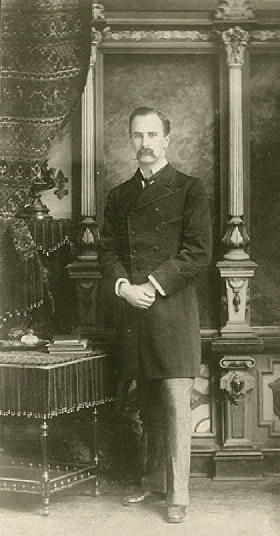
1 William Osler, October 1881, during his Montreal period
 |
|
Reproduced with permission of the Osler Library, McGill University. |
2 Ferdinand Campion Batchelor (1850–1915)
Batchelor was born on Norfolk Island, where his father was the Anglican chaplain. He was educated in England, then apprenticed to a medical practitioner in Essex. He later attended Guy’s Hospital Medical School in London, practised in England, then migrated to New Zealand and settled in Dunedin. He started in general practice, before specialising in obstetrics and gynaecology. He was “a man of commanding presence and of a dynamic personality”. He was President of the Intercolonial Medical Congress held in Dunedin in 1896. He served in World War I, at the age of 65 years, and was sent to Egypt but was invalided back to Dunedin, where he died. A Batchelor Memorial Medal was struck to commemorate his contributions to New Zealand medicine.6
3 Henry Simpson Newland (1873–1969)
Newland was a University of Adelaide graduate who did his postgraduate surgical training in England and Baltimore (with Harvey Cushing), returning to Adelaide to practise as a surgeon. He enlisted in the Australian Imperial Force in November 1914 and was appointed to the 1st Australian Stationary Hospital on the Greek island of Lemnos. With the closure of that theatre of war, he was sent to England, then France. He operated at the 3rd Australian Casualty Clearing Station in France, where he met Cushing again. Newland returned home to Adelaide, where he had a busy general surgical and neurosurgical practice.7
4 Almroth Wright (1861–1947)
Wright graduated in medicine from Trinity College, Dublin, in 1883. He was interested in experimental work and visited pathologist Julius Cohnheim in Leipzig, Germany, and physiologist Michael Foster at Cambridge University. The latter proposed him for the position of demonstrator in physiology at the University of Sydney; Wright took up this appointment, demonstrating from 1889 to 1891. He was known as the “Irish windbag” and clashed with T P Anderson Stuart, the head of the faculty. Wright went on to become the Professor of Bacteriology at St Mary’s Hospital in London. He was against women being given the right to vote, but was instrumental in setting up the Medical Research Council. He described the role of calcium in coagulation, developed typhoid vaccine, and was a founder of immunology. He also taught Alexander Fleming, who discovered penicillin.16
5 Frank Cole Madden (1873–1929)
Madden was born in Melbourne and graduated in medicine from Melbourne University in 1893. He worked at the Melbourne Hospital before travelling to London, where he eventually became medical superintendent of the Hospital for Sick Children, Great Ormond Street. He then moved to Cairo, Egypt, where he was a surgeon and teacher at the Kasr El Aini Hospital, and eventually Dean of the Faculty of Medicine at the University of Cairo. He wrote The surgery of Egypt, was interested in tropical surgery and schistosomiasis, and was awarded the Order of the British Empire for his services during World War I. He was a conscientious man, and committed suicide on 26 April 1929, probably as a result of the stress of politics between university, Egyptian and British governments.21
6 Leslie Cowlishaw (1877–1943)
Cowlishaw was born into a wealthy family and educated at Sydney Grammar School. He started his book collection in 1906 after graduating in medicine. He worked in general practice in Cooma, New South Wales, where he met and married Jessie Garnock. He enlisted with the Australian Imperial Force in 1914 and served in Egypt and Gallipoli. After the war, he had a general practice in the Sydney suburb of Hornsby, before moving to Lindfield. With Robert Scot Skirving and Herbert Moran, he started the Section of Medical History and Literature of the NSW Branch of the British Medical Association in 1925. He became an honorary lecturer in medical history at the University of Sydney in 1931.24 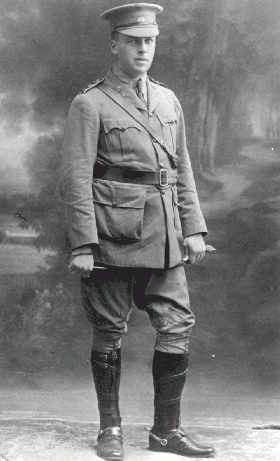 Leslie Cowlishaw in World War I uniform. Reproduced with permission of the Royal Australasian College of Surgeons. |
Competing interests
None identified.
Acknowledgements
I wish to sincerely thank Elizabeth Milford (Royal Australasian College of Surgeons), Pamela Miller (Osler Library), Liz Rouse (Royal Australasian College of Physicians), Kay Lee and Frances Miechels (Concord Hospital Medical Library) who contributed to this article with their willing help in searching for references and pictures. I acknowledge with gratitude the inspiration and guidance of Dr Charles George, Dr Richard Golden, Dr Oleg Preda, Professor Michael O’Rourke and Dr Jill Forrest.
References
- Cushing H. The life of Sir William Osler. 1st ed. Oxford: Clarendon Press, 1925. 0_CIGBJJEH
- Osler W. Christmas and the microscope. Hardwicke’s Science-Gossip 1869; (50): 44. 0_CIGECGBH
- Bliss M. William Osler: a life in medicine. Oxford: Oxford University Press, 1999. 0_i1095577
- Osler W. Aequanimitas: with other addresses to medical students, nurses and practitioners of medicine. Third impression. London: H K Lewis, 1904 [updated 1905]. 0_i1095579
- Intercolonial Medical Congress of Australasia: President’s opening address. Br Med J 1896; 1 (Apr 18): 1003. 0_i1095581
- McLintock AH, editor. An encyclopedia of New Zealand. Wellington: Government Printer, 1966. 0_i1095583
- Hughes JE. Henry Simpson Newland: a biography. Adelaide: South Australian Fellows of the Royal Australasian College of Surgeons, 1972. 0_i1095585
- Cushing H. From a surgeon’s journal 1915–1918. Boston: Little, Brown and Company, 1936. 0_i1095587
- Roxanas MG. Harvey Cushing and some Australian connections: part 1 — early life and work. J Clin Neurosci 2010; 17: 168-172. 0_i1095589
- Osler W, McCrae T. Cancer of the stomach. Philadelphia: P Blakiston’s Son & Co, 1900. 0_i1095591
- Haviland A. The statistics of cancer in England and Victoria compared. Aust Med J 1887; 9: 97-101. 0_i1095593
- Mullins GL. Cancer in New South Wales. Australas Med Gaz 1896; 15: 1-8. 0_i1095595
- Macdonald RG. Notes on the cancer statistics of New Zealand. N Z Med J 1891; 4: 91-98. 0_i1095597
- Macdonald RG. Notes on the cancer statistics of New Zealand. N Z Med J 1890; 3: 252-256. 0_i1095599
- Osler W. The reserves of life. St Marys Hosp Gaz 1907; 13: 95-98. 0_i1095601
- Dunnill M. The Plato of Praed Street: the life and times of Almroth Wright. London: Royal Society of Medicine Press, 2000. 0_i1095603
- Stone MJ. The reserves of life: William Osler versus Almroth Wright. J Med Biogr 2007; 15 Suppl 1: 28-31. 0_i1095605
- Osler W. Note on the relation of the capillary blood-vessels in purpura. Lancet 1909; 173: 1385-1386. 0_i1095607
- Golden RL, Bryan CS, Golden JT. William Osler’s the transatlantic voice: a philological study. Montreal: Osler Library, 2006. 0_i1095609
- Penfield W. Osler’s voice. In: McGovern JP, Burns CR, editors. Humanism in medicine. Springfield, Ill: Charles C Thomas, 1973: 34-40. 0_i1095611
- Power D, Spencer WG, Gask GE. Plarr’s lives of the Fellows of the Royal College of Surgeons of England. Bristol: John Wright & Sons Ltd, 1930. 0_i1095613
- Longo LD, Teigen PM, editors. “Dearest G ... Yours WO”: William Osler’s letters from Egypt to Grace Revere Osler. Montreal: Osler Library, 2002. 0_i1095615
- Osler W. The evolution of modern medicine: a series of lectures delivered at Yale University on the Silliman Foundation in April, 1913. New Haven: Yale University Press, 1921. 0_i1095617
- Russell KF. Catalogue of the historical books in the library of the Royal Australasian College of Surgeons. Melbourne: Queensberry Hill Press, 1979. 0_i1095619
- Cowlishaw L. Some early printed books: their authors and printers. Med J Aust 1926; 2: 77-81. 0_i1095621
- Besson A, editor. Thornton’s medical books, libraries and collectors: a study of bibliography and the book trade in relation to the medical sciences. 3rd ed. Aldershot: Gower Publishing Company Limited, 1990. 0_i1095623
- Cowlishaw L. The George Adlington Syme Oration. The first fifty years of medicine in Australia. Aust N Z J Surg 1936; 6: 3-17. 0_i1095625
- Cowlishaw L. The Jackson Lecture — Galen, the medical dictator: his life and influence on the progress of medicine. Med J Aust 1937; 2: 543-552. 0_i1095627
- Cowlishaw L. The development of the study of the history of medicine. Med J Aust 1938; 1: 321-326. 0_i1095629
Prisoner of war pathology in Changi, 1942–1945
Kate Ariotti, Elizabeth Roberts‐Pedersen
Should medical eponyms continue to be used in everyday practice?
Leya Nedumannil, Diana Lewis
100 years on: the first use of insulin in Australia
Sophie Templer
Reflections on the life and career of Professor Dame Valerie Beral AC DBE FRS FRCOG FMedSci (1943–2022)
Karen Canfell, Bette Liu, Emily Banks
The Honourable Dr Donald James Grimes AO
Michael Kirby, Patti Warn
From wipeout to drill out: a history of exostosis management and Australian surfing
Alon Taylor, Hannah North, Narinder P Singh, Paul A Fagan