




Volume 192 - Issue 8
Medical jargon made easy
Author: Gita Sankaran
Med J Aust 2010; 192 (8): 466. || doi: 10.5694/j.1326-5377.2010.tb03588.x
Published online: 19 April 2010
Published online: 19 April 2010
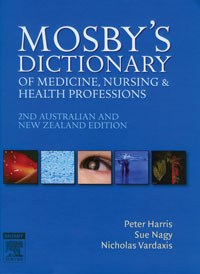
Mosby’s dictionary of medicine, nursing & health professions, 2nd Australian and New Zealand edition
. Peter Harris, Sue Nagy, Nicholas Vardaxis, editors. Sydney: Elsevier Australia, 2009 (xvi + 2015 pp). ISBN 978 0 7295 3909 8.
The first Australian and New Zealand edition of this popular American dictionary was published in 2006. It was a landmark achievement, with its Asia-Pacific orientation in both content and style. For instance, entries included the “bluebottle jellyfish”, common to Australasian waters. Local spelling and phonetic pronunciation guides were also provided.
However, almost as soon as it was published, the need for a continuing process of review and revision was recognised. And so, editors-in-chief Peter Harris, Sue Nagy and Nicholas Vardaxis led a team of 60 specialists to produce further refinements, which resulted in this second edition.
The language of medicine is constantly evolving to keep up with the latest developments in research and technology. Thus, some of the new terms in the second edition include Hendra virus, Nipah virus, swine flu and vancomycin-resistant enterococcus.
There were some 40 000 entries and 2400 colour images in the first edition. More than 500 images, 300 drug entries and 73 tables have been added or updated in this edition. The many useful appendices cover areas such as nutrition guidelines, immunisation schedules, infection control and herb–drug interactions. Charts and graphs range in content from lung sounds and burn depths to contraceptive effectiveness and cardiac arrhythmias.
Simple devices such as extensive cross-referencing and a thumb-style index make navigation easy.
The bonus “Evolve” website access provides many free online resources, such as all the images from the book, directories of key health organisations and health promotion information. This strategy has enabled the dictionary to be confined to a single volume that is still kept current through the website.
This dictionary can help health professionals and students become familiar with new medical terminology and techniques, and thus improve their communication and outcomes. Certainly, as a proofreader for the Journal, I’m sure to refer to it at least once a week.
Shifting focus to adolescent wellbeing and inclusive participation in the digital age
Allyson R Todd, Elena Wang, Stephanie R Partridge
The clinical presentation, investigation, and management of women diagnosed with endometriosis in Australian general practices, 2011–2021: an open cohort study
Danielle Mazza, Kailash Thapaliya, Sharinne B Crawford, Alissia Hui, Maryam Moradi, Luke E Grzeskowiak
The impact of the Breast Screen NSW transition from film to digital mammography, 2002–2016: a linked population health data analysis
Rachel Farber, Nehmat Houssami, Katy J L Bell
Non‐technical errors associated with deaths in surgical care, Australia, 2012–2019, by surgical specialty (Australian and New Zealand Audit of Surgical Mortality): a retrospective cohort study
Jesse Ey, Victoria Kollias, Octavia Lee, Kelly Hou, Matheesha Herath, John B North, Ellie Treloar, Suzanne Edwards, Martin Bruening, Adam J Wells, Guy J Maddern
The CURE Asthma roadmap
Gary P Anderson, Anthony Flynn, Phil G Bardin, John D Blakey, Shyamali C Dharmage, Paul Foster, Peter G Gibson, Adam Jaffe, Alan James, Christine R Jenkins, Sundram Sivamalai, Peter D Sly, Guy B Marks, Vanessa M McDonald, Judy Wetttenhall
Evidence from Australian cohort studies about asthma trajectories and transitions across the life course: a narrative review
Caroline Lodge, Xin Dai, Ingrid A. Laing, Michael P Menden, Anthony Flynn, Gary P Anderson, Sarath Ranganathan, Shyamali C Dharmage