




Volume 189 - Issue 11
The positive power of paintings
Author: Mike Barr
Med J Aust 2008; 189 (11): 679. || doi: 10.5694/j.1326-5377.2008.tb02246.x
Published online: 1 December 2008
Published online: 1 December 2008
Well chosen artworks in the doctor’s waiting room can be an unwritten prescription for peace
“Your blood pressure is up today” is a not uncommon doctor-to-patient line. If it’s a one-off reading — and as long as it’s not dangerously high — a general practitioner will usually take into account that the patient is somewhat stressed just by being there.
Well meaning as they may be, posters in the doctor’s waiting room with urgent calls for immunisation against some threatened pandemic can start the blood pressure rising. The notorious poster showing an aorta being squeezed of a white, fatty substance is enough to make us bring up the porridge we had that morning. Recently, while waiting for someone in a colonoscopy area, I had little choice but to read a poster on the many diseases of the colon. It was not consoling by any means and would be better suited in a medical student’s study.
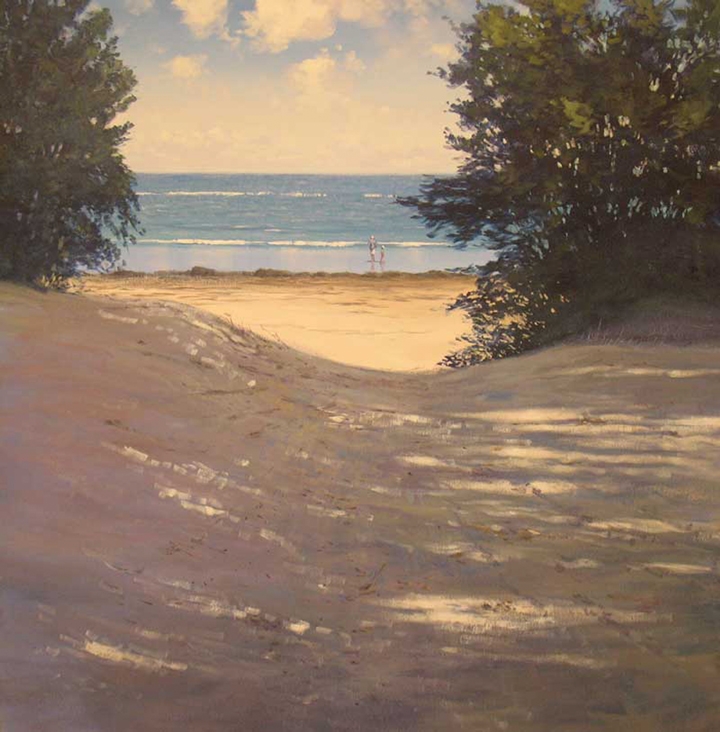
Being an artist, it might be thought that I’m a little biased about what should hang on walls, but I speak from experience too. It’s nearly 20 years since my father-in-law died in a hospice. A memory that has stuck with me over the years was the comfort I found in a Monet print in the corridor just outside his hospice room. It was a painting that the soul could enter into and, for a few moments, escape the heaviness of his impending departure. More or less, that’s the good a painting can do in a waiting room.
The healing process can begin in the mind, and where better to start than before a patient even says hello to the doctor. Artworks on the waiting room walls, whether prints or originals, are places that we can walk into and feel becalmed. Better still are paintings of local places such as beaches that are likely to strike a chord and evoke happy memories.
Having appropriate works of art on your walls is, in effect, an unwritten prescription for peace for those who enter your doors. Indeed, why not go the extra mile by printing up miniatures of the paintings (with the artist’s permission) and handing one to patients as they leave, or sending it with any correspondence? This will reinforce the pleasant experience of the waiting room, which might then spread among their peers.
Your surgery is but a few well chosen works of art away from being a much more enjoyable place for patients and staff.

Prisoner of war pathology in Changi, 1942–1945
Kate Ariotti, Elizabeth Roberts‐Pedersen
Should medical eponyms continue to be used in everyday practice?
Leya Nedumannil, Diana Lewis
100 years on: the first use of insulin in Australia
Sophie Templer
Reflections on the life and career of Professor Dame Valerie Beral AC DBE FRS FRCOG FMedSci (1943–2022)
Karen Canfell, Bette Liu, Emily Banks
The Honourable Dr Donald James Grimes AO
Michael Kirby, Patti Warn
From wipeout to drill out: a history of exostosis management and Australian surfing
Alon Taylor, Hannah North, Narinder P Singh, Paul A Fagan