




Volume 184 - Issue 9
Dialysis disseminated
Author: Shane L Carney
Med J Aust 2006 || doi: 10.5694/j.1326-5377.2006.tb00305.x
Published online: 28 April 2005
Published online: 28 April 2005
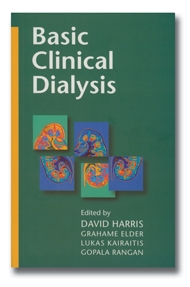
Basic clinical dialysis.
David C Harris, Grahame Elder, Lukas K Kairaitis, Gopala K Rangan (eds). Sydney: McGraw Hill, 2005 (xxiv + 264 pp). ISBN 007471501 1.
Many clinicians will have unpleasant memories of their first visit to their hospitals haemodialysis unit. Unfortunately, this situation hasnt improved much over the years, where the evening RMO is called to check Mr Jones dry weight pre-haemodialysis. This can be a difficult task for a nephrologist, so it was refreshing to review this handbook which states, after a series of helpful instructions, In practice, initial determination of the dry weight of the patient is trial and error using the signs above and frequent assessment.
This is a handbook in every sense of the word, of use to its target population of students, RMOs, advanced trainees, nurses and paramedical staff. Information on haemodialysis and peritoneal dialysis as well as acute dialysis and plasmapheresis is backed up by protocols developed within the dialysis units of the Western Sydney Renal Service. While some protocols may be of little use in established units, they could easily be incorporated into the structure of any new department with benefit.
Because many dialysis units have become the domain of the nursing profession over the past few decades, doctors dialysis knowledge and skills are often limited. Nevertheless, it is the RMO and rotating registrar that should benefit most from this book. Each section is well referenced with up to date reviews including Australian (CARI) and United States (K/DOQ1) guidelines.
Basic clinical dialysis covers more than dialysis, with sections detailing normal renal function, chronic kidney disease stages, pre-dialysis management and transplantation. In my view, this additional coverage is the books main weakness.
Excluding these ancillary areas may have allowed space to better cover emerging issues such as nocturnal dialysis. A more detailed guide to dosing of commonly prescribed drugs as found in The Oxford handbook of dialysis (Oxford University Press, 2001) would have been helpful.
In handbooks such as this, it can be difficult to get the correct balance and cover all relevant areas without too much detail. This one gets it right most of the time and would complement the library of any dialysis unit.
Shane L Carney Nephrologist John Hunter Hospital, New Lambton, NSW
The first Australian evidence‐based guidelines on male infertility
Darren J Katz, Liza O’Donnell, Robert I McLachlan, Tim J Moss, Clare V Boothroyd, Veena Jayadev, Sarah R Catford
The epidemiology of haemodialysis catheter infections in Australia, 2016–20: a prospective cohort study
Benjamin Lazarus, Kevan R Polkinghorne, Martin P Gallagher, Jayson Catiwa, Nicholas A Gray, Sarah Coggan, Kathryn R Higgins, Girish Talaulikar, Stephen P McDonald AM, Sradha Kotwal
Am I on the list? Clinician‐reported factors for kidney transplantation non‐waitlisting among Aboriginal and Torres Strait Islander people with kidney failure: a cross‐sectional study
Stephen P McDonald AM, Katie Cundale, Christopher E Davies, Kelli Karrikarringka Owen (Kaurna, Nharangga, and Ngarrindjeri), Kerry Dole, Feruza Kholmurodova, Matilda D’Antoine (Paakantyi), Jaquelyne T Hughes (Wagadagam)
Hyperkalaemic cardiac arrest due to cream of tartar ingestion
Daniel Yee Lee Ng, Laksmi Govindasamy, Andrew Hughes, Hwee Min Lee
Dialysis care in Australia: a call for reform and innovation
Dharshana Sabanayagam, Angela Makris, Frederika Sciberras, Nicole J Scholes‐Robertson, Germaine Wong
Closing the gap in kidney disease: validating the reporting of Aboriginal and/or Torres Strait Islander identification in a clinical quality registry using linked data
Heather J Baldwin, Nicole De La Mata, Grant Sara, Faye McMillan, Brett Biles, Jianyun Wu, Paul Lawton, Stephen McDonald, Angela C Webster