




Volume 183 - Issue 11
No-nonsense unmentionables
Author: Simon C Cowap
Med J Aust 2005 || doi: 10.5694/j.1326-5377.2005.tb00028.x
Published online: 13 November 2005
Published online: 13 November 2005
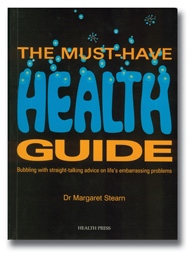
The must-have health guide. 2nd ed.
Margaret Stearn. Oxford: Heath Press, 2005 (vi + 378 pp). ISBN: 1 903734 75 4.
As the title page advises, the book focuses not on respectable medical conditions such as diabetes, but on lifes embarrassing problems. Its concerns are the floppy, the spotty, the leaky, the smelly and the discharging. Hiccups, blushing, bad breath, snoring, shaky hands, and shyness are the only topics covered that dont directly relate to breasts, bottoms, genitals, blemishes of skin and appendages, or urination. Surprisingly, even after 35 years of womens magazines covering every aspect of sexual anatomy, function and disease, genital conditions still constitute the bulk of embarrassing health problems, at least according to Stearn.
Alphabetically organised by problem, from acne to wind, the information (including treatment), is fairly detailed, readily comprehensible, and eminently practical. Unlike most self-help guides The must-have health guide is evidence-based, providing frequent references. Each problem entry concludes with a list of contacts. While most of these are UK based, they all have web addresses.
The tone of the book is English in a rather brisk, no-nonsense but not unfriendly way. Its a little like having a very knowledgable aunt in a thick tweed skirt and sensible shoes, a slight twinkle in her eye, ever ready with practical advice. For instance, in the small breasts section Stearn provides extensive information about breast implants, but reminds us that small breasts are just as functional as large ones, get less droopy, are a kilo less to carry around and are good for sports. The book is also studded with more whimsical pieces of information. Did you know, for example, that a study of male Mensa members showed they had thicker body hair than average, and the most intelligent had hairy backs?
For those embarrassed by crab lice, faecal incontinence or urinating during sex and lets face it, most of us still are this is an extremely helpful guide.
Simon C CowapGeneral Practitioner Newtown, NSW
Co-Designed Best Practice Principles for the Care of Fathers and Non-Birthing Parents Exposed to Perinatal Trauma: A Participatory Action Research Study
Alka Kothari, Dale Trevor, Glen Quinn, Jane Geltch, Joel Dulhunty, Helen Skouteris, Leonie K. Callaway
Beyond Structural Neglect: Using Evidence to Strengthen Primary Health Care Systems, Policies and Programs for Aboriginal and Torres Strait Islander Men
Kootsy Canuto, Celina Gaweda, James Smith, Karla J. Canuto
The first Australian evidence‐based guidelines on male infertility
Darren J Katz, Liza O’Donnell, Robert I McLachlan, Tim J Moss, Clare V Boothroyd, Veena Jayadev, Sarah R Catford
The public health impacts of mining in Australia
Javier Cortes‐Ramirez, Ruby N Michael, Leisa‐Maree Toms, Melissa Haswell
Who smokes in Australia? Cross‐sectional analysis of Australian Bureau of Statistics survey data, 2017–19
Jessica Yi Han Aw, Christina Heris, Raglan Maddox, Grace Joshy, Emily Banks AM
Dual‐energy x‐ray absorptiometry assessment of bone health in Australian men with prostate cancer commencing androgen deprivation therapy
Mariya F Hamid, Amy Hayden, Tania Moujaber, Sandra Turner, Howard Gurney, Mathis Grossmann, Peter Wong